





Quick Answer
Team Software Process (TSP) is a structured framework that helps software engineering teams plan, manage, measure, and improve their projects. Watts S.
Humphrey developed TSP at Carnegie Mellon University’s Software Engineering Institute. TSP combines team planning, defined roles, quality management, project tracking, risk management, and continuous improvement to help teams deliver reliable software within planned cost and schedule targets.
Author Information
Author: Gulnaz Malik
Role: Founder, Publisher & Technology Content Specialist
Experience: 5+ Years in Technology, AI, Software & Digital Innovation
Content Review: All content follows Google’s latest EEAT guidelines and includes fact-checked information from official documentation, trusted technology sources, industry reports, and practical research to ensure accuracy, reliability, and up-to-date insights.
Introduction
Software development depends on more than talented programmers. Teams also need clear goals, realistic plans, measurable progress, strong communication, and consistent quality practices.
This need explains what is Team Software Process and why software engineering teams use it.
Team Software Process, commonly called TSP, gives development teams a structured way to organize their work.
It helps team members define goals, estimate work, assign responsibilities, track progress, manage risks, and improve software quality.
Watts S. Humphrey developed TSP through the Software Engineering Institute at Carnegie Mellon University.
The SEI published its major technical report in 2000. TSP builds on disciplined individual practices and extends them to the team level. (SEI at CMU)
This guide explains TSP from beginner to advanced level. You will learn how TSP works, its phases, roles, benefits, limitations, practical examples, and how modern teams can apply its principles in 2026.
Table of Contents
- What Is Team Software Process?
- Why Was Team Software Process Created?
- How Does Team Software Process Work?
- Team Software Process Roles
- Team Software Process Phases
- Key Practices in Team Software Process
- Team Software Process vs Agile
- Benefits of Team Software Process
- Common Challenges and Mistakes
- How to Implement Team Software Process
- Real-World Use Cases
- Team Software Process and Software Quality
- Team Software Process in 2026
- Best Practices
- Key Takeaways
- Conclusion
- FAQs
What Is Team Software Process?
Team Software Process is a defined framework that helps software engineering teams organize and manage development work.
TSP focuses on both team building and team working. The team establishes goals, defines responsibilities, creates plans, tracks measurements, manages quality, and reviews results.
The Software Engineering Institute describes TSP as a process for engineering teams that helps improve quality and productivity while supporting more precise cost and schedule commitments.
TSP does not simply tell developers how to write code. Instead, it creates a disciplined environment around software development.
For example, imagine a team building an online banking application.
Without a structured team process, developers might estimate tasks differently. Testers might discover major problems late. Managers might lack accurate progress information.
With TSP, the team can:
- Define measurable project goals.
- Estimate development work.
- Assign specific responsibilities.
- Identify project risks.
- Track actual effort.
- Record defects.
- Monitor schedule performance.
- Review quality results.
- Improve the process after each development cycle.
This structure helps the team make decisions using actual project data instead of assumptions.
For background on software quality practices, see TechCrebia’s Software Quality Assurance guide.
Why Use Team Software Process?

Software projects often fail because teams underestimate work, discover defects too late, communicate poorly, or lose control of changing requirements.
Humphrey designed TSP to address these team-level problems.
TSP builds on the Personal Software Process (PSP). PSP focuses on disciplined individual engineering practices.
TSP extends those ideas across an entire development team. The SEI describes Humphrey as the person who led the development of both PSP and TSP.
The central idea remains simple:
A disciplined team can use planning and measurement to improve software quality, productivity, and predictability.
TSP also supports self-directed teams. Team members participate in planning and tracking instead of relying entirely on a manager to assign every task.
That approach can create stronger ownership.
How Does Team Software Process Work?
TSP follows a structured cycle. The team starts by establishing goals and creating a detailed plan. Members then perform development work while tracking actual effort, schedules, defects, and other measurements.
Teams review this information regularly. If actual results differ from the plan, they can adjust their approach.
The cycle ends with a review that helps the team identify lessons and improve future performance.
TSP Quality Management
- The team defines project objectives.
- Members estimate the required work.
- Developers divide the project into manageable tasks.
- The team establishes quality expectations.
- Members identify major risks.
- The team creates a schedule.
- Responsibilities become clear.
TSP Execution
- Development work begins according to the approved plan.
- Team members track effort and project progress.
- Defects receive attention as developers discover them.
- Testing activities verify software functionality.
- Regular reviews reveal potential project problems.
- Actual results help the team compare progress with its plan.
- Schedule or task priorities can change when project conditions require adjustments.
The SEI’s TSP material describes launching, teamwork, tracking, and process improvement as important elements of the framework.
Team Software Process Roles
TSP assigns responsibilities to team members so everyone understands their contribution.
The exact structure can vary by project, but common responsibilities include leadership, development, planning, quality, process, and support activities.
Team Leader
- Coordinates team activities.
- Communicates project status.
- Helps maintain team goals.
- Works with management on project outcomes.
Development Manager
- Coordinates technical development activities.
- Helps manage engineering work.
- Supports technical decisions.
Planning Manager
- Coordinates project planning.
- Maintains estimates and schedules.
- Helps track planned versus actual work.
Quality Manager
- Monitors quality objectives.
- Tracks defects and quality measurements.
- Helps the team maintain quality standards.
Process Manager
- Helps the team follow its defined process.
- Identifies process problems.
- Supports continuous improvement.
Support Roles
- Configuration management protects controlled project assets.
- Testing activities verify system behavior.
- Risk management identifies threats to project goals.
- Documentation supports communication and maintenance.
One important TSP concept involves separating team leadership from the coach role. The coach supports process knowledge and team performance, while the team leader remains responsible for team and project outcomes.
Team Software Process Phases
TSP uses structured activities rather than treating development as an unplanned sequence of coding tasks.
The major activities include team launch, planning, development, tracking, quality management, and postmortem analysis.
1. Team Launch
The team begins by establishing its foundation.
Members discuss:
- Project goals
- Customer needs
- Product requirements
- Team responsibilities
- Development strategy
- Risks
- Estimates
- Quality targets
The launch helps create a common understanding before substantial development begins.
2. Planning
The team breaks the project into tasks and estimates the effort.
Good estimates help the team create a realistic schedule.
3. Development
Developers implement the product while following the agreed process.
They also record useful project measurements.
4. Tracking
The team compares actual performance with the original plan.
For example, a developer may estimate eight hours for a feature but spend twelve hours completing it.
The difference provides useful information.
5. Quality Management
The team tracks defects and evaluates whether the product meets its quality objectives.
This approach places quality alongside schedule and cost.
6. Postmortem
After completing a cycle, the team studies what happened.
Members ask:
- What worked?
- What failed?
- Which estimates missed the target?
- Which defects appeared repeatedly?
- Which process changes could improve the next cycle?
The team then uses these lessons for future planning.
Key Practices in Team Software Process
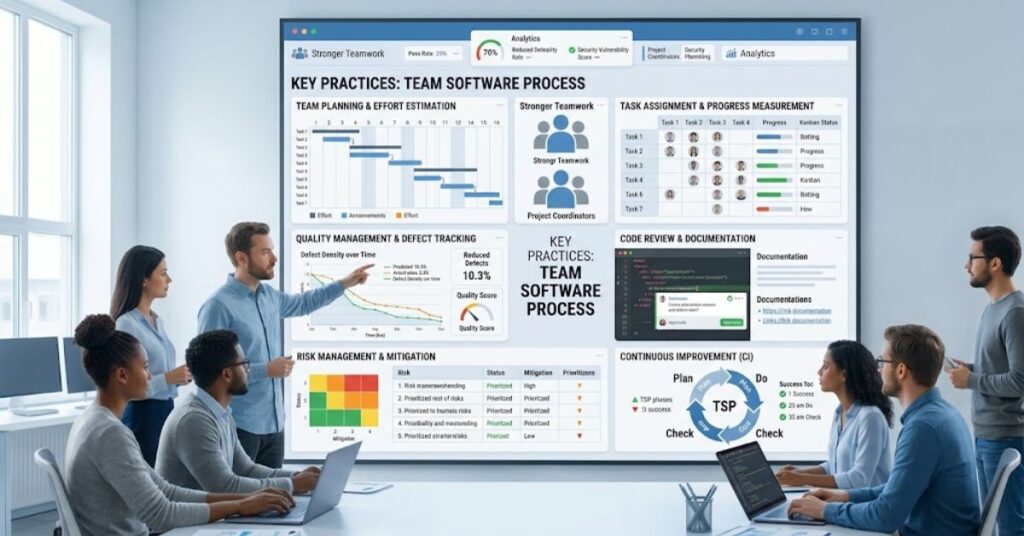
TSP depends heavily on measurement and disciplined teamwork.
Teams track information such as effort, schedule, task completion, defects, and quality results.
Measurement does not mean collecting numbers without purpose. Teams should use measurements to answer practical questions.
For example:
Question: Why did the project miss its schedule?
Useful data: Planned hours, actual hours, task completion, defect rework, and interruptions.
The team can then identify the real cause.
TSP also encourages early defect detection. Finding a problem during requirements or design review often costs less than finding the same problem after deployment.
A strong development process also benefits from modern software engineering practices. TechCrebia’s Embedded Software Development guide provides a useful example of how structured development practices support complex engineering projects.
Team Software Process vs Agile
TSP and Agile both support organized software development, but they approach process management differently.
| Feature | TSP | Agile |
| Main focus | Team discipline and measurement | Iterative delivery and adaptability |
| Planning | Detailed and measurement-driven | Iterative and incremental |
| Roles | Clearly defined process responsibilities | Often flexible |
| Metrics | Strong emphasis | Varies by framework |
| Quality | Integrated into the process | Integrated into iterations |
| Change | Managed through structured planning | Embraced through iteration |
| Team model | Self-directed and disciplined | Collaborative and adaptive |
TSP does not automatically replace Agile.
Organizations can combine selected TSP practices with Agile development.
For example, an Agile team can use TSP-style estimation, defect tracking, measurement, and retrospectives while continuing to deliver work through short iterations.
The best approach depends on project requirements, team experience, risk, and organizational needs.
Benefits of Team Software Process
TSP can provide several benefits when teams apply it consistently.
Better planning: Teams create estimates before significant development begins.
Clear accountability: Defined responsibilities reduce confusion.
Improved quality: Teams track defects and quality goals throughout development.
Better schedule control: Actual progress can reveal schedule problems early.
Stronger teamwork: Members share goals and participate in planning.
Data-driven decisions: Teams can use project measurements instead of guesswork.
Continuous improvement: Postmortem analysis creates feedback for future work.
The SEI’s early TSP research reported improvements in quality and productivity and better alignment with cost and schedule commitments. (SEI at CMU)
However, teams should not treat historical results as a guarantee. TSP works best when teams receive proper training and consistently follow the process.
Common Challenges and Mistakes
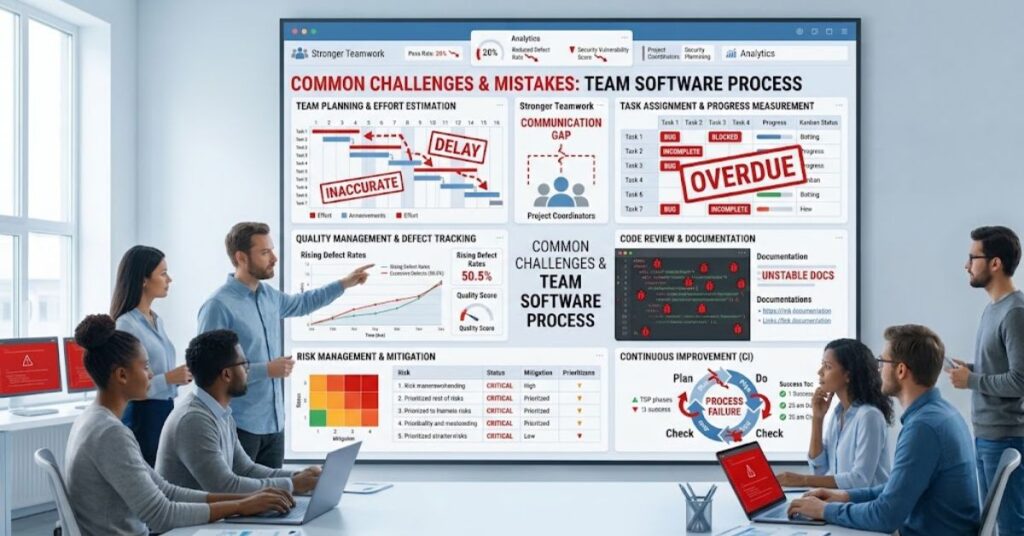
TSP can fail when teams treat it as paperwork instead of an engineering practice.
Common mistakes include:
- Creating unrealistic estimates.
- Recording inaccurate measurements.
- Skipping quality activities.
- Treating roles as titles instead of responsibilities.
- Focusing on metrics rather than outcomes.
- Failing to update plans.
- Ignoring risks.
- Collecting too much unnecessary data.
- Expecting immediate results.
- Using TSP without adequate team training.
Another mistake involves copying the framework without adapting it to the organization’s environment.
A small startup may not need the same process depth as a large safety-critical engineering organization.
Teams should preserve the core principles while adjusting implementation details.
For troubleshooting software problems after release, TechCrebia’s System Glitch Software Issues guide offers additional practical context.
How to Implement Team Software Process
Organizations should introduce TSP gradually.
Start with a clear business problem.
For example, perhaps the team repeatedly misses deadlines. Or perhaps production defects continue to increase.
Next, establish measurable goals.
A practical implementation can follow these steps:
- Train the team. Explain TSP concepts and responsibilities.
- Define project goals. Make goals measurable.
- Establish roles. Give every major responsibility clear ownership.
- Create estimates. Break large work into smaller tasks.
- Build a project plan. Include schedule, resources, quality goals, and risks.
- Track actual performance. Record useful effort, schedule, and defect data.
- Review progress regularly. Compare actual results with the plan.
- Address problems early. Do not wait until project completion.
- Run a postmortem. Identify lessons and process improvements.
- Repeat and improve. Apply lessons to the next development cycle.
Teams can also use modern project-management and engineering tools to automate measurements and reporting.
The goal should remain process improvement, not paperwork.
Real-World Use Cases
TSP can support many types of software projects.
Enterprise Applications
Large business applications often involve multiple developers, testers, analysts, and managers.
TSP can help these teams coordinate responsibilities and monitor project performance.
Safety-Critical Software
Medical, aerospace, automotive, and industrial systems require strong quality controls.
TSP’s emphasis on planning, measurement, defect prevention, and quality management can support disciplined engineering environments.
Embedded Systems
Embedded projects combine hardware and software constraints.
Teams need careful planning because hardware dependencies can create expensive delays.
TechCrebia’s Embedded Software Development guide covers this type of development in greater detail.
Security-Focused Applications
Security software requires strong quality and risk management.
Teams can include security requirements in planning and quality reviews rather than waiting until final testing.
For additional security context, TechCrebia’s Anti-Phishing Software guide explains how software can help protect users from phishing threats.
Team Software Process and Software Quality
Quality represents one of TSP’s important goals.
Instead of waiting until the end of development, teams can build quality activities into planning and execution.
A team might define a quality target such as reducing escaped defects.
Members can then track:
- Defects discovered during development
- Defects discovered during testing
- Defects discovered after release
- Rework effort
- Review findings
- Test results
This information can expose weaknesses in the development process.
For example, if the same defect category appears repeatedly, the team should investigate the root cause.
Unclear requirements can create the problem. Better coding standards may also reduce recurring defects. In some cases, code reviews may fail to cover the affected component.
The team can then improve the process instead of repeatedly fixing the same symptom.
This principle aligns with modern quality engineering, where teams increasingly build quality into development instead of treating testing as a final activity.
Team Software Process in 2026

Software teams now work in environments that include cloud platforms, AI coding assistants, automated testing, continuous integration, and DevOps.
These technologies do not eliminate the core need for disciplined teamwork.
In fact, faster development can increase the need for strong process controls.
AI coding tools can generate code quickly, but developers still need to verify correctness, security, maintainability, and performance.
TSP principles can support this environment by encouraging teams to:
- Define measurable goals.
- Track engineering work.
- Review quality.
- Manage risks.
- Verify AI-generated code.
- Monitor defects.
- Analyze development data.
- Improve processes continuously.
TSP can also complement modern DevOps practices.
For example, automated pipelines can collect build and test information while teams use structured reviews to understand quality and schedule performance.
Teams should also avoid confusing TSP with a software development tool. TSP is a process framework, not an application, programming language, project-management platform, or testing product.
Best Practices
Teams can improve TSP adoption by following several practical principles.
Keep measurements useful. Track information that supports decisions.
Set realistic goals. Unrealistic targets encourage inaccurate reporting.
Review requirements early. Poor requirements create downstream problems.
Track defects consistently. Use defect information to identify process weaknesses.
Make responsibilities clear. Every major activity should have ownership.
Encourage honest reporting. Team members should report problems without fear.
Review data regularly. Measurements become useful only when teams act on them.
Automate repetitive work. Modern tools can reduce manual tracking.
Combine TSP with suitable modern practices. Teams can use TSP principles alongside Agile, DevOps, CI/CD, and automated testing.
Improve continuously. The process should evolve as the team learns.
TechCrebia’s Software Removal Tools guide also demonstrates why structured software practices matter for reliable software maintenance and troubleshooting.
Key Takeaways
- Team Software Process (TSP) provides a structured framework for software engineering teams.
- Watts S. Humphrey led the development of TSP at Carnegie Mellon’s Software Engineering Institute.
- TSP focuses on team planning, roles, measurement, quality, and continuous improvement.
- TSP builds on the principles of the Personal Software Process.
- Teams use TSP to improve project predictability and software quality.
- TSP can work alongside Agile, DevOps, and modern automation practices.
- Accurate measurements help teams identify project problems early.
- TSP works best when teams understand the process and apply it consistently.
Conclusion
So, what is Team Software Process? TSP is a disciplined framework that helps software teams plan, develop, measure, and improve their work.
It goes beyond writing code. It gives teams a structured way to define goals, assign responsibilities, estimate effort, manage quality, track progress, and learn from completed work.
TSP can provide particular value to teams that need stronger control over quality, schedules, risks, and development performance.
Modern software teams can also adapt TSP principles to Agile, DevOps, cloud development, automated testing, and AI-assisted coding.
The most important lesson remains simple: strong software results require strong team processes.
FAQs
What is Team Software Process?
Team Software Process is a structured framework that helps software teams plan, manage, measure, and improve development projects.
Who developed Team Software Process?
Watts S. Humphrey led the development of TSP at Carnegie Mellon University’s Software Engineering Institute. (SEI at CMU)
What is the main goal of TSP?
TSP aims to help engineering teams improve software quality and productivity while meeting planned cost and schedule commitments.
What is the difference between TSP and PSP?
PSP focuses on disciplined individual engineering practices, while TSP applies structured process practices at the team level.
Is TSP a software development methodology?
TSP provides a defined process framework for engineering teams. Teams can combine its practices with development approaches such as Agile.
Does TSP support software quality?
Yes. TSP includes quality planning, defect management, measurement, reviews, and continuous process improvement.
Can small teams use TSP?
Yes. The original SEI report describes TSP for teams of 2 to 20 members, with a larger multi-team process designed for projects involving more people. (SEI at CMU)
Is TSP still useful in 2026?
Yes. Teams can adapt TSP principles to modern environments that use Agile, DevOps, cloud platforms, automation, and AI-assisted development.
What does a TSP coach do?
A TSP coach supports the team’s process knowledge and performance while remaining separate from direct project management responsibility.
SEO Tags
- Team Software Process
- What Is Team Software Process
- TSP Software Development
- Team Software Process TSP
- Software Engineering Process
- Software Development Teams
- TSP Methodology
- Personal Software Process
- Software Project Management
- Software Quality Process
Internal Linking Suggestions with Anchor Text
- Software Quality Assurance → https://techcrebia.com/software-quality-assurance/
- Embedded Software Development → https://techcrebia.com/embedded-software-development-2/
- System Glitch Software Issues → https://techcrebia.com/system-glitch-software-issues/
- Anti-Phishing Software → https://techcrebia.com/anti-phishing-software/
- Software Removal Tools → https://techcrebia.com/software-removal-tools/
Authoritative External References
- Carnegie Mellon Software Engineering Institute — The Team Software Process
- Carnegie Mellon Software Engineering Institute — TSP Body of Knowledge
Social Media Title
What Is Team Software Process? Complete TSP Guide for 2026