





Quick Answer:
Software quality assurance (SQA) is a structured approach that helps teams build reliable, secure, usable, and maintainable software.
It covers requirements review, coding standards, testing, code reviews, defect tracking, automation, and continuous improvement.
SQA starts early in development and continues through release and maintenance.
Author Information
Author: Gulnaz Malik
Role: Founder, Publisher & Technology Content Specialist
Experience: 5+ Years in Technology, AI, Software & Digital Innovation
Content Review: All content follows Google’s latest EEAT guidelines and includes fact-checked information from official documentation, trusted technology sources, industry reports, and practical research to ensure accuracy, reliability, and up-to-date insights.
Introduction
Software quality can make or break a digital product.
A mobile app may have excellent features, but frequent crashes can drive users away. An online store may attract thousands of visitors, but checkout errors can cost sales.
A business application may look professional, but security weaknesses can create serious risks.
Software quality assurance helps prevent these problems.
SQA gives development teams a structured way to improve software quality throughout the software development lifecycle.
It combines processes, standards, reviews, testing, measurements, and continuous improvement.
Many people think SQA simply means testing software. Testing plays an important role, but SQA covers much more.
It focuses on preventing defects, improving development processes, and making sure the final product meets defined requirements.
This guide explains software quality assurance from beginner to advanced level. You will learn how SQA works, which activities teams perform, how it differs from software testing and quality control, which tools teams use, and how AI is changing quality engineering in 2026.
For a basic understanding of the relationship between programs and physical computing components, see TechCrebia’s guide to the difference between software and hardware.
Table of Contents
- What Is Software Quality Assurance?
- Why Software Quality Assurance Matters
- Software Quality Assurance vs Testing vs Quality Control
- Software Quality Assurance Process
- Key Activities in Software Quality Assurance
- Types of Software Testing Used in SQA
- Software Quality Metrics
- Software Quality Assurance Tools
- SQA in Agile and DevOps
- Common SQA Challenges and Mistakes
- Best Practices for Effective SQA
- Latest Software Quality Assurance Trends in 2026
- Future of Software Quality Assurance
- Key Takeaways
- Conclusion
- FAQs
- SEO Tags
- Internal Linking Suggestions
- Authoritative External References
- Social Media Title
What Is Software Quality Assurance?

Software quality assurance is a systematic approach to ensuring that software development processes and products meet defined quality requirements.
SQA focuses on prevention, detection, measurement, and continuous improvement.
Instead of waiting until the final product reaches users, teams introduce quality checks throughout development.
For example, a team building a banking application might review requirements before development begins. Developers might follow coding standards during implementation. Automated tests can check important functions after every code change. Security testing can identify vulnerabilities before release.
This approach reduces the chance of discovering serious problems at the last moment.
Software quality includes several characteristics. ISO/IEC 25010:2023 provides a product quality model with nine characteristics that teams can use when specifying, measuring, and evaluating software quality. (ISO)
Common quality areas include:
- Functional suitability
- Performance efficiency
- Compatibility
- Usability
- Reliability
- Security
- Maintainability
- Portability
- Other product-specific quality requirements
Quality priorities depend on the software.
A gaming application may emphasize performance and responsiveness. A healthcare system may place greater emphasis on reliability, security, and data integrity. An e-commerce platform may prioritize availability, usability, performance, and transaction accuracy.
Why Software Quality Assurance Matters
Poor-quality software creates technical, financial, and reputational problems.
A small defect can cause a major issue when it reaches production. For example, an incorrect payment calculation could affect thousands of transactions.
Software quality assurance helps teams identify these risks earlier.
The main benefits include:
- Fewer defects: Teams detect problems before release.
- Lower maintenance costs: Early fixes usually require less effort than production fixes.
- Better user experience: Reliable software creates greater user confidence.
- Improved security: Security checks help identify weaknesses.
- Higher reliability: Teams verify important functions under different conditions.
- Better compliance: Documented processes can support organizational and regulatory requirements.
- Faster development: Automation can reduce repetitive manual work.
- Better teamwork: Clear quality processes create shared expectations.
SQA also supports long-term software maintenance.
Modern applications receive frequent updates. Teams therefore need repeatable processes that protect existing functionality while developers introduce new features.
For example, regression testing can verify that a new shopping-cart feature does not break login, product search, or payment functionality.
TechCrebia’s guide to software updates and maintenance provides another practical example of why software stability and update management matter.
Software Quality Assurance vs Testing vs Quality Control
People often use SQA, software testing, and quality control as if they mean the same thing. They do not.
| Area | Main Focus | Typical Activities |
| Software Quality Assurance | Preventing quality problems | Process definition, audits, standards, reviews |
| Software Testing | Finding defects | Functional, performance, security testing |
| Quality Control | Checking the product | Inspections, testing, defect verification |
| Quality Engineering | Building quality into delivery | Automation, CI/CD, observability, risk management |
SQA takes a broader view.
Testing asks, “Does this software behave correctly?”
SQA asks, “What processes can help us consistently build software that behaves correctly?”
For example, a testing team might discover that developers repeatedly introduce the same type of defect. An SQA approach would investigate why the defect occurs and improve the development process.
That might involve better requirements, coding standards, developer training, automated checks, or stronger code review rules.
This distinction matters because testing alone cannot guarantee software quality.
A team can test a product extensively while still using unclear requirements or unreliable development processes.
Software Quality Assurance Process
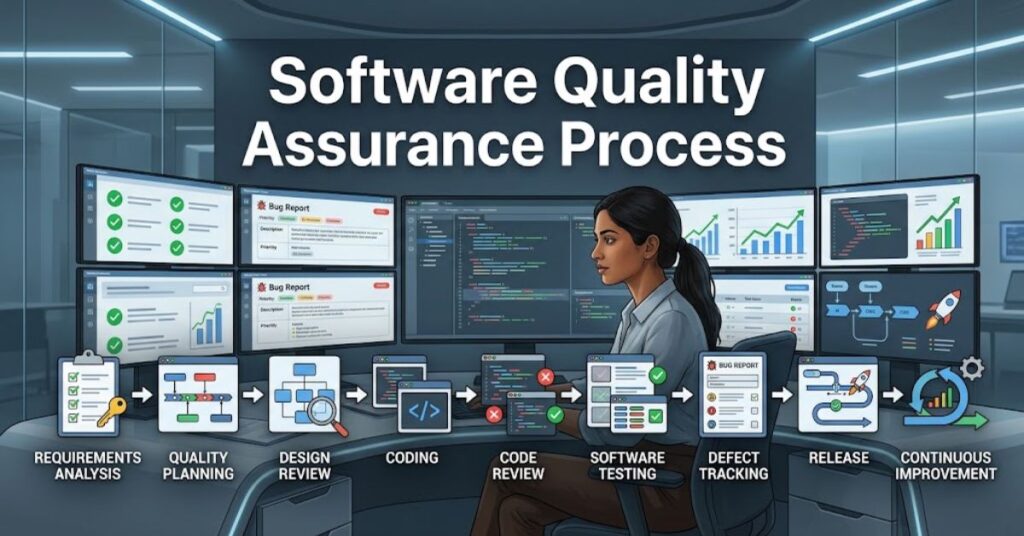
A strong SQA process starts before developers write significant amounts of code.
Teams first define quality expectations. They then establish methods for achieving and measuring those expectations.
Requirements and Planning
Teams review requirements for clarity, completeness, consistency, and testability.
Good requirements should tell developers what the system must do and what quality conditions it must meet.
For example:
“Users can log in” provides limited information.
“A registered user can log in with valid credentials within three seconds under normal operating conditions” provides a more testable requirement.
Process Definition
The team establishes development and quality processes.
These processes may define:
- Coding standards
- Review procedures
- Testing requirements
- Defect management
- Release criteria
- Security checks
- Documentation rules
- Deployment procedures
Design Review
Teams review architecture and design before implementation progresses too far.
Design reviews can identify problems involving:
- Scalability
- Security
- Performance
- Data handling
- Integration
- Maintainability
Finding a design problem early can prevent expensive rework later.
Development and Code Review
Developers implement the system while following established standards.
Peer reviews can identify logic errors, security risks, unclear code, and maintainability problems.
Automated static analysis can also scan source code for specific classes of issues.
Testing
Testers and developers validate the software at multiple levels.
Teams can combine automated and manual testing based on risk.
Defect Management
When someone discovers a defect, the team records useful information.
A good defect report usually includes:
- Problem description
- Steps to reproduce
- Expected result
- Actual result
- Environment information
- Severity
- Priority
- Evidence such as screenshots or logs
Release Evaluation
Before release, teams review quality results against defined criteria.
They may examine:
- Open critical defects
- Test coverage
- Failed tests
- Security findings
- Performance results
- Reliability indicators
Continuous Improvement
SQA does not stop after release.
Teams analyze defects and production incidents to identify recurring causes. They then improve processes to prevent similar problems.
Key Activities in Software Quality Assurance
Software quality assurance includes many activities. Teams choose activities according to project size, risk, industry, and development model.
Reviews and Inspections
- Requirements reviews: Check whether requirements make sense.
- Design reviews: Examine architecture and technical decisions.
- Code reviews: Developers inspect source code before integration.
- Documentation reviews: Teams verify technical and user documentation.
- Process audits: Teams check whether agreed processes actually work.
Reviews can catch problems before testing begins.
Standards and Process Management
SQA teams often define standards for development and testing.
These standards create consistency across projects.
A large organization might define common rules for:
- Naming conventions
- Branch management
- Pull requests
- Security checks
- Testing
- Release approvals
- Documentation
- Incident handling
Teams can adapt these rules to individual projects instead of applying every rule blindly.
Risk Management
Quality teams should prioritize risks rather than treat every defect equally.
A payment failure deserves more attention than a minor spacing problem.
Risk analysis can consider:
Impact × likelihood = risk priority
Teams can then focus testing and reviews on the areas that matter most.
Types of Software Testing Used in SQA
Testing forms one of the most visible parts of SQA.
Different tests answer different questions.
Functional Testing
Functional testing verifies whether software performs required tasks.
Examples include:
- Login testing
- Registration testing
- Search testing
- Checkout testing
- File-upload testing
- API testing
Regression Testing
Regression testing checks whether existing features still work after changes.
For example, a developer might modify the payment system. Regression tests can verify that login, shopping-cart functions, order history, and other connected features still work.
Performance Testing
Performance testing evaluates software under different workloads.
Teams may examine:
- Response time
- Throughput
- Resource usage
- Concurrent users
- System stability
A website that works perfectly for 50 users may behave differently under heavy traffic.
Security Testing
Security testing looks for weaknesses that attackers could exploit.
Teams may test authentication, authorization, input validation, session management, encryption, and other security controls.
NIST maintains software assurance work focused on testing methods, reference data, and tools that support software assurance and quality. (NIST)
Usability Testing
Usability testing evaluates how easily users can complete tasks.
A feature can work correctly while still confusing users.
For example, a checkout page may successfully process orders but hide the final payment button. Usability testing can expose this problem.
Compatibility Testing
Compatibility testing checks software across supported:
- Browsers
- Operating systems
- Devices
- Screen sizes
- Hardware configurations
- Network conditions
This matters especially for web and mobile applications.
Software Quality Metrics
Metrics help teams understand quality using measurable information.
However, teams should avoid collecting numbers simply because tools make measurement easy.
Useful metrics include:
| Metric | What It Shows |
| Defect density | Defects relative to software size |
| Defect escape rate | Problems that reach later stages or production |
| Test pass rate | Percentage of executed tests that pass |
| Test coverage | Areas exercised by tests |
| Mean time to repair | Average time needed to fix issues |
| Failure rate | Frequency of software failures |
| Build success rate | Stability of automated builds |
| Change failure rate | Frequency of changes that cause problems |
Metrics need context.
A high test count does not automatically mean high quality. Similarly, high code coverage does not prove that tests effectively validate business behavior.
Teams should combine quantitative metrics with technical reviews and user feedback.
Software Quality Assurance Tools
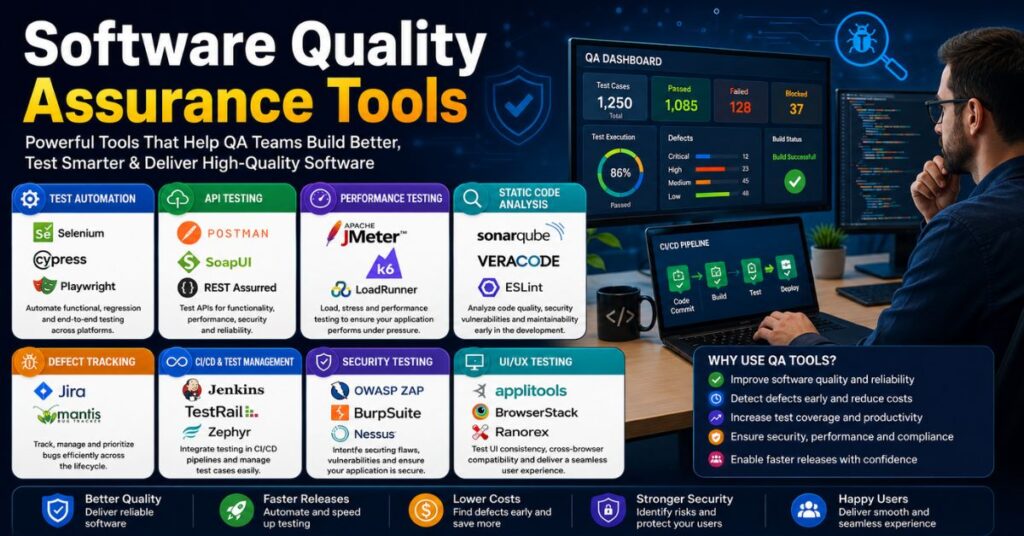
Modern SQA teams use many categories of tools.
Test automation tools execute repeatable tests quickly.
Static analysis tools inspect source code without running the application.
CI/CD platforms automatically build, test, and deploy software.
Defect tracking systems organize bugs and their status.
Performance tools simulate workloads and measure system behavior.
Security tools identify vulnerabilities and configuration problems.
Monitoring platforms detect problems after deployment.
The right tool depends on the technology stack and project needs.
A small application does not need dozens of expensive tools. Too many disconnected tools can actually make quality management harder.
For broader software-tool concepts, you can also explore TechCrebia’s productivity software guide.
SQA in Agile and DevOps
Modern development teams rarely wait until the end of a project to perform quality activities.
Agile teams integrate quality into short development cycles.
Developers, testers, product owners, and other stakeholders work together throughout the process.
DevOps takes this approach further by integrating development and operations.
A typical pipeline might follow this sequence:
- A developer commits code.
- Automated checks start.
- The system builds the application.
- Unit tests run.
- Static analysis checks the code.
- Integration tests run.
- Security checks run.
- The team reviews results.
- The pipeline deploys the application when it meets release conditions.
- Monitoring observes production behavior.
This approach creates continuous quality.
Quality becomes part of everyday development instead of a final gate.
TechCrebia’s coverage of system glitches and software issues also highlights why teams need structured troubleshooting and maintenance practices after deployment.
Common SQA Challenges and Mistakes
Even organizations with experienced teams can struggle with software quality.
Common Problems
- Testing too late: Teams wait until the final stage to test.
- Unclear requirements: Developers build features from incomplete information.
- Too much manual testing: Teams waste time repeating predictable checks.
- Ignoring non-functional requirements: Teams focus only on features.
- Weak defect reports: Developers cannot reproduce reported problems.
- Poor test environments: Test systems do not represent real usage.
- Skipping regression tests: New changes break existing features.
- Ignoring security: Teams treat security as a final-stage activity.
- Measuring the wrong things: Teams optimize metrics instead of real quality.
- Tool overload: Too many tools create unnecessary complexity.
A strong SQA program addresses these problems through early involvement, automation, clear ownership, and continuous feedback.
Best Practices for Effective SQA

Good SQA does not require complicated processes. It requires consistent execution.
Start quality planning early. Define measurable quality expectations before development moves too far.
Use risk-based testing. Spend more effort on features that can cause serious business or user harm.
Automate repetitive tests. Automation works especially well for regression testing and repeatable validation.
Keep humans involved. Human testers can explore unexpected behavior, usability problems, and unusual scenarios that automated scripts may miss.
Review requirements before coding. Clear requirements reduce ambiguity and prevent avoidable rework.
Use code reviews. A second pair of eyes can catch problems that the original developer missed.
Track production defects. Production failures provide valuable information about weaknesses in the development process.
Protect test data. Never expose sensitive production information unnecessarily in test environments.
Keep quality documentation useful. Avoid creating documents that nobody reads or updates.
Finally, connect quality with business goals. A technically impressive application still fails if it does not solve the user’s problem.
Latest Software Quality Assurance Trends in 2026
Software quality assurance continues to change as development teams adopt AI, cloud platforms, automation, and faster release cycles.
AI-assisted testing now helps teams generate test ideas, analyze failures, summarize defects, and identify potential risk areas. Teams still need human review because AI output can contain errors.
AI-generated code creates new quality challenges. Developers can produce code faster, but teams must still verify functionality, security, maintainability, and performance.
Shift-left quality continues to move quality activities toward requirements, design, and coding stages.
Shift-right practices complement this approach by using production monitoring, telemetry, feature flags, and real-user behavior to identify issues after deployment.
Continuous testing has become important for teams that deploy frequently.
Security and quality convergence also continues. Modern teams increasingly treat security, reliability, performance, and maintainability as connected quality concerns rather than separate activities.
ISO/IEC 25010:2023 provides a structured product quality model that organizations can use when specifying and evaluating quality across the software lifecycle. (ISO)
Future of Software Quality Assurance

The future of SQA will focus less on testing after development and more on engineering quality into every stage.
AI will likely support more test generation, defect analysis, code review, risk prediction, and production monitoring.
However, AI will not remove the need for skilled quality professionals.
Human judgment remains important when teams must understand business risk, user expectations, ethical concerns, security implications, and complex system behavior.
Future SQA teams will likely work more closely with developers, security engineers, data teams, product managers, and operations teams.
Quality will become increasingly measurable through real-world signals such as reliability, performance, user experience, security, and service availability.
The strongest organizations will treat quality as a shared responsibility rather than a job assigned only to testers.
Key Takeaways
- Software quality assurance helps teams prevent and detect software quality problems.
- SQA covers processes, reviews, testing, measurements, standards, and improvement.
- Testing represents one important part of SQA.
- Early quality involvement reduces expensive rework.
- Risk-based testing helps teams prioritize important problems.
- Automation improves repeatability and speed.
- Security, performance, usability, and reliability all contribute to software quality.
- Agile and DevOps integrate quality throughout development and delivery.
- AI can accelerate quality activities but still needs human oversight.
- Modern SQA focuses on continuous quality instead of final-stage testing.
Conclusion
Software quality assurance provides the foundation for building dependable digital products.
It helps teams identify problems early, improve development processes, reduce defects, and deliver better user experiences.
Effective SQA combines requirements analysis, reviews, testing, automation, security checks, metrics, and continuous improvement.
The best approach does not simply test software at the end. It builds quality into the entire development lifecycle.
As AI and automation accelerate software development in 2026, SQA becomes even more important.
Faster development can produce more software, but teams still need strong processes to verify that software works correctly and safely.
For organizations of every size, the goal remains simple: build software that users can trust.
FAQs
What is software quality assurance?
Software quality assurance is a structured approach that helps teams prevent defects and improve software quality throughout development.
Why is software quality assurance important?
It reduces defects, improves reliability, supports security, lowers rework, and helps teams deliver better software.
Is SQA the same as software testing?
No. Testing focuses on finding software defects, while SQA covers the broader processes used to prevent and manage quality problems.
What are the main SQA activities?
Requirements reviews, process definition, code reviews, testing, audits, defect management, quality measurement, and continuous improvement.
What tools do SQA teams use?
Teams use test automation, static analysis, CI/CD, defect tracking, performance testing, security testing, and monitoring tools.
What is quality assurance in Agile?
Agile teams integrate quality activities into short development cycles instead of waiting until the end of the project.
Can AI replace software quality assurance?
No. AI can automate and accelerate many quality tasks, but humans still need to evaluate risk, requirements, results, and business impact.
What is the difference between QA and QC?
Quality assurance focuses on improving processes and preventing problems, while quality control focuses on checking the resulting product.
SEO Tags
- Software Quality Assurance
- SQA Guide
- Software Testing
- Quality Assurance Testing
- Software Quality Management
- Software Testing Process
- QA Best Practices
- Software Quality Metrics
- Agile QA
- Software Testing Tools
Internal Linking Suggestions with Anchor Text
- Difference Between Software and Hardware → https://techcrebia.com/difference-between-software-and-hardware/
- System Glitch and Software Issues → https://techcrebia.com/system-glitch-software-issues/
- Productivity Software Guide → https://techcrebia.com/productivity-software/
- Samsung J7 Software Update Guide → https://techcrebia.com/samsung-j7-software-update-guide/
- Fan Controller RGB Software → https://techcrebia.com/fan-controller-rgb-software/
Authoritative External References
Social Media Title
Software Quality Assurance: Complete Guide for 2026