




Quick Answer
Embedded software development means creating software that controls dedicated hardware inside devices such as cars, medical equipment, smart appliances, industrial machines, wearables, and IoT products.
Developers write low-level code, work with microcontrollers and processors, manage memory and power, and test software against real hardware.
C and C++ remain common choices, while RTOS platforms, secure boot, edge AI, automated testing, and connected devices continue to shape modern embedded development.
Author Information
Author: Gulnaz Malik
Role: Founder, Publisher & Technology Content Specialist
Experience: 5+ Years in Technology, AI, Software & Digital Innovation
Content Review: All content follows Google’s latest EEAT guidelines and includes fact-checked information from official documentation, trusted technology sources, industry reports, and practical research to ensure accuracy, reliability, and up-to-date insights.
Introduction
Embedded software development powers many devices that people use every day. A smartphone, car, smart thermostat, fitness tracker, washing machine, printer, router, medical monitor, and industrial controller can all contain embedded software.
Unlike desktop software, embedded software usually works closely with specific hardware. It may control a motor, read a sensor, manage a battery, process signals, operate a display, or communicate with another device.
This close connection creates unique development challenges. Developers must consider memory limits, processor speed, power consumption, timing, hardware interfaces, reliability, and security.
Modern embedded systems also handle more complex workloads. IoT connectivity, machine learning, edge computing, wireless communication, and real-time processing now influence many designs.
This guide explains embedded software development from beginner concepts to advanced practices.
You will learn how embedded systems work, which languages and tools developers use, how RTOS platforms fit into projects, how teams test firmware, and which trends will shape the field in 2026 and beyond.
Table of Contents
- What Is Embedded Software Development?
- How Embedded Software Works
- Types of Embedded Systems
- Programming Languages for Embedded Software Development
- Essential Tools for Embedded Software Development
- RTOS and Embedded Linux
- Embedded Software Development Process
- Testing and Debugging Embedded Software
- Security in Embedded Software Development
- Common Challenges and Mistakes
- Real-World Applications
- Skills Needed for Embedded Software Development
- Latest Trends in Embedded Software Development
- Future of Embedded Software Development
- Key Takeaways
- Conclusion
- FAQs
- SEO Tags
- Internal Linking Suggestions
- Authoritative External References
- Social Media Title
What Is Embedded Software Development?
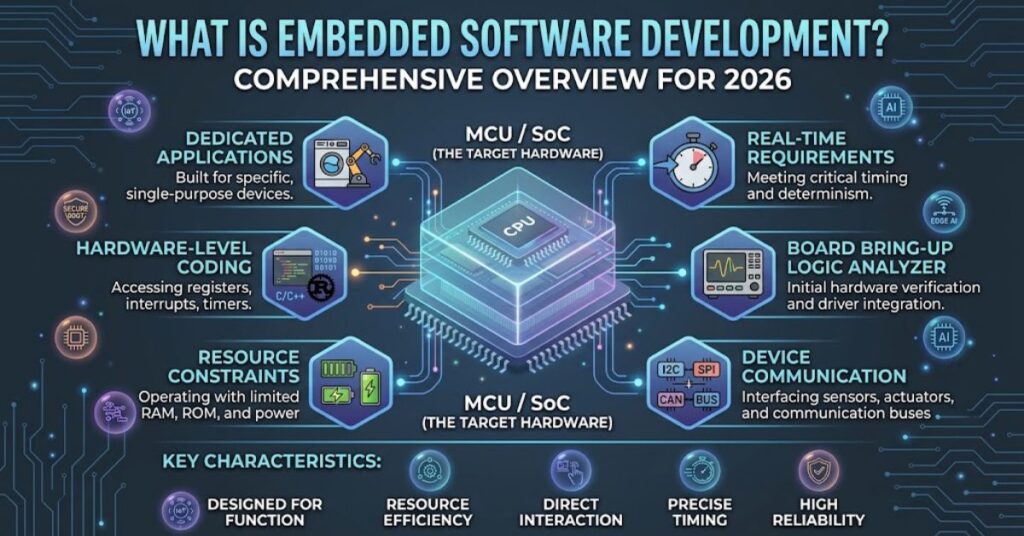
Embedded software development involves designing, programming, testing, and maintaining software that runs inside dedicated electronic systems.
A normal desktop application often serves many different hardware configurations. Embedded software usually targets a specific processor, microcontroller, board, or device.
For example, a washing machine may contain a microcontroller that reads water-level sensors, controls the motor, manages buttons, and displays the current cycle. The code that performs these functions represents embedded software.
Embedded software often has direct access to hardware resources. Developers may work with registers, interrupts, timers, memory addresses, communication buses, and device drivers.
This relationship explains why embedded developers need knowledge of both software and hardware.
If you want a basic explanation of how these two areas connect, TechCrebia’s guide on the difference between software and hardware provides useful background.
Common characteristics of embedded software include:
- Dedicated functionality
- Limited memory or processing resources
- Direct hardware interaction
- Strong timing requirements
- Low power requirements in many devices
- Long product lifecycles
- High reliability requirements
- Hardware-specific testing
Embedded software can range from a few thousand lines of code in a simple sensor to millions of lines in advanced automotive or industrial platforms.
How Embedded Software Works
Embedded software creates a communication layer between hardware components and the functions that users expect from a device.
Consider a smart thermostat. Its temperature sensor produces data. The embedded program reads that data, compares it with the desired temperature, and controls the heating or cooling system.
A simplified process looks like this:
- A sensor produces data.
- The microcontroller receives the data.
- Embedded code processes the information.
- The program applies predefined logic.
- The system sends commands to an actuator.
- The hardware performs the requested action.
- The software continues monitoring the system.
Developers often divide embedded software into several layers.
The hardware abstraction layer hides some hardware-specific details. Device drivers communicate with peripherals such as sensors, displays, communication modules, and storage devices.
Middleware can provide networking, file systems, graphics, security functions, or communication protocols.
Application code then implements the product’s actual behavior.
This layered design helps teams maintain large projects and replace individual components more easily.
Types of Embedded Systems
Embedded systems differ greatly in complexity, processing capability, and operating requirements.
Simple Embedded Systems
- Microcontroller-based devices: Small systems that perform focused tasks, such as digital thermometers and basic controllers.
- Consumer electronics: Devices such as remote controls, printers, and simple kitchen appliances.
- Sensor systems: Small products that collect environmental or machine data.
Advanced Embedded Systems
- Automotive systems: Engine controllers, infotainment systems, driver assistance systems, battery management, and body-control modules.
- Industrial systems: Programmable controllers, robotics, machine monitoring, and automated production equipment.
- Medical devices: Patient monitors, diagnostic equipment, infusion systems, and portable medical electronics.
- IoT devices: Connected sensors, smart locks, gateways, cameras, and home automation equipment.
The complexity of the system determines the required processor, operating system, communication architecture, testing strategy, and development tools.
Programming Languages for Embedded Software Development
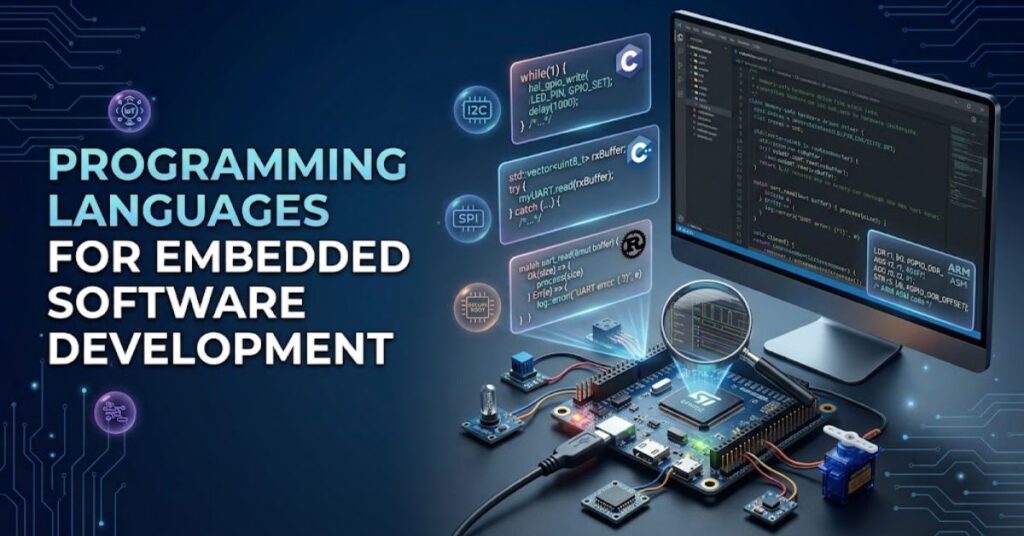
Programming language selection depends on hardware, performance requirements, safety requirements, memory constraints, and team expertise.
C remains one of the most important languages in embedded software development. It gives developers detailed control over memory and hardware while keeping runtime overhead relatively small.
C++ adds object-oriented programming and other higher-level features. Developers often use it for larger embedded applications where software architecture and code reuse matter.
Assembly provides direct processor-level control. Developers generally use it only when they need highly specific optimization, startup routines, interrupt handling, or processor-specific functionality.
Rust has gained attention because it provides memory-safety features without requiring a traditional garbage collector. Embedded teams increasingly evaluate Rust for new projects where safety and reliability matter.
Python usually plays a different role. Developers may use it for testing, automation, simulation, manufacturing tools, or higher-level embedded Linux applications. It does not replace C or C++ for every resource-constrained microcontroller.
A practical language comparison looks like this:
| Language | Main Strength | Common Embedded Use |
| C | Low-level control | Microcontrollers and firmware |
| C++ | Abstraction and scalability | Complex embedded applications |
| Rust | Memory safety | Safety-focused modern systems |
| Assembly | Processor-level control | Optimization and startup code |
| Python | Fast development | Testing, automation, embedded Linux |
Essential Tools for Embedded Software Development
A professional embedded development environment normally includes a compiler, debugger, IDE or build system, hardware development board, source-control system, and testing tools.
Developers compile source code into machine instructions that the target processor can execute. They then flash the resulting firmware onto the device.
Debuggers help developers inspect variables, registers, memory, stack activity, and program execution.
Modern embedded toolchains also support automated builds and testing. Arm provides development tools for creating, debugging, testing, and optimizing software across different stages of embedded development.
Common tools include:
- IDEs and code editors
- Cross-compilers
- Linkers
- Debug probes
- JTAG or SWD interfaces
- Logic analyzers
- Oscilloscopes
- Hardware development boards
- Static-analysis tools
- Version-control systems
- Automated build systems
- Unit-testing frameworks
Developers should select tools based on the target processor and project requirements rather than choosing the most popular tool automatically.
RTOS and Embedded Linux
Not every embedded system needs an operating system.
A simple device may run bare-metal firmware. The program starts after boot and executes a main loop while interrupts handle urgent events.
As systems become more complex, developers may introduce a real-time operating system, or RTOS.
An RTOS helps organize multiple tasks. It can provide scheduling, queues, semaphores, timers, synchronization, and task management.
FreeRTOS targets microcontrollers and small microprocessors and supports many processor architectures.
Its current documentation also highlights networking, SMP, security-related capabilities, and cloud integration.
When to Use an RTOS
- Multiple concurrent tasks: Use an RTOS when several activities need structured scheduling.
- Predictable timing: Choose an RTOS when the application requires controlled task timing.
- Communication between tasks: RTOS features such as queues and semaphores simplify coordination.
- Growing software complexity: An RTOS can provide a cleaner architecture than one large main loop.
When Embedded Linux Makes Sense
- Powerful processors: Embedded Linux fits systems with more memory and processing capacity.
- Advanced networking: Linux provides mature networking capabilities and software ecosystems.
- Rich user interfaces: Complex displays and multimedia applications can benefit from Linux.
- Long-running applications: Linux can support sophisticated services and applications.
The choice depends on requirements. A small battery-powered sensor may need bare-metal firmware, while a connected industrial gateway may benefit from embedded Linux.
Embedded Software Development Process
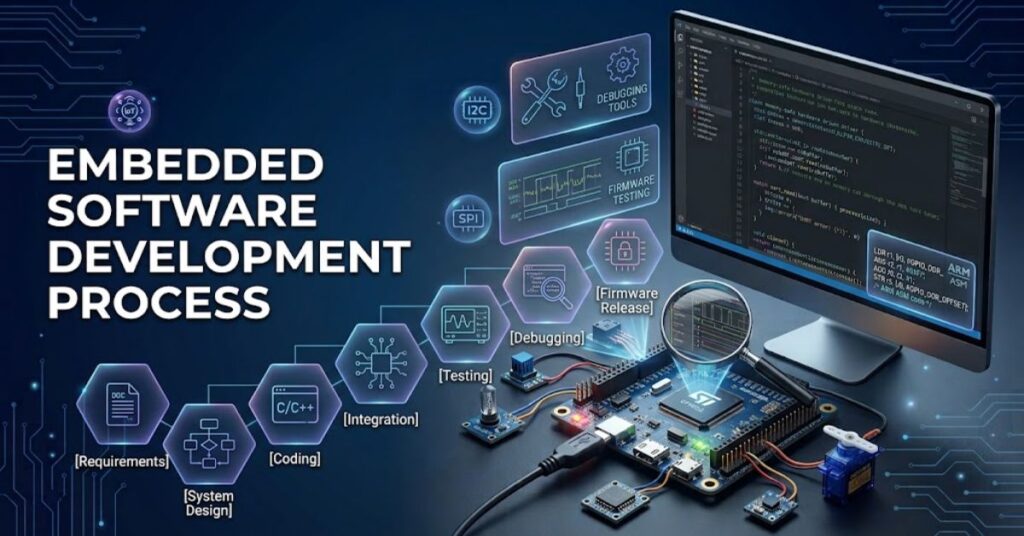
A disciplined development process reduces defects and helps teams manage hardware dependencies.
Requirements and Architecture
- Define requirements: Identify inputs, outputs, timing, power, security, performance, and reliability requirements.
- Study the hardware: Review processor documentation, memory maps, peripheral specifications, electrical interfaces, and board designs.
- Design the architecture: Decide how drivers, middleware, RTOS components, and application logic will interact.
- Plan interfaces: Define communication methods such as UART, SPI, I2C, CAN, USB, Ethernet, or wireless protocols.
Implementation and Integration
- Create the development environment: Configure the compiler, debugger, build system, SDK, libraries, and board support package.
- Develop drivers: Create reliable interfaces for sensors, displays, motors, storage, and communication hardware.
- Build application logic: Implement the device’s main features.
- Integrate gradually: Test hardware and software components as you combine them.
Verification and Release
- Run automated tests: Catch regressions early.
- Perform hardware testing: Verify behavior on actual devices.
- Measure performance: Check timing, memory, CPU load, power consumption, and thermal behavior.
- Document releases: Record firmware versions, changes, known issues, and hardware compatibility.
This workflow works especially well when teams use version control and continuous integration.
Testing and Debugging Embedded Software
Testing becomes especially important because embedded software can directly control physical equipment.
A software bug in a desktop application might crash an application. A bug in an automotive controller or industrial machine can create much more serious consequences.
Developers should test at several levels.
Unit testing checks individual functions.
Integration testing verifies that multiple software components work together.
Hardware-in-the-loop testing connects software with real or simulated hardware to evaluate system behavior.
System testing examines the complete device under realistic operating conditions.
Debugging often starts with a clear symptom. For example:
- Did the bootloader start?
- Did the clock initialize correctly?
- Did the peripheral respond?
- Did the interrupt trigger?
- Did the driver return an error?
- Did the task miss its deadline?
- Did memory usage increase unexpectedly?
Useful debugging tools include breakpoints, watchpoints, serial logs, trace systems, logic analyzers, oscilloscopes, and hardware debuggers.
Developers should avoid relying only on print statements. Logging can change timing and hide real-time problems. A disciplined debugging strategy produces more reliable results.
Security in Embedded Software Development
Security now plays a central role in embedded software development because many devices connect to networks or exchange sensitive data.
A secure design starts before developers write the first line of code.
Important security measures include:
- Secure boot
- Signed firmware
- Secure firmware updates
- Strong device authentication
- Encryption
- Access control
- Hardware-backed security features
- Memory protection
- Secure key storage
- Vulnerability monitoring
- Minimal software privileges
Developers should also protect the update process. An attacker who can install unauthorized firmware can potentially control the entire device.
Connected products need special attention because vulnerabilities can remain active for years. Teams should create a security maintenance plan that covers vulnerability response, firmware updates, credential management, and end-of-life policies.
Common Challenges and Mistakes
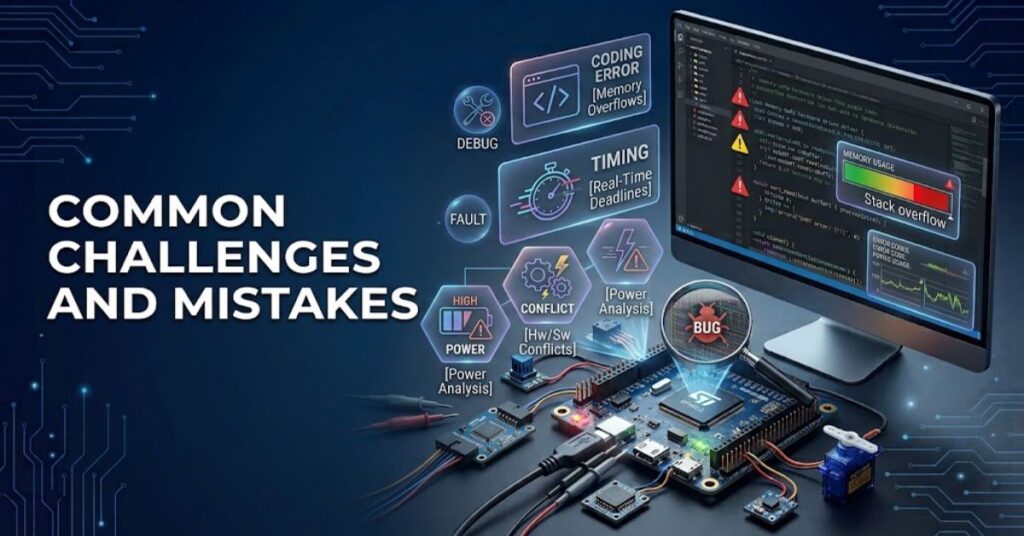
Embedded projects often fail because teams underestimate hardware dependencies or system constraints.
One common mistake involves ignoring memory limits. A program may work during development but fail after engineers add additional features.
Another problem involves poor timing design. Developers may create long blocking operations that prevent urgent tasks from running on time.
Ignoring power consumption can also cause serious problems in battery-powered devices.
Insufficient hardware testing creates another risk. Software that works in a simulator may behave differently on physical hardware because of electrical noise, timing differences, sensor behavior, or peripheral limitations.
Other common mistakes include:
- Using unnecessary libraries
- Ignoring compiler warnings
- Skipping code reviews
- Mixing hardware-control logic with application logic
- Failing to document registers and interfaces
- Using unsafe memory operations
- Testing only normal conditions
- Running several tools that interfere with the same hardware interface
- Updating firmware without a recovery mechanism
Developers should design for failure. Watchdogs, error handling, safe states, diagnostics, and recovery procedures can improve system reliability.
Real-World Applications
Embedded software development supports a wide range of industries.
Automotive
Cars contain numerous embedded controllers. Software can manage engine functions, braking systems, lighting, climate control, infotainment, driver assistance, and battery systems.
Electric vehicles increase the software workload further. Battery management, charging, thermal control, and motor control all depend heavily on embedded computing.
Consumer Electronics
Smart TVs, cameras, printers, routers, speakers, appliances, and wearables all use embedded software.
For example, a modern printer combines embedded control software with networking, display management, sensors, motors, and security features.
Industrial Automation
Factories use embedded controllers to monitor machines, control motors, read sensors, and coordinate production systems.
Real-time behavior matters because machines often need predictable responses.
Healthcare
Medical equipment uses embedded software for sensing, monitoring, control, communication, and user interfaces. These systems require careful validation and strong reliability practices.
IoT
IoT products combine embedded processing with wireless connectivity. A smart sensor might collect data locally, process it, and transmit selected information to a cloud service.
This architecture reduces unnecessary communication and can improve responsiveness.
Skills Needed for Embedded Software Development
A successful embedded developer needs more than programming knowledge.
Core skills include:
- C and C++ programming
- Data structures and algorithms
- Microcontroller architecture
- Digital electronics basics
- Memory management
- Interrupts and timers
- Communication protocols
- Debugging
- Git and version control
- RTOS concepts
- Linux fundamentals
- Testing and automation
- Secure coding
- Hardware datasheet reading
Developers should also learn how to read reference manuals and datasheets. These documents explain registers, electrical characteristics, peripheral behavior, timing requirements, and hardware limitations.
Practical projects provide an excellent learning path. A beginner can start with an LED controller, then build a sensor monitor, communication project, RTOS application, and connected IoT device.
Latest Trends in Embedded Software Development
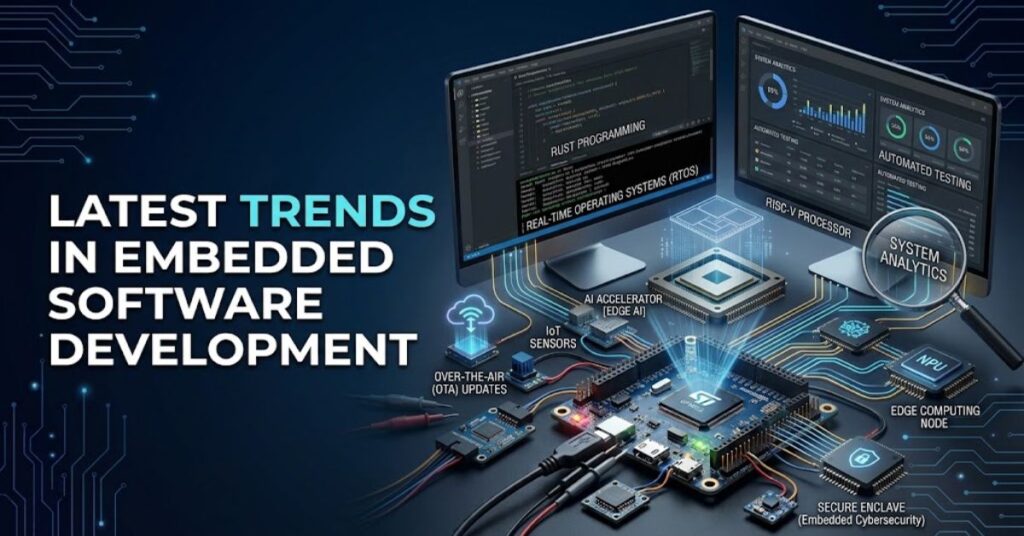
Embedded systems continue to move toward greater connectivity, intelligence, and automation.
Edge AI represents one major trend. Instead of sending every piece of data to a cloud server, devices can perform some machine-learning tasks locally.
RISC-V also continues to attract attention because its open instruction-set architecture enables companies and researchers to create customized processor designs.
Rust for embedded systems has gained interest because developers want stronger memory-safety guarantees.
Embedded DevOps is another growing area. Teams increasingly use automated builds, continuous integration, hardware testing, static analysis, and repeatable release processes.
Over-the-air updates also matter for connected products. Manufacturers can fix bugs and improve features without requiring users to manually replace firmware.
Security-by-design will become even more important as devices remain connected for longer periods.
Future of Embedded Software Development
The future of embedded software development will combine efficient hardware with increasingly capable software.
AI will allow embedded devices to interpret images, audio, sensor data, and other information locally. This approach can reduce latency and limit unnecessary data transmission.
Developers will also work with more powerful multicore processors, heterogeneous computing architectures, specialized AI accelerators, and secure hardware features.
Virtual development environments will become more useful as well. Teams can test portions of software before physical hardware becomes available.
Another important shift involves software maintainability. Manufacturers increasingly need devices that receive security fixes and feature updates throughout long product lifecycles.
The development process will therefore become more automated. Continuous integration, automated hardware testing, static analysis, security scanning, simulation, and observability will help teams find defects earlier.
The core principles will remain the same: understand the hardware, control resources carefully, design predictable behavior, test thoroughly, and protect the device throughout its lifecycle.
Key Takeaways
- Embedded software development creates software for dedicated electronic systems.
- C and C++ remain important languages for embedded projects.
- Bare-metal programming works well for simple systems.
- RTOS platforms help organize applications with multiple real-time tasks.
- Embedded Linux suits more powerful devices with complex software requirements.
- Developers must understand processors, memory, peripherals, and communication protocols.
- Testing should cover software components, hardware interfaces, and complete systems.
- Secure boot, signed firmware, encryption, and secure updates strengthen device security.
- Edge AI, RISC-V, Rust, IoT, and automated testing continue to influence the industry.
- Reliable embedded products require long-term maintenance and careful lifecycle planning.
Conclusion
Embedded software development sits at the intersection of programming and electronics. It turns processors, sensors, memory, communication interfaces, and other hardware into useful products.
The field ranges from simple microcontroller firmware to sophisticated automotive, industrial, medical, and IoT platforms. Developers must therefore understand both code and the physical system that runs it.
A strong learning path starts with C, microcontroller fundamentals, debugging, and communication protocols. From there, developers can explore RTOS platforms, embedded Linux, security, automated testing, networking, and edge AI.
As embedded devices become smarter and more connected, development practices will continue to evolve.
However, the fundamentals will remain essential: efficient code, predictable behavior, reliable testing, secure design, and a clear understanding of hardware.
FAQs
What is embedded software development?
Embedded software development involves creating software that controls dedicated hardware inside devices such as cars, appliances, medical equipment, and IoT products.
Which language do embedded developers use most?
C remains one of the most widely used embedded programming languages because it offers high performance and fine-grained hardware control.
Is C++ useful for embedded software development?
Yes. C++ works well for larger embedded applications that need stronger abstraction, reusable components, and object-oriented design.
Do all embedded systems need an RTOS?
No. Simple systems can run bare-metal firmware, while more complex applications may benefit from an RTOS for task scheduling and synchronization.
What tools do embedded developers need?
Developers commonly use compilers, IDEs, debuggers, development boards, hardware probes, logic analyzers, version-control systems, and automated testing tools.
Is embedded software difficult to learn?
It can feel challenging because it combines programming with hardware concepts. A gradual approach using microcontrollers and practical projects makes learning easier.
What is the difference between firmware and embedded software?
Firmware generally refers to software stored on and closely associated with hardware, while embedded software describes the broader software created for dedicated embedded systems.
What are the future trends in embedded software?
Edge AI, secure connected devices, RISC-V, Rust, automated testing, over-the-air updates, and embedded DevOps will continue influencing the field.
SEO Tags
- Embedded Software Development
- Embedded Systems
- Embedded Programming
- Firmware Development
- Microcontroller Programming
- Embedded C
- Embedded C++
- RTOS Development
- IoT Software Development
- Embedded Software Engineering
Internal Linking Suggestions
- Embedded Software vs Hardware — Link to TechCrebia’s Difference Between Software and Hardware.
- PC Software and Hardware Basics — Link to the same topic when explaining hardware-software interaction in a supporting article.
- Software Productivity Tools — Link to TechCrebia’s Productivity Software guide when discussing development productivity and project organization.
- Software Update Concepts — Link to TechCrebia’s Samsung J7 Software Update guide when discussing firmware and software update practices.
- Hardware Control Software — Link to TechCrebia’s Fan Controller RGB Software guide when discussing software interaction with physical hardware.
Authoritative External References
- Arm Embedded and Software Tools — Official Arm resources for embedded development tools and workflows.
- FreeRTOS Documentation — Official documentation for the FreeRTOS real-time operating system.
Social Media Title
Embedded Software Development: Complete Guide for 2026