





Quick Answer:
Fan controller RGB software lets you manage compatible PC fans, fan speeds, temperatures, lighting effects, and performance profiles from Windows.
Depending on your hardware, tools such as ASUS Armoury Crate, Corsair iCUE, and other RGB utilities can control fans and lighting.
The best option depends on your motherboard, fan controller, connectors, and device compatibility.
Author Information
Author: Gulnaz Malik
Role: Founder, Publisher & Technology Content Specialist
Experience: 5+ Years in Technology, AI, Software & Digital Innovation
Content Review: All content follows Google’s latest EEAT guidelines and includes fact-checked information from official documentation, trusted technology sources, industry reports, and practical research to ensure accuracy, reliability, and up-to-date insights.
Introduction
Modern gaming PCs use more than one fan to manage heat. Many builds also include RGB lighting for a cleaner and more attractive look.
Managing both systems can become confusing when every component uses a different controller or application.
Fan controller RGB software solves much of this problem. It gives users a central interface for changing fan speed, creating fan curves, monitoring temperatures, and controlling RGB effects.
Some applications focus on one hardware brand. Others support products from several manufacturers. Your motherboard and fan controller often determine which software can access your fans.
This guide explains how fan controller RGB software works, what features you should look for, how to configure safe fan curves, and how to fix common RGB and fan-control problems.
You will also learn how to choose software for gaming, quiet operation, high-performance workloads, and mixed-brand RGB setups.
For a basic understanding of how software interacts with physical computer components, you can also read TechCrebia’s guide to the difference between software and hardware. (techcrebia.com)
Table of Contents
- What Is Fan Controller RGB Software?
- How Fan Controller RGB Software Works
- Main Features to Look For
- Best Fan Controller RGB Software Options
- How to Set Up Fan Controller RGB Software
- Best Fan Curve Settings for Gaming and Everyday Use
- How RGB Fan Control Works
- Common Problems and Troubleshooting
- Best Practices for Safe Fan Control
- Latest Trends in RGB Fan Control
- Key Takeaways
- Conclusion
- FAQs
- SEO Tags
- Internal Linking Suggestions
- Authoritative External References
- Social Media Title
What Is Fan Controller RGB Software?

Fan controller RGB software is a Windows utility that lets you manage compatible PC cooling fans and their lighting.
Depending on the hardware, the software can adjust fan speed, monitor temperatures, create custom curves, change RGB colors, and save profiles.
The software does not physically control every fan by itself. Your motherboard, fan hub, RGB controller, or dedicated fan controller must provide a compatible connection.
A typical gaming PC may include:
- CPU cooler fans
- Front intake fans
- Rear exhaust fans
- Top radiator fans
- GPU cooling
- RGB LED fans
- An RGB controller or hub
The software communicates with supported hardware and sends control commands. For example, you might create a profile that keeps fans quiet when the CPU stays cool and increases fan speed when temperatures rise.
This setup creates a balance between cooling, noise, performance, and appearance.
Fan control and RGB control also represent two different functions. A fan may use PWM or DC control for its motor while its RGB lighting uses a separate connection.
Some modern controllers combine both functions, while others keep them separate.
That distinction explains why a fan can spin correctly while its RGB lights fail to respond.
Fan Controller RGB Software Features
Fan controller RGB software usually communicates with hardware through the motherboard, USB-connected controller, or dedicated fan hub.
The motherboard provides fan headers that can report speed and control compatible fans. A controller can provide additional ports when a PC contains many fans.
The software reads information such as CPU temperature, GPU temperature, fan RPM, and sometimes coolant temperature. It then applies the rules that you create.
For example:
- Your CPU reaches 50°C.
- The software checks your fan curve.
- The curve tells the controller to increase fan speed.
- The fan spins faster.
- The system removes more heat.
- The temperature eventually drops.
- The fan slows down again.
This process can happen continuously.
RGB control follows a different path. The software sends lighting commands to compatible LEDs or an RGB controller. You can then select colors, brightness, effects, animation speed, and synchronization options.
ASUS describes Fan Xpert as a tool that controls motherboard-connected fans, including fan speed, fan curves, and temperature monitoring. (ASUS Global)
For users who want a deeper look at software-based hardware management, TechCrebia’s PhysX System Software guide provides another example of software interacting with PC hardware. (techcrebia.com)
Main Features to Look For
Good fan controller RGB software should give you enough control without making configuration unnecessarily complicated.
Fan Controller RGB Software Features
- Manual fan-speed adjustment
- Automatic fan curves
- Temperature-based control
- RPM monitoring
- Multiple temperature sensors
- Silent and performance profiles
- Startup profiles
- Minimum fan-speed settings
- Fan calibration or detection
A fan curve remains one of the most useful features. Instead of forcing a fan to run at one speed, you can make the speed respond to temperature.
RGB Fan Control Features
- Static colors
- Rainbow effects
- Breathing effects
- Wave effects
- Brightness control
- Lighting speed control
- Device synchronization
- Game-based lighting
- Custom lighting profiles
Monitoring Features
- CPU temperature
- GPU temperature
- Fan RPM
- Pump speed
- System temperature
- CPU usage
- GPU usage
Compatibility Features
- Motherboard support
- USB cprovides users with a central interface to adjust fan speed, create fan curves, monitor temperatures, and controlontroller support
- PWM fan support
- Addressable RGB support
- 12V RGB support
- 5V ARGB support
- Multiple device support
Compatibility matters more than the number of visual effects. A beautiful RGB application cannot help if it cannot communicate with your hardware.
Best Fan Controller RGB Software Options
Different users need different software. A brand-specific application often provides the deepest hardware integration, while a universal tool can simplify mixed-brand setups.
| Software | Main Strength | Fan Control | RGB Control | Best For |
| ASUS Armoury Crate | ASUS ecosystem | Yes | Yes | ASUS builds |
| Corsair iCUE | Corsair ecosystem | Yes | Yes | Corsair hardware |
| SignalRGB | Multi-brand RGB | Yes | Yes | Mixed RGB setups |
| Motherboard utility | Direct board control | Usually | Usually | Simple builds |
| BIOS/UEFI | Low-level fan control | Yes | Limited | Basic cooling setup |
ASUS Armoury Crate combines RGB lighting, fan control, hardware monitoring, and performance management in one interface.
Corsair iCUE also supports fan and RGB configuration for compatible Corsair controllers and fans. Corsair’s current setup instructions show how users can configure connected RGB fans through the iCUE interface.
If you use products from several brands, check compatibility before installing another RGB application. Running several hardware-control utilities at the same time can create conflicts.
How to Set Up Fan Controller RGB Software
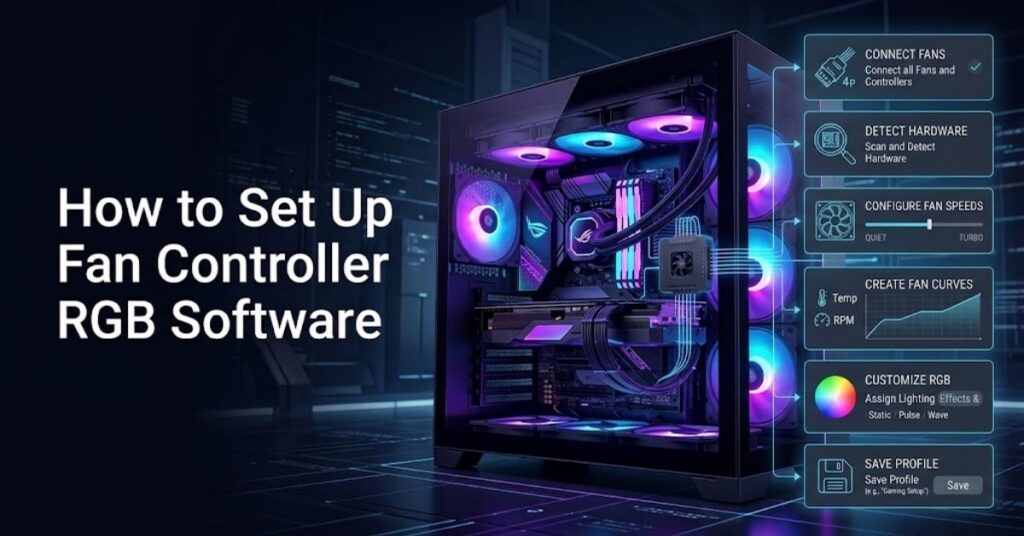
Before installing software, identify your motherboard, fans, controller, and connectors. This step prevents many configuration problems.
Check Your Hardware
- Identify your motherboard model.
- Check whether your fans use PWM or DC control.
- Identify the RGB connector type.
- Find out whether your fans connect directly to the motherboard or a controller.
- Check whether the controller uses USB.
- Confirm software compatibility.
- Update motherboard firmware when appropriate.
Do not confuse 4-pin PWM fan connectors with 4-pin 12V RGB connectors. They serve different purposes. Also, 3-pin 5V ARGB differs from 12V RGB.
Connecting the wrong RGB type can damage components.
Install the Correct Software
Download the application from the manufacturer’s official website. Avoid unofficial installers because hardware-control utilities often require elevated system access.
After installation, restart Windows if the application requests it.
Open the software and allow it to detect your motherboard or controller. Some applications require a setup wizard before they recognize fans.
Corsair, for example, provides a lighting setup process that detects compatible fans connected to its controller.
Configure Fan Profiles
Start with a balanced profile instead of immediately setting every fan to maximum speed.
A simple profile might look like this:
| CPU Temperature | Suggested Fan Speed |
| Below 40°C | 25–30% |
| 40–55°C | 35–45% |
| 55–70°C | 50–65% |
| 70–80°C | 70–80% |
| Above 80°C | 90–100% |
These values provide a starting point, not a universal rule. Your CPU, cooler, case airflow, room temperature, and fan model can change the ideal settings.
Configure RGB Lighting
Once fan control works correctly, configure the lighting.
Choose one main color or create a synchronized effect across compatible devices. Save your preferred setup as a profile.
Avoid changing many settings at once. Test each change so you can quickly identify a problem.
Best Fan Controller RGB Software Settings
A good fan curve should respond to real temperatures without creating constant speed changes.
If your fan jumps from 30% to 100% every time the CPU temperature changes slightly, the PC can become noisy. A smoother curve usually creates a better experience.
For everyday tasks, you can prioritize low noise. Browsing, office work, and video playback rarely require maximum cooling.
For gaming, increase fan speed gradually as CPU and GPU temperatures rise.
For heavy workloads such as video rendering or 3D work, prioritize cooling over silence.
A practical strategy looks like this:
- Keep low temperatures quiet.
- Increase fan speed gradually.
- Use higher speeds during sustained workloads.
- Avoid unnecessary 100% fan operation.
- Monitor temperatures after every major change.
- Save separate quiet and performance profiles.
Do not rely only on a single temperature sensor. A CPU-heavy workload may heat the CPU while leaving the GPU relatively cool. A graphics-heavy game can do the opposite.
Advanced fan-control software may let you use multiple temperature sources. That feature can help you create smarter cooling behavior.
For example, case fans can respond to GPU temperature during gaming. This can improve airflow without forcing the CPU cooler to run unnecessarily fast.
How RGB Fan Control Software Works
RGB fan control depends heavily on the lighting standard and controller.
RGB usually refers to red, green, and blue lighting. The controller combines these channels to create different colors.
ARGB adds individually addressable LEDs. This allows different LEDs on the same fan or strip to display different colors and patterns.
That difference matters when you build a synchronized lighting setup.
A 5V ARGB connector and a 12V RGB connector do not provide the same electrical configuration. Always check the motherboard manual and fan documentation before connecting them.
Brand ecosystems also use their own controllers. Corsair, for example, provides dedicated controller-based fan and lighting management through iCUE.
Its documentation explains how users configure connected fans and lighting devices. (Corsair Help)
For users with mixed hardware, software such as SignalRGB can provide broader device support. However, you should still check the current compatibility list before relying on a third-party application.
RGB synchronization can include:
- Motherboard lighting
- Case fans
- CPU cooler
- RAM
- GPU
- Keyboard
- Mouse
- Headset
- LED strips
A unified profile can make the entire PC follow one lighting theme.
Common Problems and Troubleshooting

Fan controller RGB software can fail for several reasons. Most problems involve hardware connections, software conflicts, incorrect settings, or compatibility limitations.
Fans do not appear in the software: Check the fan header, controller connection, USB cable, and power connection. Restart the software after checking the hardware.
Fans spin but RGB does not work: Check the RGB cable separately from the fan power cable. The motor and lighting often use separate connections.
RGB works but fan speed does not change: Confirm that the fan connects to a controllable PWM or DC header or a compatible controller.
Software shows incorrect fan order: Run the application’s detection or lighting setup wizard. Corsair specifically provides a setup process for identifying fan order and orientation. (Corsair Help)
Fans run at maximum speed: Check whether the software has loaded a profile. Also check BIOS fan settings and the selected control mode.
Two RGB applications fight for control: Close or remove unnecessary control applications. Keep one primary RGB controller whenever possible.
Fan speed changes constantly: Smooth the fan curve. Add gradual temperature steps instead of sharp changes.
RGB stops after Windows starts: Check whether the application launches with Windows. Also check whether the controller saves lighting settings to hardware.
When troubleshooting, change one thing at a time. This approach makes the cause easier to identify.
You can also review TechCrebia’s Samsung software update troubleshooting guide for another example of a structured approach to software-related troubleshooting. (techcrebia.com)
Best Practices for Safe Fan Control
Fan-control software can improve cooling, but careless settings can create unnecessary noise or poor thermal behavior.
Start with conservative settings. Test your PC under normal use before running demanding workloads.
Monitor temperatures while gaming or performing CPU/GPU-heavy tasks. Do not assume that a quiet PC automatically has good cooling.
Keep your fan and radiator surfaces clean. Dust can reduce airflow and force fans to work harder.
Use the correct connector type. Never connect a 5V ARGB device to a 12V RGB header.
Keep software updated. Manufacturers regularly improve compatibility and fix bugs.
Avoid installing several applications that attempt to control the same hardware. One application may overwrite settings from another.
You should also keep your motherboard firmware and device firmware current when the manufacturer recommends an update.
For broader software maintenance ideas, TechCrebia’s productivity software guide explains why choosing software based on actual needs can reduce unnecessary complexity. (techcrebia.com)
Latest Trends in RGB Fan Control
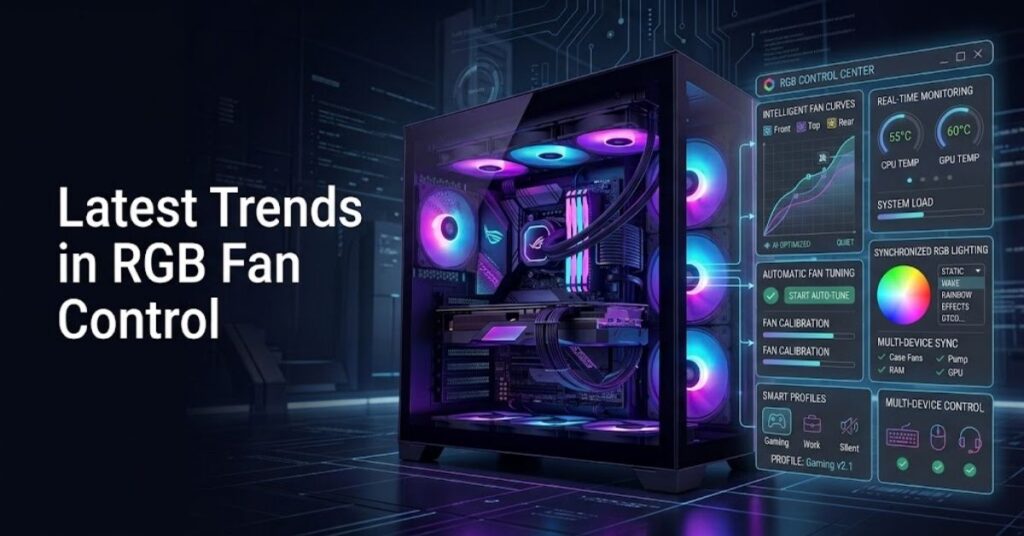
RGB cooling has moved beyond simple color selection. Modern PC software increasingly combines lighting, cooling, monitoring, and performance management in one dashboard.
One major trend involves unified device ecosystems. Users want one application to control fans, keyboards, mice, RAM, motherboards, and other RGB hardware.
Another trend involves automatic thermal control. Instead of manually selecting a fixed fan speed, newer utilities can use temperature data and automated tuning to create suitable fan behavior. ASUS currently promotes Fan Xpert within Armoury Crate for fan tuning and temperature-based control. (ASUS Global)
Game-reactive RGB also continues to grow. Lighting can respond to game events, audio, or system activity.
Mixed-brand compatibility has become another important goal. Users often build PCs with components from different manufacturers, so universal RGB applications can provide a more convenient experience.
Hardware-stored profiles also offer an important advantage. When compatible controllers store settings internally, the PC can maintain certain lighting or fan behaviors without depending entirely on Windows software.
Security and stability also matter more now. RGB applications sometimes install low-level components to communicate with hardware. Users should therefore download software only from trusted sources and keep it updated.
Future software will likely combine thermal monitoring, automatic fan tuning, RGB synchronization, and performance profiles into simpler interfaces.
Key Takeaways
- Fan controller RGB software manages compatible fans, cooling, temperatures, and lighting.
- Your motherboard and controller determine software compatibility.
- PWM, DC, RGB, and ARGB connections serve different purposes.
- RGB lighting and fan-speed control can use separate connections.
- Brand-specific software usually provides the deepest hardware support.
- Mixed-brand systems may benefit from broader RGB software.
- Use gradual fan curves instead of aggressive speed changes.
- Monitor temperatures after changing fan settings.
- Avoid running several applications that control the same hardware.
- Always check connector voltage and type before connecting RGB devices.
- Keep fan-control software and supported firmware updated.
Conclusion
Fan controller RGB software can make PC cooling and lighting much easier to manage. Instead of adjusting every device separately, you can create profiles for everyday work, gaming, and demanding workloads.
The best software depends on your hardware. ASUS users may benefit from Armoury Crate and Fan Xpert. Corsair users can use iCUE for compatible fans and controllers. Mixed-brand systems may need a broader RGB solution.
The most important step involves checking compatibility before installation. You should also understand the difference between fan connectors and RGB connectors.
Once you configure a smooth fan curve and a reliable RGB profile, your PC can stay cooler, quieter, and more visually consistent.
FAQs
What is fan controller RGB software?
It is software that manages compatible PC fan speeds, temperatures, RGB lighting, effects, and performance profiles.
Can RGB software control fan speed?
Yes, compatible software can control fan speed when the fan connects through a supported motherboard header or fan controller.
What is the best fan controller RGB software?
The best option depends on your hardware. Brand-specific software usually offers the strongest support for that manufacturer’s devices.
Can RGB software control all PC fans?
No. The software needs compatible hardware connections and controller support to access a fan.
What is the difference between RGB and ARGB?
RGB normally controls lighting channels together, while ARGB supports individually addressable LEDs for more detailed lighting effects.
Why does my fan spin but RGB does not work?
The fan motor and RGB lighting may use separate cables. Check the lighting cable, controller, header, and software compatibility.
Should I run multiple RGB programs?
Usually no. Multiple programs can compete for hardware control and cause lighting or fan settings to conflict.
Can fan-control software reduce noise?
Yes. A well-designed fan curve can keep fans slower during light workloads and increase speed only when temperatures rise.
Is fan controller RGB software safe?
It can be safe when you download it from the manufacturer’s official website and keep it updated.
Can I control fans without Windows software?
Yes. Many motherboards provide fan-control options through BIOS or UEFI, although RGB features may require additional software.
SEO Tags
- fan controller RGB software
- RGB fan control software
- PC fan controller software
- RGB lighting software
- PC cooling software
- fan speed control software
- RGB fan controller
- ARGB software
- PC fan curve software
- gaming PC RGB software
Internal Linking Suggestions with Anchor Text
- Difference Between Software and Hardware — use when explaining how software communicates with physical PC components. (techcrebia.com)
- PhysX System Software — use when discussing software that interacts with gaming hardware. (techcrebia.com)
- Productivity Software Guide — use for broader software management and utility topics. (techcrebia.com)
- Samsung J7 Software Update Guide — use as a related software troubleshooting resource. (techcrebia.com)
- Samsung Galaxy J7 Update Software — use for software update and maintenance content. (techcrebia.com)
Authoritative External References
- ASUS Fan Xpert 4 Official Support — official documentation for motherboard fan control, fan curves, and temperature monitoring. (ASUS Global)
- Corsair iCUE RGB Fan Setup Guide — official instructions for configuring compatible Corsair RGB fans. (Corsair Help)
Social Media Title
Fan Controller RGB Software: Complete PC Cooling & RGB Guide 2026