





Quick Answer
Lean software development is an approach that helps teams deliver valuable software faster while reducing waste, delays, defects, and unnecessary work.
It focuses on customer value, continuous learning, fast delivery, team empowerment, built-in quality, and improving the entire development process.
Teams often combine lean practices with Agile, Kanban, DevOps, continuous integration, and automated testing.
Author Information
Author: Gulnaz Malik
Role: Founder, Publisher & Technology Content Specialist
Experience: 5+ Years in Technology, AI, Software & Digital Innovation
Content Review: All content follows Google’s latest EEAT guidelines and includes fact-checked information from official documentation, trusted technology sources, industry reports, and practical research to ensure accuracy, reliability, and up-to-date insights.
Introduction
Software teams face constant pressure to build better products in less time. Customers expect useful features, reliable performance, strong security, and frequent improvements. At the same time, developers must manage changing requirements, technical debt, testing, bugs, and limited resources.
Lean software development offers a practical way to handle these challenges.
Instead of encouraging teams to produce more work, lean thinking asks teams to produce more customer value with less unnecessary effort. It encourages small batches, fast feedback, continuous improvement, and early problem detection.
The approach comes from lean manufacturing ideas and became closely connected with Agile software development. Mary and Tom Poppendieck adapted lean thinking for software development and presented seven major principles for software teams. (Scrum Alliance Resources)
This guide explains lean software development from beginner to advanced level. You will learn its principles, process, benefits, tools, Agile relationship, practical examples, common mistakes, and modern trends.
Table of Contents
- What Is Lean Software Development?
- How Lean Software Development Works
- Seven Principles of Lean Software Development
- Lean Software Development Process
- Lean Software Development vs Agile
- Lean Software Development vs Waterfall
- Tools and Practices
- Benefits of Lean Software Development
- Real-World Use Cases
- Common Challenges and Mistakes
- Best Practices for Successful Implementation
- Latest Trends in Lean Software Development
- Key Takeaways
- Conclusion
- FAQs
- SEO Tags
- Internal Linking Suggestions
- Authoritative External References
- Social Media Title
What Is Lean Software Development?
Lean software development is a software development approach that focuses on maximizing customer value while minimizing waste.
Waste does not only mean money or unused resources. In software, waste can include unfinished features, unnecessary meetings, excessive documentation, waiting, repeated work, context switching, avoidable defects, and features that customers never use.
For example, imagine a team spends three months building 20 features. After launch, customers use only eight of them.
The other 12 features consumed developer time, testing resources, design effort, and project management time without creating enough customer value.
A lean team would try to identify customer needs earlier. It would build smaller pieces, release them sooner, collect feedback, and adjust the product based on real usage.
This mindset also requires teams to look beyond individual tasks.
A developer might complete a task quickly, but the entire delivery process can still move slowly because testing, security review, deployment, or approval creates a bottleneck.
Lean software development therefore focuses on the entire value stream, not just individual productivity.
Software teams can apply this thinking to web applications, mobile apps, cloud platforms, enterprise systems, SaaS products, APIs, and internal business applications.
Teams can also utilize lean thinking in conjunction with modern software practices, such as DevOps, automated testing, continuous integration, and continuous delivery.
Seven Principles of Lean Software Development
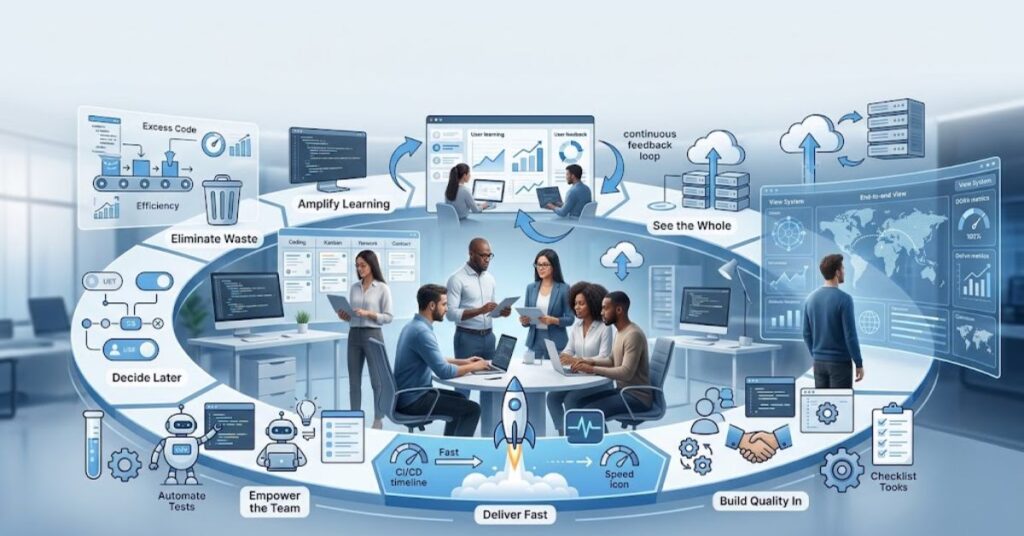
Lean software development traditionally uses seven core principles: eliminate waste, amplify learning, decide as late as possible, deliver as fast as possible, empower the team, build integrity in, and see the whole. (Scrum Alliance Resources)
Eliminate Waste
Waste represents work that does not create meaningful customer value.
Common examples include:
- Unused features
- Duplicate work
- Excessive handoffs
- Long approval processes
- Waiting for another team
- Manual repetitive tasks
- Large amounts of unfinished work
- Frequent context switching
- Avoidable defects
- Excessive documentation
The goal does not involve eliminating every activity that does not directly reach customers. Some activities, such as security testing and architecture work, support quality and long-term value.
The key question is simple:
Does this activity help the product, customer, team, or business achieve a meaningful goal?
Amplify Learning
Software development involves uncertainty. Teams cannot predict every customer need, technical problem, or market change before development begins.
Lean teams therefore create short feedback loops.
They can use:
- Prototypes
- Automated tests
- User feedback
- Code reviews
- Analytics
- Experiments
- Small releases
- Retrospectives
A small experiment can teach a team more than months of assumptions.
Decide as Late as Possible
This principle does not mean delaying every decision.
It means delaying irreversible decisions until the team has enough information.
For example, a team might postpone selecting a permanent architecture for a feature until it understands expected traffic, security requirements, and integration needs.
This approach keeps options open.
However, teams should still make decisions early when delaying them creates risk.
Deliver as Fast as Possible
Fast delivery helps teams learn faster.
A team that releases useful software every few weeks can collect feedback sooner than a team that waits a year for one major release.
Fast delivery also reduces the amount of work sitting in progress.
Small batches make problems easier to identify and fix.
Agile practices strongly support this idea. The Agile principles emphasize frequent delivery of working software and continuous customer value. (Agile Alliance)
Empower the Team
Developers, testers, designers, product specialists, and other people close to the work often understand technical problems better than distant managers.
Lean development gives teams enough authority to make appropriate decisions.
Empowerment can improve:
- Problem solving
- Ownership
- Communication
- Innovation
- Development speed
- Product quality
Leadership still matters. Managers should establish clear goals, constraints, priorities, and accountability.
Build Integrity In
Quality should not become a final checkpoint.
Teams should build quality into every stage.
Useful practices include:
- Automated testing
- Code review
- Continuous integration
- Security testing
- Refactoring
- Monitoring
- Clear architecture
- Definition of done
- Automated deployment checks
This principle reduces the cost of discovering problems late.
See the Whole
A lean team should optimize the complete delivery system.
Suppose developers finish work quickly, but testers receive hundreds of items at once. Testing then becomes a bottleneck.
Increasing developer output will not solve the real problem.
The team should improve the entire flow from idea to production.
This principle separates lean thinking from narrow productivity measurements.
Lean Software Development Process
Lean software development does not require one rigid sequence of steps. Teams adapt the process to their product, customers, technology, and organization.
A practical lean workflow can look like this:
- Identify customer value.
- Define the problem clearly.
- Remove unnecessary requirements.
- Break work into small batches.
- Build the smallest useful solution.
- Test continuously.
- Release quickly.
- Collect feedback.
- Measure outcomes.
- Improve the process.
For example, suppose a company wants to build a food delivery application.
Instead of developing every possible feature first, the team might begin with:
- Restaurant discovery
- Menu browsing
- Cart
- Checkout
- Order tracking
The team can launch this core experience, observe customer behavior, and then decide whether advanced loyalty features, recommendations, or other additions deserve development.
This approach reduces the risk of spending months on features that customers do not need.
Teams can also use a Kanban-style board to visualize work:
| Stage | Example |
| Ideas | Customer problems and requests |
| Ready | Prioritized work |
| Development | Current coding tasks |
| Testing | Verification and quality checks |
| Ready to release | Completed work |
| Production | Live software |
| Learning | Feedback and improvement |
The team should limit work in progress. Too many simultaneous tasks increase context switching and make bottlenecks harder to see.
Lean Software Development vs Agile
Lean and Agile share many ideas, but they are not identical. The Lean approach focuses strongly on value, waste reduction, smooth flow, continuous learning, and quality.
It also encourages teams to optimize the entire development system instead of improving only one part.
Agile provides a broader set of values and principles for responding to change and delivering software incrementally.
Many teams combine them.
| Area | Lean | Agile |
| Main focus | Value and waste reduction | Adaptability and customer collaboration |
| Delivery | Small and fast | Iterative and incremental |
| Feedback | Continuous | Frequent |
| Quality | Built into the process | Continuous technical excellence |
| Planning | Flexible | Adaptive |
| Team | Empowered | Collaborative |
| Common tools | Kanban, value-stream mapping | Scrum, Kanban, XP |
A team does not need to choose only one.
For example, a Scrum team can use lean thinking to reduce unnecessary meetings, limit work in progress, remove bottlenecks, and improve its delivery flow.
Lean Software Development vs Waterfall
Lean differs significantly from traditional Waterfall development.
Waterfall usually organizes work into larger sequential phases. Teams may spend substantial time defining requirements before development begins.
Lean prefers shorter feedback loops and smaller batches.
| Feature | Lean | Waterfall |
| Requirements | Can evolve | Usually defined early |
| Delivery | Frequent | Often later |
| Feedback | Continuous | Often later |
| Change | Expected | Can become expensive |
| Testing | Continuous | Often follows development phases |
| Customer involvement | Frequent | Often concentrated around milestones |
| Risk discovery | Earlier | Can happen later |
Waterfall still has appropriate use cases. Projects with stable requirements, strict regulatory processes, or fixed contractual constraints may need more structured planning.
Lean works particularly well when teams face uncertainty and frequent changes.
Lean Software Development Tools and Practices

In real projects, these principles help developers reduce waste, improve workflow, and focus on customer value. Teams can also use feedback,
continuous improvement, and efficient planning to strengthen their development process.
Value Stream Mapping
Value stream mapping helps teams visualize the journey from an idea to delivered software.
The team can measure:
- Development time
- Waiting time
- Testing time
- Approval time
- Deployment time
- Rework
- Handoffs
This can reveal hidden bottlenecks.
Kanban
Kanban helps teams visualize work and manage flow.
A simple board might include:
- Backlog
- Ready
- Development
- Code Review
- Testing
- Deployment
- Done
Teams can add work-in-progress limits to prevent overloaded stages.
Continuous Integration
Continuous integration encourages developers to integrate code frequently.
Automated builds and tests can detect integration problems early.
Automated Testing
Automation reduces repetitive manual checking and helps teams receive faster feedback.
Teams should combine unit, integration, system, security, and other appropriate tests.
Small Batch Development
Small batches reduce risk.
Instead of merging a massive feature after several months, developers can divide it into smaller increments.
Small batches also make code reviews and testing easier.
Continuous Improvement
Teams should regularly ask:
- What slowed us down?
- Where did defects appear?
- Which process created unnecessary work?
- What should we stop doing?
- What should we automate?
- What should we change next?
A retrospective becomes more useful when the team converts observations into measurable experiments.
Benefits of Lean Software Development
Lean software development can provide several practical benefits when teams apply its principles correctly.
Faster Delivery
Small batches and reduced waiting can shorten delivery cycles.
Better Quality
Continuous testing and early feedback help teams discover defects sooner.
Lower Waste
Teams spend less time building unnecessary features or maintaining inefficient processes.
Better Customer Alignment
Frequent feedback helps teams build products around actual customer needs.
Greater Team Ownership
Empowered teams can solve problems without waiting for unnecessary approvals.
Lower Development Risk
Small releases reduce the size of each change. Teams can identify problems before they affect a large portion of the product.
Better Flow
Teams can identify bottlenecks instead of focusing only on individual developer output.
For teams that manage many digital tools, selecting software carefully also matters. TechCrebia’s productivity software guide provides useful context on how software tools can support efficient work.
Real-World Use Cases
Lean software development works across many technology environments.
SaaS products: Teams can release small features, measure customer adoption, and improve the product continuously.
Mobile applications: Developers can release focused improvements instead of waiting for a large feature package.
E-commerce platforms: Teams can test checkout improvements, search changes, and recommendation features using real customer behavior.
Enterprise software: Lean practices can help reduce approval delays, manual processes, and large development batches.
Cloud applications: Continuous delivery and automated infrastructure can support fast, repeatable releases.
Maintenance teams: Lean thinking can help prioritize bugs and customer-impacting issues while reducing unnecessary work.
Software itself also illustrates lean thinking well. TechCrebia’s difference between software and hardware guide explains why software can evolve through updates without physically replacing the underlying hardware.
Common Challenges and Mistakes
Lean adoption can fail when organizations treat it as a collection of shortcuts.
Mistake 1: Confusing lean with doing less work
Lean does not mean cutting necessary engineering work. Teams should remove waste while protecting quality, security, and reliability.
Mistake 2: Measuring developer activity instead of value
Lines of code, hours worked, or tickets closed do not automatically represent customer value.
Mistake 3: Releasing too quickly without quality controls
Speed without testing creates technical debt and production problems.
Mistake 4: Starting too many tasks
Too much work in progress creates delays and context switching.
Mistake 5: Ignoring bottlenecks
Improving one department does not help if another stage remains overloaded.
Mistake 6: Treating lean as a fixed framework
Lean provides principles. Teams should adapt practices to their environment.
Mistake 7: Ignoring people
Process optimization should not turn developers into production machines. Sustainable workloads, autonomy, communication, and learning remain important.
Best Practices for Successful Implementation
Start small.
Choose one product team or workflow rather than transforming the entire organization overnight.
Measure the current process first.
Useful measurements include:
- Lead time
- Cycle time
- Deployment frequency
- Defect rates
- Rework
- Work in progress
- Customer satisfaction
- Change failure rate
Do not use metrics to punish individuals. Use them to understand the system.
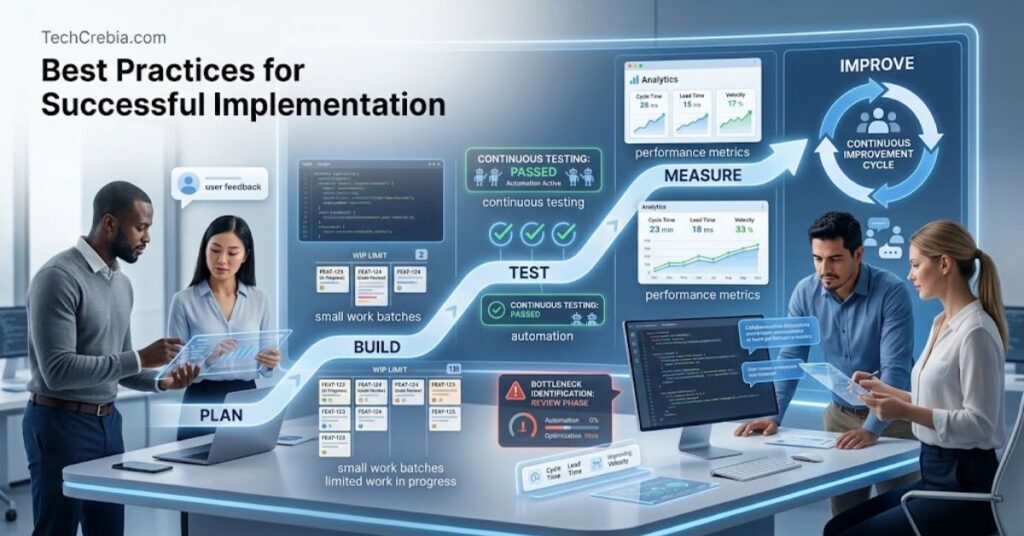
Create smaller work items. Define clear acceptance criteria. Automate repetitive checks. Reduce unnecessary handoffs. Make bottlenecks visible.
Teams should also establish a strong feedback loop.
A practical improvement cycle looks like this:
Measure → Identify → Experiment → Release → Learn → Improve
This cycle keeps lean development focused on evidence rather than assumptions.
When software interacts with physical systems, teams should also understand the underlying technology. TechCrebia’s PhysX System Software guide offers an example of how software can interact closely with hardware and system components.
For maintenance work, TechCrebia’s Samsung J7 software update guide also shows why structured troubleshooting and safe update practices matter when managing software changes.
Latest Trends in Lean Software Development
Lean thinking continues to evolve alongside modern software engineering.
AI-assisted development can reduce repetitive coding, testing, documentation, and analysis work. Teams should still review AI-generated output because speed does not replace engineering judgment.
DevOps and continuous delivery support lean goals by reducing manual handoffs and shortening feedback loops.
Platform engineering can help development teams access standardized infrastructure and deployment capabilities without repeatedly solving the same operational problems.
Observability gives teams faster feedback about how software behaves in production. Logs, metrics, traces, and real-user signals can support continuous learning.
Automated testing continues to become more important as release frequency increases.
Value stream management also helps organizations examine the complete flow from product idea to customer outcome rather than measuring isolated departments.
The future of lean software development will likely focus less on simply producing software faster and more on delivering measurable customer value safely and sustainably.
Key Takeaways
- Lean software development focuses on customer value and waste reduction.
- The approach uses seven core principles.
- Small batches reduce development risk.
- Continuous feedback helps teams learn faster.
- Teams should build quality into development rather than inspect it only at the end.
- Lean and Agile work well together.
- Kanban, continuous integration, automated testing, and value-stream mapping support lean practices.
- Teams should optimize the entire delivery system.
- Speed without quality creates new waste.
- AI, DevOps, automation, and observability will continue to shape lean development.
Conclusion
Lean software development gives software teams a practical way to improve delivery without sacrificing quality.
Its central idea remains simple: create more customer value while reducing unnecessary work and delays.
Teams can achieve this by delivering small increments, collecting feedback, empowering people, building quality into every stage, and improving the complete value stream.
Lean does not require a team to abandon Agile, Scrum, Kanban, DevOps, or other established practices. Instead, it provides a way to evaluate whether those practices actually improve customer value and development flow.
The strongest lean teams do not simply move faster. They learn faster, detect problems earlier, reduce unnecessary work, and make better decisions.
That makes lean software development highly relevant for modern software teams working in fast-changing technology environments.
FAQs
What is lean software development?
Lean software development is an approach that maximizes customer value while reducing waste, delays, defects, and unnecessary work.
What are the seven principles of lean software development?
They are eliminate waste, amplify learning, decide as late as possible, deliver as fast as possible, empower the team, build integrity in, and see the whole.
Is lean software development the same as Agile?
No. Lean focuses strongly on value, waste, flow, and system improvement, while Agile provides broader principles for adaptive and iterative software development.
Is Kanban part of lean software development?
Kanban is not identical to lean, but its visualization, flow management, and work-in-progress limits support many lean principles.
What is the biggest benefit of lean software development?
The biggest benefit is the ability to deliver valuable software faster while reducing unnecessary work and improving feedback.
Does lean software development reduce software quality?
No. Lean development encourages teams to build quality into the process through testing, automation, feedback, and continuous improvement.
Can small companies use lean software development?
Yes. Small teams can apply lean principles without adopting complicated frameworks or expensive tools.
How does AI support lean software development?
AI can automate repetitive coding, testing, documentation, and analysis tasks, but developers should review AI output for quality, security, and correctness.
SEO Tags
- Lean Software Development
- Lean Software Development Principles
- Lean Development Methodology
- Agile Software Development
- Lean vs Agile
- Software Development Process
- Lean Software Engineering
- Kanban Software Development
- Software Development Best Practices
- Agile Lean Methodology
Internal Linking Suggestions with Anchor Text
- Difference Between Software and Hardware — https://techcrebia.com/difference-between-software-and-hardware/
- Productivity Software Guide — https://techcrebia.com/productivity-software/
- PhysX System Software Guide — https://techcrebia.com/physx-system-software/
- Samsung J7 Software Update Guide — https://techcrebia.com/samsung-j7-software-update-guide/
- Fan Controller RGB Software Guide — https://techcrebia.com/fan-controller-rgb-software/
Authoritative External References
- Agile Alliance — 12 Principles Behind the Agile Manifesto: https://agilealliance.org/agile101/12-principles-behind-the-agile-manifesto/ (Agile Alliance)
- Learn more about efficient development practiceshttps://resources.scrumalliance.org/Article/lean-software-development (Scrum Alliance Resources)
Social Media Title
Lean Software Development: 7 Principles, Process & Benefits 2026