





Quick Answer
An IBM software engineer internship gives students practical experience with software development, cloud computing, AI, automation, and other technologies.
IBM offers internship opportunities through its student and entry-level programs, but requirements vary by role and location.
Strong programming skills, projects, problem-solving ability, communication skills, and a focused resume can improve your chances.
Author Information
Author: Gulnaz Malik
Role: Founder, Publisher & Technology Content Specialist
Experience: 5+ Years in Technology, AI, Software & Digital Innovation
Content Review: All content follows Google’s latest EEAT guidelines and includes fact-checked information from official documentation, trusted technology sources, industry reports, and practical research to ensure accuracy, reliability, and up-to-date insights.
Introduction
An IBM software engineer internship can give students a valuable entry point into the technology industry.
Instead of learning only through university assignments, interns can work on practical projects and develop professional engineering skills.
IBM operates across areas such as artificial intelligence, hybrid cloud, automation, software development, cybersecurity, and enterprise technology.
Its software engineering teams work on products and systems that serve businesses and users around the world.
IBM also maintains dedicated internship and entry-level career programs for students and recent graduates.
However, getting an IBM software engineer internship at a major technology company requires preparation.
Students often compete with candidates who have strong academic backgrounds, programming projects, open-source contributions, and technical interview experience.
Building practical skills and preparing early can help you create a stronger application and stand out during the selection process.
This guide explains how IBM software engineering internships work, what skills you need, how to prepare your resume, what the application process can involve, and how to improve your chances in 2026.
If you are also exploring software engineering careers at other technology companies, TechCrebia’s Google software engineer salary guide can help you understand another major technology career path.
Table of Contents
- What Is an IBM Software Engineer Internship?
- Why Choose an IBM Software Engineering Internship?
- What Do IBM Software Engineering Interns Do?
- Skills You Need for an IBM Software Engineer Internship
- IBM Software Engineer Internship Eligibility
- How to Apply for an IBM Software Engineer Internship
- How to Prepare for IBM Coding Assessments
- How to Build a Strong Internship Resume
- IBM Software Engineering Internship Interview Tips
- Common Mistakes to Avoid
- IBM Internship Work Experience and Career Growth
- Latest Trends in IBM Software Engineering Internships
- Salary and Benefits Considerations
- How to Stand Out From Other Applicants
- Troubleshooting Common Application Problems
- Key Takeaways
- Conclusion
- FAQs
- SEO Tags
- Internal Linking Suggestions
- Authoritative External References
- Social Media Title
What Is an IBM Software Engineering Internship?
An IBM software engineer internship is a temporary learning and work opportunity that allows students to gain practical software engineering experience inside IBM.
Interns can work with professional engineering teams and contribute to projects related to software, cloud platforms, artificial intelligence, automation, data, cybersecurity, or other technology areas. The exact work depends on the specific internship, location, team, and business unit.
IBM describes its internship programs as opportunities where interns can contribute to important projects and collaborate with IBM employees. Its software engineering career area also highlights technologies such as open source, cloud computing, AI, automation, and hybrid cloud architectures.
A software engineering intern may work on tasks such as:
- Writing and testing code
- Fixing software bugs
- Building application features
- Reviewing code
- Creating automated tests
- Working with APIs
- Using Git and development tools
- Supporting cloud-based applications
- Analyzing technical problems
- Documenting software changes
For example, an intern might join a team developing a cloud application. The intern could receive a small feature, write the required code, test it, submit the changes for review, and improve the implementation after receiving feedback.
That process teaches something university courses cannot fully reproduce: how professional software teams build and maintain real systems.
Why Choose an IBM Software Engineering Internship?
IBM offers students exposure to a large technology organization and a wide range of technical fields.
One major advantage involves practical experience. Interns can apply programming concepts to real development tasks instead of limiting their work to classroom projects.
Another benefit involves teamwork. Professional developers rarely work alone. They communicate with developers, testers, product managers, designers, data specialists, and other technical professionals.
An internship can also help students understand professional engineering practices.
These may include:
- Version control
- Code reviews
- Agile development
- Automated testing
- Documentation
- Issue tracking
- Debugging
- Team communication
- Cloud development
IBM’s current software engineering career information specifically highlights agile development, open-source technologies, cloud computing, AI, automation, and hybrid cloud architectures.
The experience can also strengthen your future job applications. Instead of writing only that you “know Python,” you can describe a practical project and explain what you built, how you solved problems, and what results you achieved.
What Do IBM Software Engineering Interns Do?
The daily work depends on the internship. Some interns may focus on backend development, while others may work with frontend systems, cloud services, testing, data, DevOps, or AI-related applications.
A typical project might follow a simple workflow:
- The team defines a technical requirement.
- The intern studies the existing codebase.
- A mentor or manager explains the assigned task.
- The intern designs a solution.
- The intern writes and tests code.
- The team reviews the changes.
- The intern fixes issues.
- The team integrates the completed work.
An intern may also attend team meetings, planning sessions, technical discussions, and learning activities.
IBM’s software engineering career area lists several related roles, including software engineer, full-stack developer, DevOps engineer, front-end developer, technical support, and test engineer.
This variety means students should not assume that every internship follows the same structure.
Skills for an IBM Software Engineering Internship

Strong technical fundamentals matter, but you do not need to know every programming language or technology before applying.
Focus on skills that help you solve problems and understand software systems.
Programming Skills
- Learn at least one programming language well.
- Practice Python, Java, C++, JavaScript, or another language relevant to the job.
- Understand variables, functions, loops, data structures, and error handling.
- Write clean and readable code.
- Practice debugging instead of relying only on tutorials.
Data Structures and Algorithms
- Learn arrays, strings, linked lists, stacks, and queues.
- Understand hash tables and trees.
- Practice sorting and searching.
- Study recursion and basic graph concepts.
- Analyze time and space complexity.
- Solve coding problems regularly.
Software Development Skills
- Learn Git and basic version control.
- Understand APIs and HTTP.
- Learn basic database concepts.
- Understand testing and debugging.
- Build projects instead of collecting certificates only.
- Learn how software components communicate.
Cloud and Modern Technology Skills
- Understand basic cloud concepts.
- Learn how applications use servers and databases.
- Explore containers and APIs.
- Study AI and machine learning fundamentals if the role involves them.
- Understand basic cybersecurity practices.
You do not need advanced knowledge of every area. Match your preparation to the job description.
IBM Software Engineer Internship Eligibility
Eligibility varies by internship and location. IBM does not use one universal requirement for every internship.
Some opportunities target students currently enrolled in university programs. Other entry-level opportunities target recent graduates or candidates with different educational backgrounds.
IBM’s entry-level career information includes internships, co-op opportunities, apprenticeships, and other early-career paths.
Before applying, check the individual job description for:
- Degree requirements
- Graduation date
- Student status
- Required programming skills
- Preferred technical skills
- Work location
- Work authorization
- Availability dates
- Language requirements
- Internship duration
Do not rely on an old internship listing. Companies change requirements as teams and projects change.
A strong candidate should read the entire posting rather than focusing only on the job title.
How to Apply for an IBM Software Engineering Internship
IBM’s application process can include several stages. The exact sequence depends on the role.
IBM’s official application guidance describes possible stages such as coding assessments, video assessments, English-language assessments, and interviews.
Find the Right Internship
- Visit IBM Careers.
- Search for software engineering internships.
- Filter results by location and experience level.
- Read each job description carefully.
- Compare your skills with the listed requirements.
- Save relevant openings before applying.
You can use IBM’s official internship opportunities page to explore current openings and IBM’s student-focused programs.
Prepare Your Application
- Create a one-page resume.
- Highlight programming skills.
- Add two or three strong projects.
- Include measurable project results when possible.
- Mention relevant coursework.
- Add GitHub or portfolio links when appropriate.
- Check your resume for spelling and formatting errors.
Complete the Selection Process
- Submit the application.
- Monitor your candidate portal.
- Prepare for coding assessments.
- Practice technical questions.
- Prepare behavioral examples.
- Research the role and team.
- Attend interviews professionally.
IBM says candidates can create an online application, upload a resume, and track application status through its candidate portal.
IBM Coding Assessment Preparation

Coding assessments can test how well you understand programming and problem solving.
Do not focus only on memorizing solutions. Learn how to recognize common patterns.
Start with easy problems and gradually increase difficulty.
A useful preparation plan looks like this:
- Review one programming language.
- Study common data structures.
- Practice algorithm patterns.
- Solve coding problems without looking at solutions.
- Review mistakes after every problem.
- Practice under a time limit.
- Explain your solution aloud.
- Improve your code after solving the problem.
Practice also matters because interviewers may care about your reasoning process.
For example, if a problem asks you to find duplicate values in an array, do not immediately write code. First explain the approach. Then discuss its complexity. Finally, implement and test it.
IBM’s application guidance recommends technical candidates practice coding assessments and technical interviews as part of their preparation.
How to Build a Strong Internship Resume
Your resume should make your technical ability easy to understand.
Avoid filling the page with generic statements such as “hardworking student” or “team player.” Show evidence instead.
A stronger project description might explain:
Project: Student Task Management Application
- Built a task management web application using JavaScript and Node.js.
- Created REST API endpoints for task creation and updates.
- Added user authentication and database storage.
- Tested API functionality and fixed validation errors.
This format gives recruiters useful information quickly.
Your resume can include:
| Resume Section | What to Include |
| Education | Degree, university, graduation date |
| Technical Skills | Languages, frameworks, tools |
| Projects | Practical applications you built |
| Experience | Jobs, internships, research, freelance work |
| Achievements | Competitions, awards, certifications |
| Links | GitHub, portfolio, LinkedIn when relevant |
Avoid listing 20 technologies that you barely understand. A shorter list of real skills creates more credibility.
For general software knowledge, TechCrebia’s difference between software and hardware guide can also help beginners understand the technical foundation behind software engineering.
IBM Software Engineering Internship Interview Tips
IBM’s interview process can include technical and behavioral questions. The company says interview questions vary according to the role and experience level.
Prepare for both categories.
Technical questions may cover:
- Programming fundamentals
- Data structures
- Algorithms
- Object-oriented programming
- Databases
- APIs
- Debugging
- Software design
- Projects listed on your resume
Behavioral questions may ask about teamwork, conflict, failure, leadership, learning, and problem solving.
Use the STAR structure when answering behavioral questions:
Situation: Explain the context.
Task: Explain your responsibility.
Action: Explain what you did.
Result: Explain what happened.
Keep your answers specific. Do not claim achievements that you cannot prove.
Also prepare questions for the interviewer. Good questions show curiosity about the team and role.
Examples include:
- What type of project would an intern work on?
- How does the team support interns?
- What technologies does the team use most?
- How does the team measure internship success?
- What skills help interns contribute quickly?
Common Mistakes to Avoid
Many applicants lose opportunities because they prepare in the wrong way.
The biggest mistake involves applying without reading the job description. A strong resume cannot compensate for a major eligibility mismatch.
Other common mistakes include:
- Using a generic resume for every role
- Listing skills without practical projects
- Ignoring data structures and algorithms
- Practicing coding only a few days before an assessment
- Giving vague behavioral answers
- Copying project descriptions from the internet
- Claiming experience you do not have
- Ignoring communication skills
- Failing to test your portfolio links
- Applying to roles without checking location requirements
Another important issue involves artificial intelligence.
IBM’s current recruitment guidance allows candidates to use AI for activities such as improving resume clarity, understanding job descriptions, and preparing for interviews. However, IBM prohibits candidates from using AI to complete assessments, technical tests, or live interviews.
Use AI as a learning assistant, not as a substitute for your own technical ability.
Internship Work Experience and Career Growth
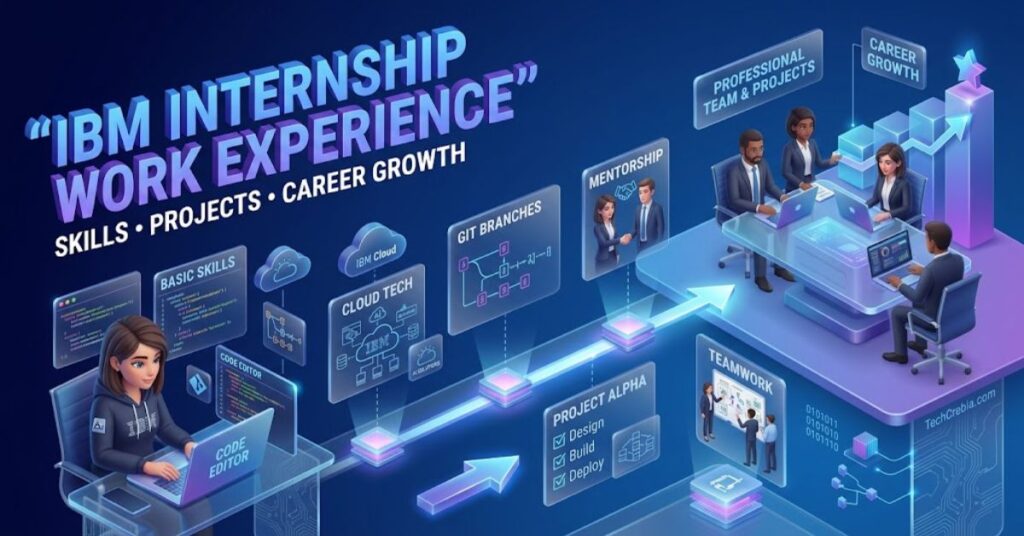
An internship can help you understand whether software engineering fits your career goals.
You can learn how professional teams communicate, plan projects, review code, handle bugs, and release software.
IBM also highlights examples of interns progressing into longer-term careers. Its internship program page features stories about interns who later became IBM employees.
However, an internship does not guarantee a full-time job.
Your performance, business needs, available roles, location, skills, and hiring decisions can all affect future opportunities.
Think about the internship as a chance to build evidence of your abilities.
Keep a record of:
- Projects you contributed to
- Technologies you learned
- Problems you solved
- Performance improvements
- Bugs you fixed
- Team responsibilities
- Feedback from mentors
That information can strengthen your next resume and interview.
Latest Trends in IBM Software Engineering Internships
Software engineering continues to change quickly. Students now need more than traditional programming knowledge.
AI has become especially important. IBM’s current software engineering career information emphasizes AI, automation, cloud computing, and hybrid cloud architectures.
Other important trends include:
AI-assisted development: Developers increasingly use AI tools for code explanation, debugging, documentation, and productivity.
Cloud-native development: Modern applications often depend on cloud services, containers, APIs, and distributed systems.
Cybersecurity: Developers need to understand secure coding and basic application security.
Automation: Engineering teams automate testing, deployment, monitoring, and repetitive development tasks.
Open source: Developers can learn professional workflows by contributing to public projects.
These trends make project-based learning increasingly valuable. A student who builds a small cloud application and explains the architecture may demonstrate more practical knowledge than someone who only lists several certificates.
Salary and Benefits Considerations
Internship compensation varies by location, role, education level, work arrangement, and local employment practices.
Do not assume that every IBM internship offers the same salary or benefits.
The job posting should provide the most relevant information for a specific opening. If compensation does not appear in the listing, candidates should check the official recruitment information or ask the recruiting team.
You should also consider the total value of an internship.
Relevant factors include:
- Pay
- Duration
- Learning opportunities
- Mentorship
- Project quality
- Location
- Work arrangement
- Networking opportunities
- Potential future opportunities
For students comparing technology careers, TechCrebia’s software engineer career and salary content can provide additional context about engineering career paths.
How to Stand Out From Other Applicants
Competition can become intense, so you need evidence that supports your application.
Build two or three meaningful projects.
For example, create:
- A full-stack web application
- A cloud-based API
- A data analysis project
- An AI-powered application
- A developer tool
- An open-source contribution
Do not simply copy a tutorial. Change the project and solve a real problem.
You can also improve your profile through technical communities and open-source contributions.
Your GitHub profile should show consistent work. Keep important repositories organized. Add useful README files. Explain what each project does and how you built it.
Communication can also differentiate you.
A software engineer needs to explain technical problems clearly. Practice describing your projects to someone who does not have a technical background.
If you can explain both what you built and why you built it, your project becomes much more valuable during an interview.
For another software-focused resource, TechCrebia’s productivity software guide explains how modern software supports workflows and digital work.
Troubleshooting Common Application Problems
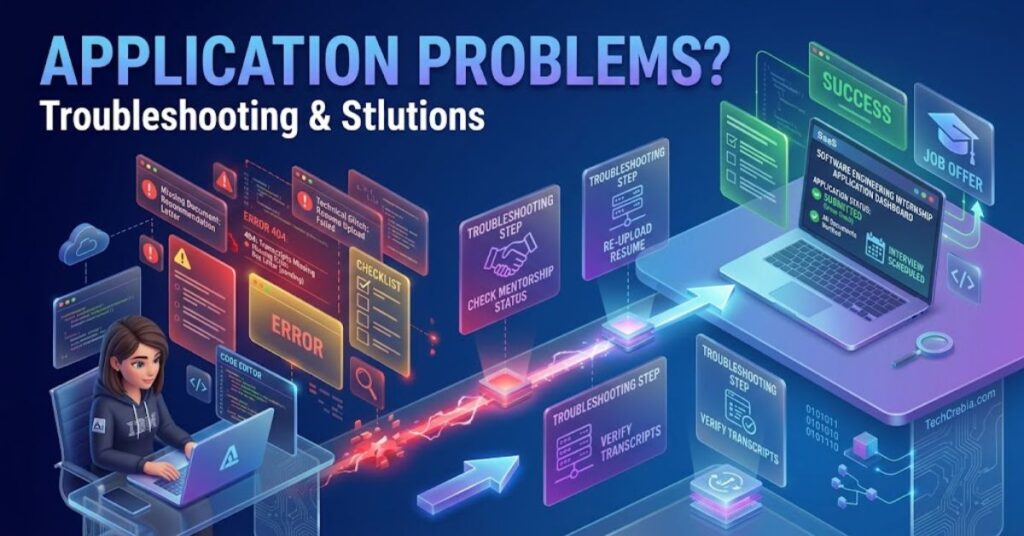
Sometimes candidates encounter problems during the application process.
If your application shows an unexpected status, first check the IBM candidate portal and the specific job requirements.
IBM explains that an application can move to “No Longer Under Consideration” when it does not meet one or more basic requirements. The company also notes that selection timelines vary depending on the role, applicant volume, and other factors.
If you cannot find a suitable opening, IBM recommends joining its Talent Network and setting up job alerts.
For technical problems:
- Check that you use the correct IBM account.
- Confirm your application information.
- Save copies of important documents.
- Check official IBM recruitment messages.
- Contact IBM recruitment support when necessary.
Be careful with fake internship advertisements. Verify job opportunities through IBM’s official careers platform instead of trusting random social media posts or unofficial recruiters.
For additional PC and software troubleshooting knowledge, TechCrebia’s Fan Controller RGB Software guide provides an example of structured technical troubleshooting.
Key Takeaways
- An IBM software engineer internship can provide practical development experience.
- IBM offers internship and entry-level opportunities across different technology areas.
- Requirements vary by role, location, and internship program.
- Programming fundamentals and problem-solving skills remain essential.
- Data structures and algorithms matter for technical assessments.
- Real projects can strengthen your resume significantly.
- Read every job description before applying.
- Prepare for both technical and behavioral interviews.
- Use AI responsibly during recruitment preparation.
- Never use AI to complete an assessment or live interview when IBM prohibits it.
- Check official IBM career pages for current openings and requirements.
- An internship can support future career growth, but it does not guarantee a full-time position.
Conclusion
An IBM software engineer internship can give students valuable experience in professional software development. IBM works across AI, cloud computing, automation, open source, hybrid cloud, and other technology areas, creating opportunities for students with different technical interests.
The best way to prepare involves building strong fundamentals, creating practical projects, improving your resume, and practicing technical interviews.
Do not focus only on getting an internship. Focus on becoming the type of candidate who can contribute after joining the team.
Start with one programming language. Build useful projects. Practice algorithms. Learn Git and APIs. Improve your communication skills. Then apply to roles that match your actual abilities.
Most importantly, always verify current eligibility and application requirements through IBM’s official careers platform because internship openings and requirements can change.
FAQs
1. How do I get an IBM software engineer internship?
Build strong programming skills, create practical projects, prepare for coding assessments, and apply through IBM’s official careers platform.
2. What programming languages should I learn for an IBM internship?
Python, Java, C++, and JavaScript can all provide useful foundations, but the best choice depends on the specific job description.
3. Does IBM offer internships for students?
Yes. IBM offers internship opportunities for students, with requirements that vary by program, role, and location.
4. Does an IBM internship guarantee a full-time job?
No. An internship can create valuable experience, but future employment depends on performance, available roles, business needs, and hiring decisions.
5. What does IBM test during technical assessments?
Depending on the role, IBM may assess programming knowledge through multiple-choice questions or coding challenges.
6. Can I use ChatGPT while completing an IBM coding assessment?
IBM’s current guidance prohibits using AI to complete assessments, technical tests, or live interviews unless the company explicitly permits it.
7. Should I include GitHub projects on my resume?
Yes, if the projects demonstrate real technical skills and contain clear, original work.
8. Can international students apply for IBM internships?
Some roles may accept international candidates, while others have location or work-authorization requirements. Always check the individual job posting.
9. What makes an IBM internship application stronger?
Relevant technical skills, practical projects, a focused resume, coding preparation, clear communication, and a strong match with the job description can improve your application.
SEO Tags
- IBM software engineer internship
- IBM internship 2026
- IBM software engineering internship
- IBM internships for students
- IBM tech internship
- IBM developer internship
- software engineering internship
- IBM internship requirements
- IBM coding assessment
- IBM careers
Internal Linking Suggestions with Anchor Text
- Software and hardware differences → https://techcrebia.com/difference-between-software-and-hardware/
- Google software engineer salary → https://techcrebia.com/google-software-engineer-salary/
- Productivity software guide → https://techcrebia.com/productivity-software/
- Fan Controller RGB Software → https://techcrebia.com/fan-controller-rgb-software/
- Samsung J7 software update → https://techcrebia.com/samsung-j7-software-update-guide/
Authoritative External References
Social Media Title
IBM Software Engineer Internship 2026: Skills, Application & Interview Guide