





Quick Answer
Agile software development is an iterative approach that helps teams build software in small, useful increments.
Teams collect feedback, respond to changing requirements, test continuously, and improve each release.
Popular approaches include Scrum, Kanban, Extreme Programming, and Lean Software Development.
Agile can improve flexibility, customer involvement, product quality, and delivery speed when teams apply its principles rather than simply following ceremonies.
Author Information
Author: Gulnaz Malik
Role: Founder, Publisher & Technology Content Specialist
Experience: 5+ Years in Technology, AI, Software & Digital Innovation
Content Review: All content follows Google’s latest EEAT guidelines and includes fact-checked information from official documentation, trusted technology sources, industry reports, and practical research to ensure accuracy, reliability, and up-to-date insights.
Introduction
Agile software development has changed how modern teams build digital products. Instead of planning every detail months before writing code, agile teams work in smaller cycles. They build useful features, test them, collect feedback, and improve the product continuously.
This approach works especially well when requirements can change during development. Mobile apps, SaaS platforms, websites, AI products, financial applications, and enterprise systems often evolve as users provide new feedback.
The Agile Manifesto emerged in 2001 and introduced four core values that emphasize people, working software, customer collaboration, and responding to change.
Today, agile software development includes many approaches. Scrum provides a structured framework for complex work, while Kanban focuses on visualizing and improving workflow.
Teams can also combine agile practices with DevOps, automated testing, cloud platforms, and AI-assisted development.
This guide explains agile software development from beginner to advanced level. You will learn how it works, which methodologies teams use, its benefits and limitations, common mistakes, practical examples, and important trends for 2026.
Table of Contents
- What Is Agile Software Development?
- How Agile Software Development Works
- Agile Principles and Values
- Popular Agile Software Development Methodologies
- Agile Software Development Life Cycle
- Roles in Agile Teams
- Agile Tools and Technologies
- Benefits of Agile Software Development
- Common Challenges and Mistakes
- Agile vs Waterfall
- Best Practices for Successful Agile Development
- Agile Software Development for Different Projects
- Latest Agile Software Development Trends in 2026
- Key Takeaways
- Conclusion
- FAQs
- SEO Tags
- Internal Linking Suggestions
- Authoritative External References
- Social Media Title
What Is Agile Software Development?
Agile software development is an approach to building software through short, repeated development cycles. Each cycle produces useful work that teams can review and improve.
Traditional development often tries to define the complete product before implementation. Agile takes a different path. Teams accept that users, markets, technology, and business requirements can change.
For example, imagine a company building an online shopping application.
Instead of spending a year building every feature, an agile team might first create:
- User registration.
- Product browsing.
- Shopping cart functionality.
- Basic checkout.
- Payment integration.
- Order tracking.
The team can release useful functionality early. Customers can then provide feedback before developers build less important features.
Agile does not mean “develop without a plan.” Teams still plan their work. However, they keep plans flexible and adjust priorities as they learn.
Agile also does not mean eliminating documentation. Good agile teams create enough documentation to support development, security, maintenance, and knowledge sharing.
For beginners who want to understand the foundation of software itself, TechCrebia’s guide to the difference between software and hardware provides useful background.
How Agile Software Development Works
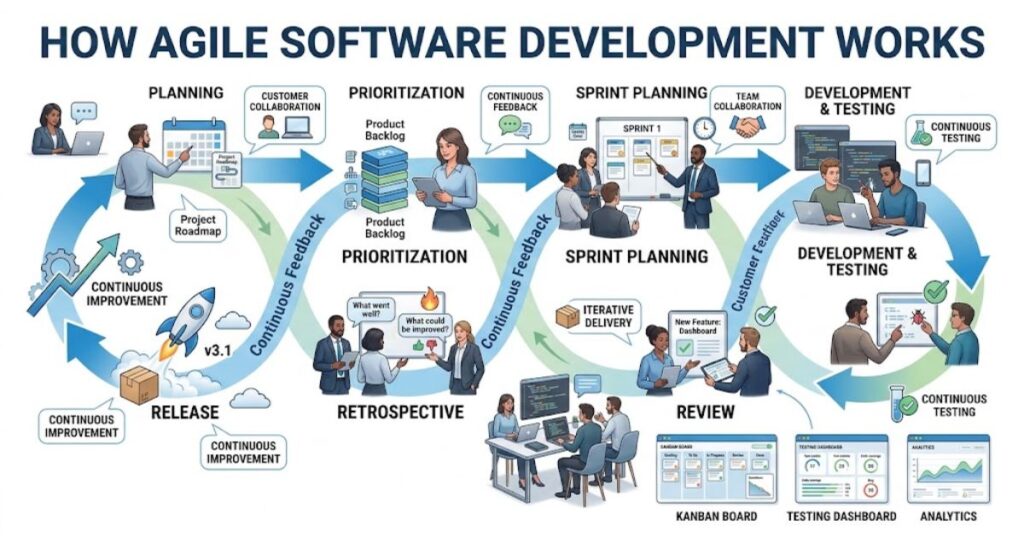
Agile software development relies on iterative and incremental delivery.
An iteration represents a short development cycle. Depending on the team’s framework, the cycle may last one to several weeks.
A typical workflow looks like this:
- The team identifies business and user needs.
- The product owner or business representative prioritizes requirements.
- Developers select valuable work.
- Designers and developers create the solution.
- Testers verify the work.
- The team demonstrates the result.
- Stakeholders provide feedback.
- The team updates priorities.
- Developers begin the next cycle.
This creates a continuous learning loop.
Suppose a banking application needs a new budgeting feature. The team may first create expense tracking. Users then test it and request spending categories. The team can prioritize that feedback in a later iteration.
This approach reduces the risk of spending months developing a feature that customers do not need.
Core Agile Practices
- Short iterations: Teams divide large projects into manageable pieces.
- Continuous feedback: Customers and stakeholders review progress regularly.
- Frequent testing: Developers test features throughout development.
- Prioritized backlogs: Teams focus on the most valuable work first.
- Continuous improvement: Teams inspect their process and make adjustments.
- Cross-functional teamwork: Developers, testers, designers, and product specialists collaborate closely.
The official Agile principles emphasize frequent delivery, changing requirements, sustainable development, technical excellence, simplicity, and regular team reflection.
Agile Principles and Values
The Agile Manifesto defines four important values. These values guide the mindset behind agile software development.
Individuals and interactions over processes and tools means effective collaboration matters more than blindly following a process.
Working software over comprehensive documentation means usable software provides more immediate value than excessive paperwork.
Customer collaboration over contract negotiation means teams should work with customers throughout development instead of treating requirements as permanently fixed.
Responding to change over following a plan means teams should adapt when new information changes priorities.
The wording does not make the second option worthless. The Agile Manifesto specifically states that teams still value the items on the right while giving greater importance to the items on the left.
These values become practical when teams apply the 12 Agile principles.
Important principles include:
- Deliver valuable software early and continuously.
- Welcome changing requirements.
- Deliver working software frequently.
- Encourage close cooperation between business and development teams.
- Build projects around motivated people.
- Use effective communication.
- Measure progress through working software.
- Maintain a sustainable development pace.
- Focus on technical excellence.
- Keep solutions simple.
- Support self-organizing teams.
- Regularly reflect and improve.
Agile therefore represents more than a collection of meetings. It encourages teams to create value, learn quickly, and adapt.
Popular Agile Software Development Methodologies
Different teams use different agile frameworks and methods. No single approach fits every organization.
Scrum
Scrum provides a lightweight framework for complex work. The current official Scrum Guide defines elements such as the Product Backlog, Sprint Backlog, Increment, Sprint, Sprint Planning, Daily Scrum, Sprint Review, and Sprint Retrospective.
A Scrum team typically includes:
- Developers.
- Product Owner.
- Scrum Master.
Teams work through Sprints and aim to create valuable increments.
Kanban
Kanban uses a visual workflow. A simple board might contain:
To Do → In Progress → Review → Testing → Done
Teams limit work in progress so they can finish existing work before starting too many new tasks.
Kanban works well for maintenance teams, support groups, DevOps workflows, and environments with constantly changing priorities.
Extreme Programming
Extreme Programming, or XP, emphasizes engineering quality. Practices can include pair programming, test-driven development, continuous integration, simple design, and frequent releases.
XP can help teams that need strong technical discipline and rapid feedback.
Lean Software Development
Lean focuses on reducing waste and maximizing customer value. Teams try to remove unnecessary work, reduce delays, improve flow, and learn continuously.
Organizations can combine Lean ideas with Scrum, Kanban, DevOps, and other practices.
Agile Software Development Life Cycle
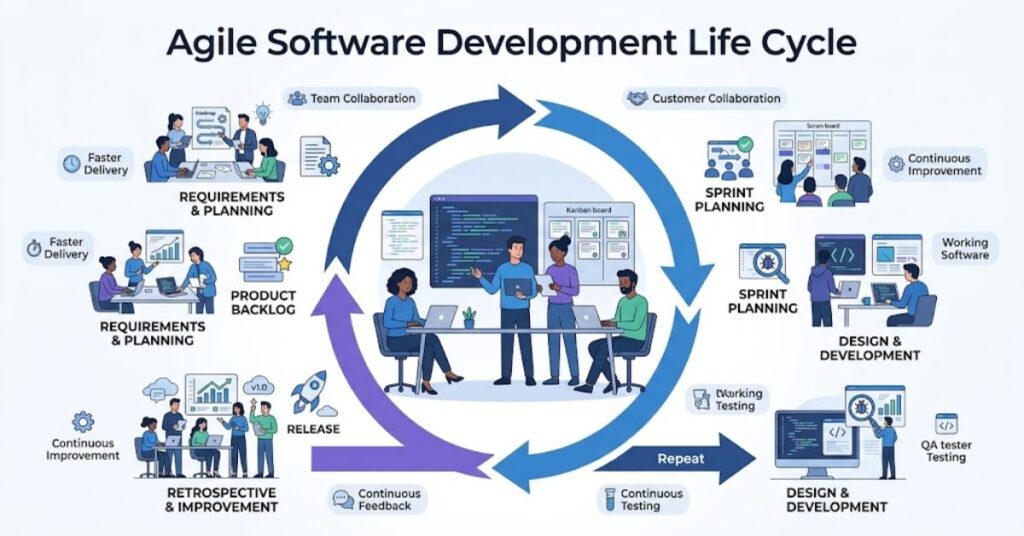
The agile life cycle differs from a rigid sequential model because teams repeat important activities.
Planning and Discovery
Teams define the product vision, business goals, target users, and major requirements.
They create an initial backlog and prioritize the most valuable work.
Design and Development
Designers and developers collaborate on selected requirements. Developers then implement small features.
Teams avoid building unnecessary complexity before they understand actual user needs.
Testing
Testing happens throughout development rather than only at the end.
Automated tests can check application behavior repeatedly. Manual testing remains useful for exploratory scenarios, usability, and situations that require human judgment.
Review and Feedback
The team demonstrates working functionality to stakeholders or customers.
Feedback can reveal:
- Missing requirements.
- Usability problems.
- Technical issues.
- Changing business needs.
- New opportunities.
Release and Improvement
The team releases useful functionality when it meets the required quality standards.
Afterward, developers continue monitoring the product and improving it.
This cycle creates a continuous path from idea to feedback and improvement.
Roles in Agile Teams
Agile teams need clear responsibilities even when they use flexible processes.
The Product Owner usually manages product priorities and helps maximize product value.
Developers design, build, test, and maintain the product.
The Scrum Master, in a Scrum environment, helps the team understand Scrum, remove obstacles, and improve its effectiveness.
Other professionals can also contribute:
- UX/UI designers.
- QA engineers.
- Security specialists.
- DevOps engineers.
- Data engineers.
- Technical writers.
- Business analysts.
- Architects.
Modern teams often operate as cross-functional groups. This reduces unnecessary handoffs and allows problems to move toward resolution faster.
Agile Software Development Tools and Technologies
Agile teams rely on digital tools to manage work, communication, source code, testing, and deployment.
Common tool categories include:
| Tool Category | Main Purpose |
| Project management | Track tasks, priorities, and progress |
| Backlog management | Organize product requirements |
| Version control | Manage source-code changes |
| CI/CD platforms | Automate build and deployment workflows |
| Testing tools | Automate software verification |
| Communication tools | Support team collaboration |
| Documentation tools | Store technical and product knowledge |
| Monitoring tools | Track application health and performance |
Teams should select tools based on their actual workflow.
More software does not automatically create a more agile team. In fact, excessive tools can increase complexity.
TechCrebia’s productivity software guide also explains how software can support organization, communication, planning, and efficient work.
Benefits of Agile Software Development
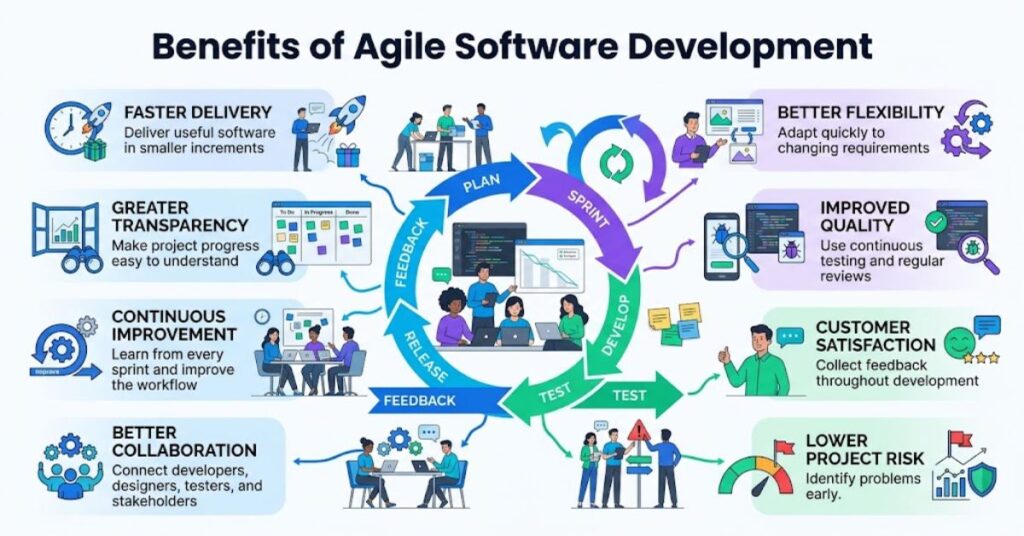
Agile software development offers several practical benefits.
Faster feedback: Customers can review working features before the entire product reaches completion.
Greater flexibility: Teams can change priorities when business conditions change.
Better visibility: Regular reviews help stakeholders understand actual progress.
Early risk detection: Small development cycles expose technical and product problems earlier.
Improved collaboration: Cross-functional teams communicate frequently.
Continuous improvement: Retrospectives help teams identify process problems.
Better customer alignment: Regular feedback helps teams build features that address real needs.
For example, an AI startup may discover that customers prefer document summarization over an initially planned chatbot feature. An agile team can adjust the backlog and direct future development toward the higher-value capability.
Agile does not guarantee success. Strong leadership, technical quality, realistic planning, and effective communication still matter.
Common Agile Software Development Challenges
Agile can fail when organizations adopt its terminology without adopting its principles.
One common mistake involves turning daily meetings into status reports. A Daily Scrum should help developers inspect progress toward the Sprint Goal and adapt their plan when needed.
Another mistake involves changing priorities constantly. Agile welcomes change, but uncontrolled changes can prevent teams from finishing meaningful work.
Other problems include:
- Creating oversized user stories.
- Ignoring technical debt.
- Measuring teams only by story points.
- Skipping testing to meet deadlines.
- Holding retrospectives without acting on findings.
- Adding unnecessary meetings.
- Treating Scrum as a rigid checklist.
- Allowing stakeholders to bypass prioritization.
- Starting too much work simultaneously.
- Ignoring security and performance.
A mature agile team balances speed with engineering quality.
When teams face software-related problems, structured troubleshooting matters as well. TechCrebia’s software update troubleshooting guide demonstrates how checking connectivity, storage, compatibility, and system conditions can help isolate software issues.
Agile Software Development vs Waterfall
Agile and Waterfall use different approaches to planning and delivery.
| Feature | Agile | Waterfall |
| Planning | Iterative | Usually sequential |
| Requirements | Can evolve | Usually defined early |
| Delivery | Frequent increments | Often later in the project |
| Feedback | Continuous | Often concentrated at milestones |
| Change | Expected and managed | Usually more expensive later |
| Testing | Throughout development | Often follows major development stages |
| Customer involvement | Regular | Often lower during implementation |
| Best fit | Changing requirements | Stable requirements |
Neither approach works best for every situation.
A project with stable requirements, strict contractual boundaries, and predictable deliverables may benefit from a more sequential approach.
A product with uncertain requirements and frequent customer feedback may benefit more from agile software development.
Teams can also combine approaches when project constraints demand it.
Best Practices for Agile Software Development

Build Small, Valuable Increments
Break large requirements into manageable pieces.
A good increment should provide meaningful value and meet the team’s quality expectations.
Keep the Backlog Healthy
A backlog should reflect current priorities. Remove obsolete items and clarify upcoming work.
Automate Repetitive Testing
Automated testing can reduce repetitive manual effort and provide rapid feedback after code changes.
Protect Technical Quality
Do not sacrifice architecture, security, maintainability, or testing simply to increase short-term delivery speed.
Use Data Carefully
Track useful indicators such as:
- Lead time.
- Cycle time.
- Deployment frequency.
- Defect trends.
- Reliability.
- Customer outcomes.
Avoid using one metric as a complete measure of developer performance.
Make Retrospectives Actionable
A retrospective should produce useful learning. Teams should choose a small number of improvements and actually implement them.
Keep Customers Involved
Customer feedback should influence priorities throughout development.
Combine Agile With DevOps
Continuous integration, automated deployment, infrastructure automation, observability, and reliable release processes can strengthen agile delivery.
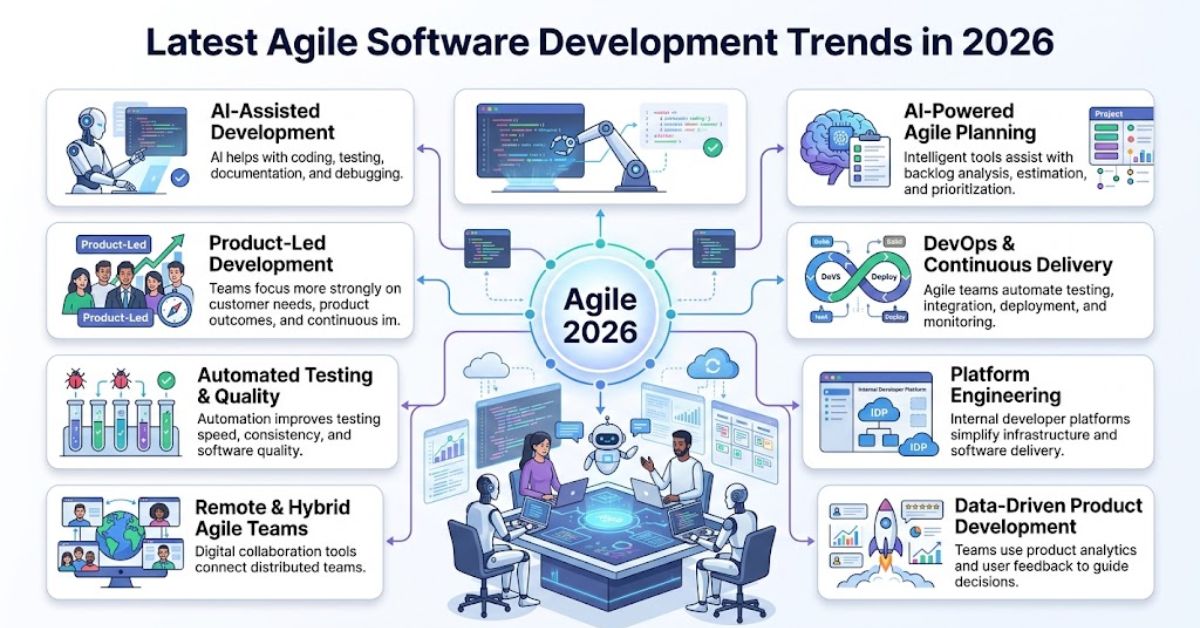
Latest Agile Software Development Trends in

Agile continues to evolve as software engineering changes.
AI-assisted development now supports coding, test generation, documentation, code review, debugging, and requirements analysis. Teams still need human review because generated code can introduce errors, security problems, or incorrect assumptions.
AI-native agile workflows are also emerging. Recent research explores models in which AI becomes a more active participant in planning, coordination, knowledge management, and software delivery rather than acting only as a coding assistant.
Platform engineering also influences agile delivery. Internal developer platforms can provide standardized deployment, infrastructure, security, and observability capabilities.
Continuous delivery continues to reduce the gap between development and production. Smaller releases can reduce release risk when teams maintain strong automated testing and monitoring.
Product-led development puts stronger emphasis on measurable customer outcomes instead of simply completing a predetermined feature list.
Remote and distributed collaboration remains important. Agile teams increasingly depend on digital boards, video meetings, asynchronous documentation, collaborative design tools, and automated workflows.
The future of agile software development will likely focus less on rigid ceremonies and more on fast learning, reliable delivery, engineering quality, customer outcomes, and intelligent automation.
Key Takeaways
- Agile software development delivers software through iterative and incremental cycles.
- Agile values people, working software, customer collaboration, and adaptability.
- Scrum, Kanban, XP, and Lean provide different ways to apply agile thinking.
- Agile teams need clear priorities and frequent feedback.
- Testing should happen throughout development.
- Agile does not mean removing planning or documentation.
- Strong technical quality remains essential.
- Teams should avoid unnecessary meetings and excessive process.
- Metrics should measure delivery and outcomes rather than create unhealthy pressure.
- AI is becoming an important part of modern agile development workflows.
- Agile works best when teams adopt its principles instead of simply copying its ceremonies.
Conclusion
Agile software development gives technology teams a practical way to manage changing requirements, deliver value sooner, and learn from real feedback.
Its biggest strength comes from adaptability. Teams do not need to predict every future requirement before development begins. They can build, test, learn, and improve.
However, agile does not automatically create better software. Teams still need skilled developers, thoughtful product leadership, strong testing, secure architecture, reliable infrastructure, and clear communication.
The best agile teams focus on outcomes rather than ceremonies. They use Scrum, Kanban, XP, DevOps, automation, and AI where those practices solve real problems.
As software development becomes more AI-assisted and continuously delivered, the core agile idea remains valuable: build useful software, learn from feedback, and improve continuously.
FAQs
What is agile software development?
Agile software development is an iterative approach that helps teams build, test, release, and improve software in small increments.
What are the four Agile values?
The four values prioritize individuals and interactions, working software, customer collaboration, and responding to change.
Is Scrum the same as Agile?
No. Agile represents a broader set of values and principles, while Scrum provides a specific framework for managing complex work.
What is an Agile Sprint?
A Sprint is a fixed-length period in Scrum during which a team works toward creating a valuable product increment.
Is Agile better than Waterfall?
Neither approach always works better. Agile suits changing requirements, while Waterfall can fit projects with stable and well-defined requirements.
Can Agile work with DevOps?
Yes. Agile and DevOps can complement each other by combining iterative development with automation, continuous integration, deployment, monitoring, and operations practices.
Does Agile eliminate documentation?
No. Agile teams still create useful documentation when it supports development, maintenance, compliance, security, or knowledge sharing.
How does AI affect agile software development?
AI can assist with coding, testing, documentation, analysis, and planning, but teams still need human judgment, validation, security reviews, and product oversight.
SEO Tags
- agile software development
- agile development
- agile methodology
- agile software development life cycle
- Scrum
- Kanban
- agile project management
- software development methodology
- agile development tools
- software engineering
Internal Linking Suggestions with Anchor Text
- Difference Between Software and Hardware — https://techcrebia.com/difference-between-software-and-hardware/
- Productivity Software Guide — https://techcrebia.com/productivity-software/
- PhysX System Software — https://techcrebia.com/physx-system-software/
- Samsung J7 Software Update Guide — https://techcrebia.com/samsung-j7-software-update-guide/
- Samsung Galaxy J7 Update Software — https://techcrebia.com/samsung-galaxy-j7-update-software/
Authoritative External References
- Agile Manifesto — Agile Manifesto
- Official Scrum Guide — Scrum Guide
Social Media Title
Agile Software Development: Complete 2026 Guide