





Quick Answer
A principal software engineer is a senior technical leader who solves complex engineering problems, guides architecture, influences multiple teams, and helps shape long-term technology strategy.
Unlike an engineering manager, the role usually focuses on technical leadership rather than direct people management.
Strong skills in system design, coding, communication, architecture, mentoring, and business judgment help engineers reach this level.
Author Information
Author: Gulnaz Malik
Role: Founder, Publisher & Technology Content Specialist
Experience: 5+ Years in Technology, AI, Software & Digital Innovation
Content Review: All content follows Google’s latest EEAT guidelines and includes fact-checked information from official documentation, trusted technology sources, industry reports, and practical research to ensure accuracy, reliability, and up-to-date insights.
Introduction
Software teams need more than developers who can write good code. Large products also need engineers who can understand complex systems, make difficult technical decisions, and guide several teams toward a common solution.
That responsibility often belongs to a principal software engineer.
A principal software engineer usually sits near the top of the individual contributor engineering path. This professional combines deep technical knowledge with broad organizational influence.
They may design distributed systems, review architecture, solve production problems, mentor senior engineers, and help product leaders understand technical trade-offs.
The role can look different from one company to another. Some organizations expect principals to write production code regularly. Others expect them to spend more time on architecture, technical strategy, and cross-team leadership.
This guide explains the role from beginner to advanced level. You will learn about responsibilities, skills, qualifications, salary factors, career progression, daily work, common mistakes, and the future of the profession.
Table of Contents
- What Is a Principal Software Engineer?
- What Does a Principal Software Engineer Do?
- Principal Software Engineer vs Senior Software Engineer
- Principal Software Engineer vs Engineering Manager
- Skills Required for a Principal Software Engineer
- Education and Experience Requirements
- Tools and Technologies
- How to Become a Principal Software Engineer
- Salary and Job Outlook
- Common Challenges and Mistakes
- Best Practices for Success
- Latest Trends in Principal Software Engineering
- Key Takeaways
- Conclusion
- FAQs
- SEO Tags
- Internal Linking Suggestions
- Authoritative External References
- Social Media Title
What Is a Principal Software Engineer?
A principal software engineer is a highly experienced engineer who provides technical direction across important systems, products, or engineering teams.
The word principal usually indicates broad scope. A senior engineer may own a large feature or service. A principal engineer often influences several services, teams, or product areas.
The role usually remains an individual contributor (IC) position. That means the engineer can lead technically without becoming a people manager.
A principal engineer might answer questions such as:
- Which architecture should the company use?
- How can the platform handle ten times more traffic?
- Should the team build or buy a critical component?
- How should several services communicate?
- How can engineers reduce reliability risks?
- Which technical debt deserves immediate attention?
- How can teams create a consistent engineering standard?
For example, imagine an online marketplace that struggles during major sales events. A principal software engineer might investigate database bottlenecks, service dependencies, caching, observability, and deployment processes.
They could then create an architecture strategy that allows several teams to improve scalability without rewriting the entire platform.
The role therefore combines technical depth, strategic thinking, communication, and influence.
Current principal-level job descriptions also show this broad scope. For example, a current OpenAI principal engineering role emphasizes architecture, hands-on implementation, reliability, security, observability, cross-functional influence, and end-to-end product ownership.
For a foundation in how software works alongside physical computing components, TechCrebia’s guide on the difference between software and hardware provides useful background.
What Does a Principal Software Engineer Do?
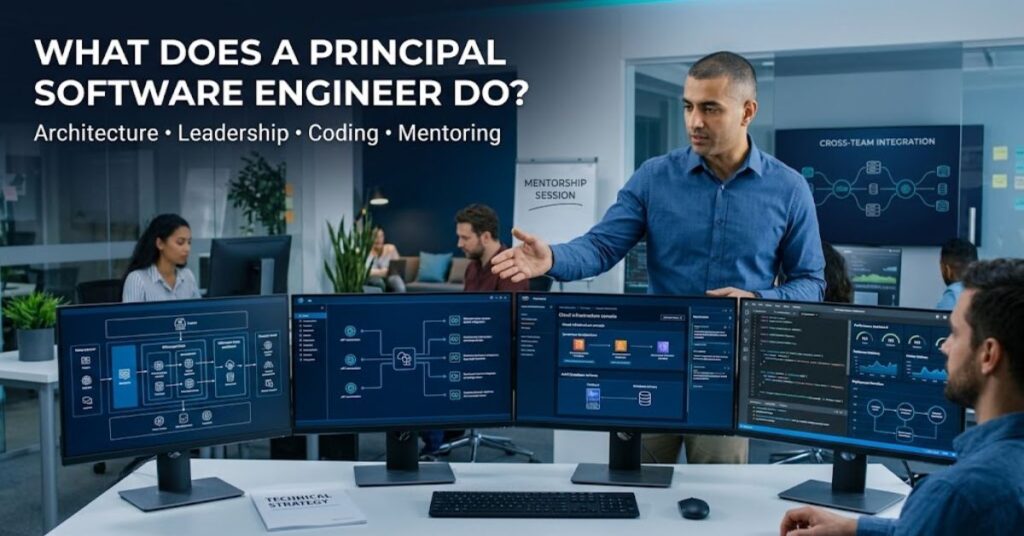
A principal software engineer usually works on problems that require more experience and broader judgment than ordinary feature development.
The exact responsibilities depend on the company, product, and engineering organization.
Architecture and System Design
Principals design systems that need scalability, reliability, security, and maintainability.
They evaluate:
- Service architecture
- APIs
- Databases
- Caching
- Messaging systems
- Cloud infrastructure
- Data pipelines
- Authentication
- Authorization
- Monitoring
- Disaster recovery
They also document important architectural decisions so future engineers understand why the team selected a particular approach.
Technical Strategy
A principal engineer helps define long-term technical direction.
For example, a company might have several applications that use different authentication systems. A principal could develop a unified identity strategy that improves security and reduces duplicated engineering work.
Cross-Team Leadership
Principals often work across organizational boundaries.
They may coordinate engineers from backend, frontend, infrastructure, security, data, and product teams.
They do not necessarily manage these engineers. Instead, they create technical alignment and help teams make informed decisions.
Hands-On Engineering
The title does not automatically mean that the engineer stops coding.
Many principal engineers still write code, build prototypes, review pull requests, debug production systems, and test architectural ideas.
The balance changes according to the organization.
Mentoring
Principal engineers help experienced developers grow.
They may review designs, explain architectural trade-offs, lead technical discussions, and teach engineers how to approach complex problems.
Reliability and Operations
A principal engineer also considers what happens after deployment.
They think about:
- Monitoring
- Logging
- Alerting
- Incident response
- Performance
- Capacity planning
- Rollbacks
- Backups
- Security
- Failure recovery
This broader perspective separates principal-level engineering from simply writing more complex code.
Principal Software Engineer vs Senior Software Engineer
These titles often overlap, but the scope usually differs.
| Area | Senior Software Engineer | Principal Software Engineer |
| Scope | Team or major project | Multiple teams or systems |
| Coding | High | High to moderate |
| Architecture | Major features | Organization-level systems |
| Leadership | Team-focused | Cross-team |
| Mentoring | Junior and mid-level engineers | Senior and experienced engineers |
| Strategy | Project level | Long-term technical direction |
| Influence | Primarily within team | Across organization |
| Problem complexity | High | Very high and ambiguous |
A senior engineer may own the architecture for a service. A principal engineer may determine how that service should interact with ten other services.
The distinction does not depend only on years of experience. Scope and measurable impact matter more than the title.
Principal Software Engineer vs Engineering Manager
A principal software engineer and engineering manager can both provide leadership, but they usually focus on different areas.
| Role | Primary Focus |
| Principal Software Engineer | Technical direction and engineering impact |
| Engineering Manager | People, delivery, hiring, performance, and team health |
An engineering manager may conduct one-to-one meetings, manage hiring, support career development, and coordinate team execution.
A principal engineer may spend that same time designing architecture, solving technical risks, reviewing system proposals, or guiding several engineering teams.
Neither path represents a higher version of the other. They represent different leadership directions.
Skills Required for a Principal Software Engineer
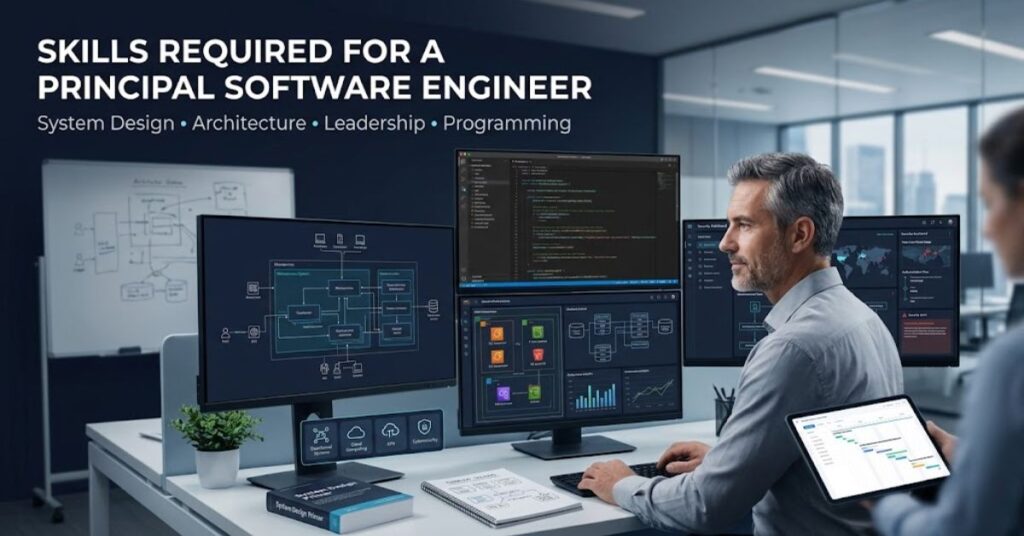
A principal software engineer needs more than advanced programming knowledge. The role requires a combination of technical and leadership skills.
Technical Skills
- System design: Design scalable and maintainable systems.
- Architecture: Understand architectural patterns and trade-offs.
- Programming: Maintain strong knowledge of one or more programming languages.
- Databases: Understand relational and NoSQL database design.
- Cloud computing: Work comfortably with modern cloud platforms.
- Distributed systems: Understand communication, consistency, availability, and failure handling.
- Security: Build secure systems and identify technical risks.
- Performance engineering: Find and remove bottlenecks.
- Testing: Build reliable testing strategies.
- Observability: Use logs, metrics, traces, and alerts effectively.
TechCrebia’s Google software engineer salary guide also provides useful context about engineering levels, compensation, and skills that support advancement in large technology organizations.
Leadership Skills
- Clear communication
- Technical writing
- Negotiation
- Mentoring
- Conflict resolution
- Decision-making
- Strategic thinking
- Stakeholder management
- Business awareness
- Risk management
Technical expertise alone cannot make someone an effective principal engineer.
A great principal engineer can explain a complicated architecture to developers, executives, product managers, and nontechnical stakeholders in language each group understands.
Education and Experience for Principal Software Engineers
Many software engineers begin with a bachelor’s degree in computer science, software engineering, information technology, mathematics, or a related field.
However, companies often evaluate senior engineers through experience and demonstrated impact rather than education alone.
The U.S. Bureau of Labor Statistics reports that software developers typically need a bachelor’s degree, while also highlighting programming, analytical thinking, communication, creativity, and problem-solving as important qualities. (Bureau of Labor Statistics)
Principal roles normally require substantial professional experience because engineers need time to develop technical judgment.
A typical progression may look like:
- Junior Software Engineer
- Software Engineer
- Senior Software Engineer
- Staff or Lead Engineer
- Principal Software Engineer
- Distinguished Engineer or Fellow
Not every organization uses this exact ladder.
Some companies use different titles. Others move engineers from senior directly into principal-level responsibilities.
The important point is simple: you should demonstrate principal-level impact before you expect a principal-level title.
Tools and Technologies for Principal Software Engineers
Principal engineers rarely specialize in every technology. Instead, they understand how different technologies fit together.
Common technology areas include:
| Area | Examples |
| Languages | Java, Python, Go, C#, JavaScript, TypeScript, C++ |
| Cloud | AWS, Azure, Google Cloud |
| Containers | Docker, Kubernetes |
| Databases | PostgreSQL, MySQL, MongoDB, Redis |
| Messaging | Kafka, RabbitMQ, cloud messaging services |
| Version control | Git |
| CI/CD | GitHub Actions, GitLab CI, Jenkins |
| Observability | OpenTelemetry, Prometheus, Grafana |
| Infrastructure | Terraform and cloud-native tools |
| Collaboration | Jira, Confluence, documentation platforms |
The exact stack matters less than the engineer’s ability to understand architecture and trade-offs.
For example, a principal engineer does not need to memorize every Kubernetes feature. They need to understand when container orchestration makes sense, what operational risks it creates, and how it affects cost, reliability, security, and developer productivity.
How to Become a Principal Software Engineer

Becoming a principal software engineer requires deliberate career development.
Build Strong Engineering Fundamentals
Start with programming, algorithms, data structures, databases, networking, operating systems, testing, and version control.
Strong fundamentals help you reason about unfamiliar systems.
Develop System Design Expertise
Learn how real systems handle:
- High traffic
- Distributed workloads
- Data consistency
- Failures
- Security
- Latency
- Availability
- Large data volumes
Do not only memorize system design interview diagrams. Build systems and study how they behave under real conditions.
Expand Your Scope
Start taking responsibility beyond individual tickets.
Volunteer for problems that affect several services or teams.
For example, instead of fixing one API’s slow response, investigate whether shared caching, database queries, service dependencies, or infrastructure create the larger performance problem.
Learn to Write Technical Proposals
Strong technical writing creates organizational leverage.
A good design document should explain:
- The problem
- Current limitations
- Proposed solution
- Alternatives
- Trade-offs
- Risks
- Rollout strategy
- Success measurements
Mentor Other Engineers
Help other engineers solve difficult problems without taking ownership away from them.
Your goal should involve making the entire engineering organization stronger.
Connect Technology With Business Results
Principal engineers need business awareness.
A technically perfect system can still fail if it costs too much, delays a product launch, or solves a problem customers do not have.
Always ask:
What business or customer problem does this technical decision solve?
Build a Track Record of Impact
Keep evidence of your contributions.
Examples include:
- Reduced infrastructure costs
- Improved system latency
- Increased service reliability
- Simplified architecture
- Reduced deployment failures
- Improved developer productivity
- Removed major technical risks
Impact gives your promotion case much more strength than a long list of technologies.
Principal Software Engineer Salary and Job Outlook
Principal software engineer salaries vary significantly by company, location, industry, experience, specialization, and total compensation structure.
Employers may combine:
- Base salary
- Performance bonus
- Equity
- Retirement benefits
- Sign-on bonuses
- Other benefits
Because companies use different leveling systems, you should avoid treating a single salary number as a universal principal-engineer salary.
For broader software-development employment, the U.S. Bureau of Labor Statistics currently projects 10% employment growth for software developers, quality assurance analysts, and testers from 2025 to 2035. It also reports a $135,980 median annual wage for software developers in May 2025. These figures cover the broader occupation, not specifically principal software engineers. (Bureau of Labor Statistics)
Demand should remain strong in areas such as AI, cloud platforms, cybersecurity, automation, distributed systems, and connected devices.
TechCrebia’s productivity software guide also explains how modern software supports automation and collaboration across different workplaces.
Common Challenges for Principal Software Engineers
Principal-level work comes with unique challenges.
Solving the Wrong Problem
Experienced engineers can sometimes become too focused on elegant technical solutions.
Before designing anything, confirm that the problem actually matters.
Overengineering
Do not introduce distributed architecture, microservices, or complex infrastructure simply because the technology looks impressive.
Choose the simplest solution that meets current and expected requirements.
Ignoring People
Technical leadership still involves people.
A technically strong proposal can fail if the engineer communicates poorly or ignores the concerns of teams that must implement it.
Becoming a Bottleneck
A principal engineer should not become the only person who can make technical decisions.
Document knowledge. Mentor engineers. Create reusable patterns.
Chasing Every New Technology
AI, cloud platforms, programming languages, and developer tools change quickly.
Do not adopt technology simply because it is popular.
Evaluate its value, maturity, security, cost, and long-term maintenance requirements.
Focusing Only on Code
Coding remains valuable, but principal-level impact extends beyond individual code contributions.
Architecture, mentoring, technical strategy, communication, and organizational influence become increasingly important.
Best Practices for Principal Software Engineers
A strong principal software engineer follows a few consistent practices.
- Start with the customer or business problem.
- Prefer simple architecture when it meets requirements.
- Document major technical decisions.
- Measure performance before optimizing.
- Design for failure.
- Treat security as a core requirement.
- Automate repetitive engineering work.
- Share knowledge across teams.
- Review architecture without blocking delivery.
- Build strong relationships with product and engineering leaders.
- Use metrics to demonstrate technical impact.
- Keep learning without chasing every trend.
A useful principle is:
Increase the effectiveness of other engineers, not just your own output.
That mindset creates lasting technical leadership.
Latest Trends in Principal Software Engineering
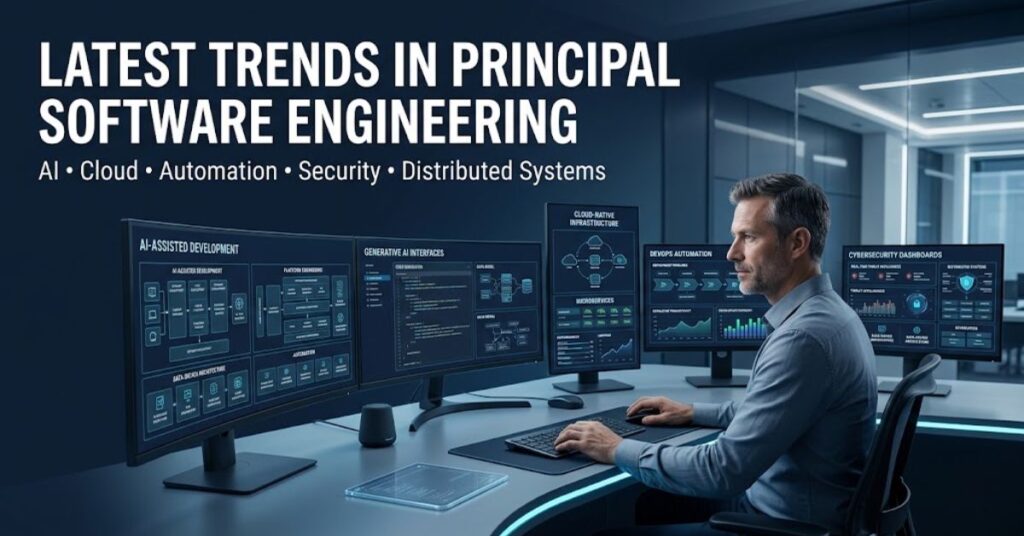
The principal software engineer role continues to evolve as technology becomes more complex.
AI-Assisted Engineering
AI coding assistants can accelerate development, testing, documentation, and debugging.
Principal engineers now need to evaluate where AI can improve productivity without weakening security, code quality, privacy, or architectural discipline.
AI and Distributed Systems
AI applications introduce new architecture challenges involving model inference, data pipelines, vector search, evaluation, observability, and cost management.
Principal engineers increasingly need to understand these systems even when they do not work directly as machine learning engineers.
Platform Engineering
Organizations continue building internal platforms that help developers deploy and operate software more efficiently.
Principal engineers can influence platform standards, developer experience, reliability, and reusable infrastructure.
Security by Design
Security increasingly affects architecture from the beginning of a project.
Principal engineers must consider identity, authorization, secrets, supply-chain security, data protection, and secure deployment practices during system design.
Developer Productivity
Engineering organizations increasingly measure build times, deployment frequency, incident rates, developer experience, and delivery friction.
Principal engineers can use these signals to identify improvements that benefit many teams.
Responsible Technology Decisions
Technical leaders now face questions about privacy, AI reliability, energy usage, accessibility, compliance, and responsible data handling.
The principal role therefore requires broader judgment than traditional software architecture alone.
Key Takeaways
- A principal software engineer provides high-level technical leadership.
- The role usually follows the individual contributor career path.
- Principals influence multiple teams, systems, or product areas.
- System design and architecture represent core responsibilities.
- Strong communication matters as much as technical knowledge.
- Principal engineers may continue writing production code.
- The role differs from engineering management because it emphasizes technical leadership.
- Demonstrated impact matters more than simply counting years of experience.
- AI, cloud, security, distributed systems, and platform engineering create important opportunities.
- Great principals improve the effectiveness of other engineers and the wider organization.
Conclusion
A principal software engineer represents one of the most advanced technical career paths in software development.
The role goes far beyond writing difficult code. A principal engineer solves ambiguous problems, designs reliable systems, influences architecture, mentors experienced engineers, and connects technical decisions with business outcomes.
You do not reach this level simply by learning more programming languages. You reach it by developing strong judgment, expanding your scope, communicating clearly, and repeatedly delivering meaningful technical impact.
If you want to pursue this career, focus on system design, architecture, distributed systems, security, cloud technologies, technical writing, mentoring, and business understanding. Most importantly, learn to solve problems that affect more than your immediate team.
The strongest principal engineers create systems that last and help other engineers do their best work.
FAQs
1. What is a principal software engineer?
A principal software engineer is a senior technical leader who guides architecture, solves complex problems, and influences multiple engineering teams or systems.
2. Is a principal software engineer a manager?
Usually, no. Many principal engineers follow an individual contributor path and lead through technical expertise rather than direct people management.
3. How many years does it take to become a principal software engineer?
There is no fixed timeline. Engineers usually need substantial experience and a strong record of broad technical impact.
4. What skills does a principal software engineer need?
Key skills include system design, architecture, programming, cloud computing, security, communication, mentoring, decision-making, and strategic thinking.
5. Does a principal software engineer still write code?
Yes. Many principals continue coding, prototyping, debugging, and reviewing production code, although their work often covers a broader scope.
6. Is principal engineer higher than senior engineer?
In many organizations, principal represents a higher technical level than senior. However, titles and leveling systems vary between companies.
7. What is the difference between principal engineer and engineering manager?
A principal engineer usually leads through technical direction, while an engineering manager focuses more on people, delivery, hiring, and team operations.
8. Can a software engineer become a principal engineer without a master’s degree?
Yes. Many organizations value demonstrated engineering experience, technical impact, and leadership more than an advanced academic degree.
SEO Tags
- Principal Software Engineer
- Principal Engineer Career
- Principal Software Engineer Skills
- Principal Software Engineer Salary
- Software Engineering Career
- Senior Software Engineer
- Software Architecture
- System Design
- Technical Leadership
- Engineering Career Path
Internal Linking Suggestions With Anchor Text
- Software and Hardware Differences — Link to TechCrebia’s difference between software and hardware guide.
- Google Software Engineer Salary — Link to the Google software engineer salary guide.
- Productivity Software Guide — Link to the productivity software guide.
- Fan Controller RGB Software — Link to the fan controller RGB software guide.
- PhysX System Software — Link to the PhysX system software guide.
Authoritative External References
- U.S. Bureau of Labor Statistics — Software Developers, Quality Assurance Analysts, and Testers
- OpenAI — Principal Software Engineer Role
Social Media Title
Principal Software Engineer: Skills, Salary & Career Path 2026