


In this software reverse engineering guide, Reverse engineering is the process of analyzing a software system to identify its components, interrelationships, and underlying design principles without having access to the source code or design documentation.
While traditional software development moves forward from requirements to code (forward engineering), reverse engineering works backward moving from a compiled binary, executable, or legacy system to system architecture, data models, and logic specifications.
What Is Software Reverse Engineering?
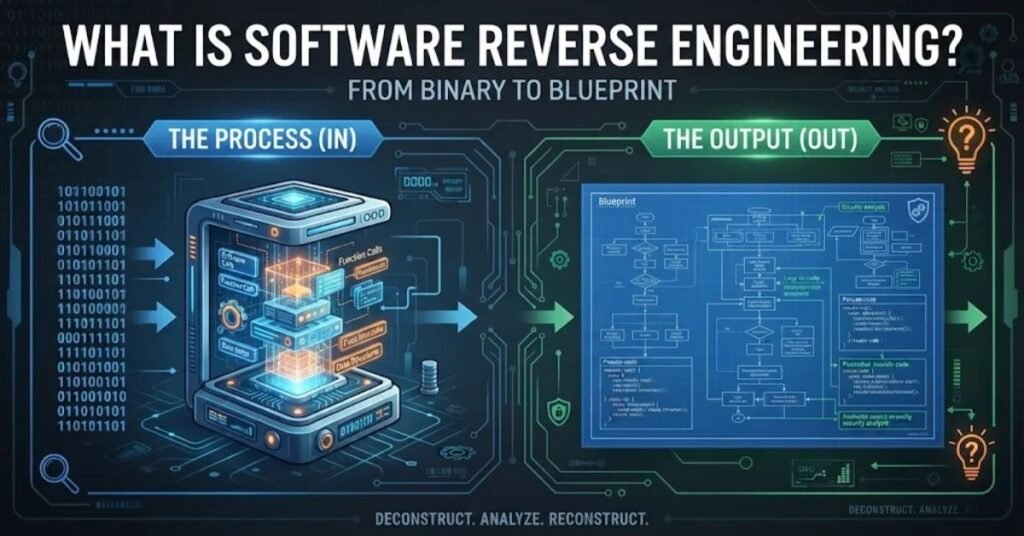
In software engineering, as highlighted in this software reverse engineering guide, reverse engineering involves breaking down a finished software application to inspect its internal structure, binary code, network interactions, and execution flow.
In software engineering, reverse engineering involves breaking down a finished software application to inspect its internal structure, binary code, network interactions, and execution flow. Software Reengineering.
It is frequently utilized when documentation is lost, when integrating proprietary file formats, during malware analysis, or as part of a formal software reengineering pipeline to o modernize legacy systems.
Unlike malicious tampering, professional software reverse engineering focuses on system understanding, interoperability, vulnerability assessment, and design recovery.
How Software Reverse Engineering Works
The reverse engineering process generally follows a structured, analytical workflow:
- Acquisition and Preparation: Gathering the target binary, executable package, or system deployment artifacts in a secure, isolated testing environment (such as a virtual machine or sandbox).
- Static Analysis: Auditing raw binary files and software components passively without triggering live execution. This includes examining file headers, metadata, strings, imported functions, and export tables.
- Dynamic Analysis: Observing the software during execution. Engineers monitor runtime behaviors, memory allocations, registry updates, API calls, and network traffic using specialized debuggers.
- Decompilation and Disassembly: Translating machine-level binary code back into human-readable assembly language or pseudo-code (such as C-like structures) to interpret algorithmic logic.
- Design Recovery: Reconstructing architectural diagrams, data flow models, and functional specifications based on insights gathered during analysis.
Core Objectives & Use Cases
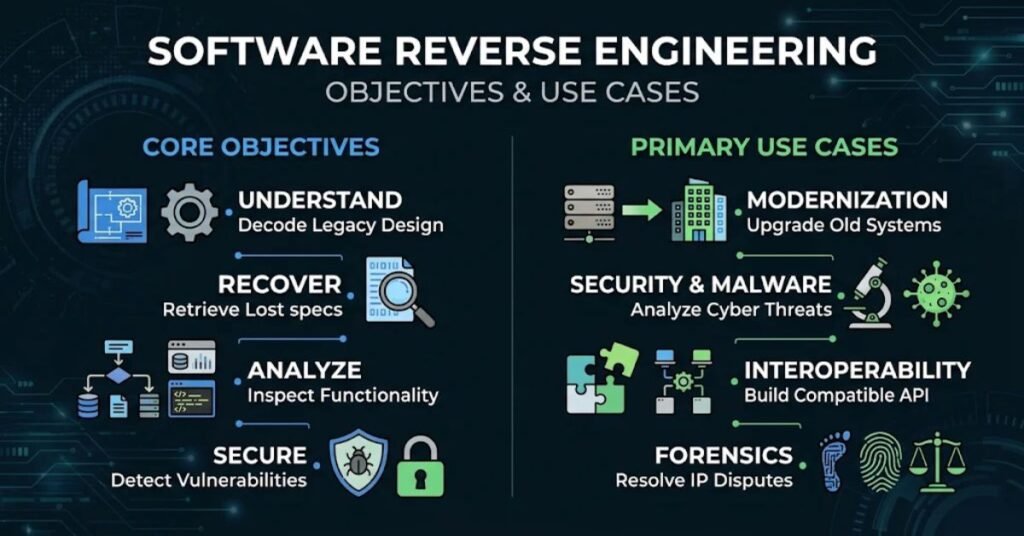
Development and security teams apply reverse engineering across several critical domains:
- Legacy System Modernization: Recovering lost documentation and business logic from outdated applications before initiating structural refactoring or migration.
- Security Auditing and Malware Analysis: Dissecting malicious payloads or zero-day exploits to understand how they compromise systems and to build protective countermeasures. NIST software security guidelines
- Interoperability and Protocol Analysis: Analyzing closed APIs, proprietary file formats, or network protocols to allow older software to communicate with modern platforms.
- Vulnerability Assessment: Checking commercial or open-source dependencies for hidden flaws, backdoors, or insecure cryptographic implementations.
Software Reverse Engineering Guide: Key Techniques & Methods
Software analysts rely on distinct analytical methodologies depending on their primary objective:
- Disassembly vs. Decompilation: Disassembly converts machine code into low-level assembly instructions, whereas decompilation attempts to reconstruct high-level language constructs (like loops and conditional statements).
- Binary Instrumentation: Injecting monitoring code into an application runtime to track function execution paths and data variables without altering the core executable permanently.
- Network Traffic Sniffing: Intercepting and inspecting packets exchanged between a client application and a remote server to map out undocumented communication schemas.
Essential Tools Used by Engineers
Professional analysts and security researchers use robust toolsets to dissect software artifacts safely:
- Disassemblers and Decompilers: IDA Pro, Ghidra, and Cutter help transform raw binaries into readable control flow graphs and pseudo-code.
- Interactive Debuggers: x64dbg, GDB (GNU Debugger), and LLDB allow developers to pause code execution, step through instructions line-by-line, and inspect CPU registers.
- Network Analyzers: Wireshark and Burp Suite capture and parse application-layer network traffic.
Advantages and Limitations
Advantages of Software Reverse Engineering
- Unlocks critical insights into legacy applications that lack official documentation.
- Strengthens enterprise cybersecurity postures by identifying hidden vulnerabilities.
- Enables software compatibility and interoperability across closed platforms.
Limitations of Software Reverse Engineering
- Highly time-consuming and demands advanced proficiency in computer architecture and assembly language.
- Obfuscation techniques, code packing, and anti-debugging mechanisms intentionally complicate analysis.
- Legal boundaries strictly govern what can be reverse-engineered, limiting its commercial application scope.
Legal and Ethical Considerations
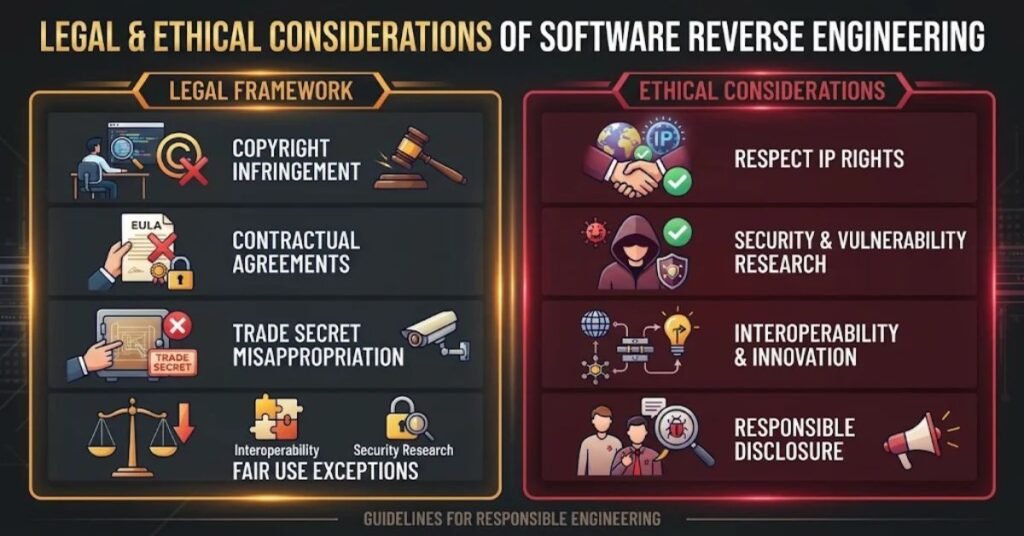
Reverse engineering occupies a complex legal landscape.
As outlined in this software reverse engineering guide, While security research, interoperability analysis, and bug hunting are widely protected under specific legal exemptions (such as the Digital Millennium Copyright Act in the US or similar interoperability directives in the EU), unauthorized reverse engineering to bypass copyright protection, steal intellectual property, or violate software End User License Agreements (EULAs) remains strictly illegal.
Developers must always verify authorization boundaries before analyzing third-party applications.
Key Takeaways
- Reverse engineering analyzes compiled software to uncover internal architecture, data flows, and logic without source code.
- The process combines static analysis (inspecting files without execution) and dynamic analysis (monitoring runtime behavior).
- Common applications include legacy system modernization, malware analysis, vulnerability assessment, and protocol interoperability.
- Specialized tools like Ghidra, IDA Pro, and x64dbg are essential for disassembling and debugging binary code.
- Legal compliance and ethical boundaries must always dictate the scope of any reverse engineering project.
Conclusion
Reverse engineering in software development bridges the gap between black-box executables and structural understanding. Whether used to recover architectural blueprints from outdated legacy applications or to dissect advanced security threats, it remains an indispensable skill set for security specialists and senior developers. For further reading on managing older systems, explore our guide on
Frequently Asked Questions
What is the difference between static and dynamic reverse engineering?
Static analysis inspects compiled files and strings without running the program, while dynamic analysis monitors live program behavior, memory, and API calls during execution.
Is software reverse engineering legal?
Yes, when done for security research, bug hunting, or software interoperability under legal exemptions, though bypassing copyrights or violating EULAs remains illegal.
Can reverse engineering recover exact original source code?
No, decompilers reconstruct readable pseudo-code and logic flows, while original comments, formatting, and variable names are permanently lost during compilation.
Which tools are best for beginners in reverse engineering?
Free, open-source tools like NSA’s Ghidra for decompilation and x64dbg for Windows debugging offer the best starting environment for binary analysis.
How is reverse engineering different from software reengineering?
Reverse engineering only analyzes and extracts existing system design, whereas software reengineering uses those findings to rebuild, modernize, and deploy an improved system.
Do I need to know assembly language for reverse engineering?
Yes, basic x86/x64 or ARM assembly knowledge is essential because compiled executables translate high-level code into low-level CPU instructions.