


Quick Answer
Software development methodologies are structured approaches that guide teams through planning, designing, coding, testing, and maintaining software.
They help developers organize tasks, manage project requirements, control quality, and deliver applications efficiently.
Popular approaches include Waterfall, Agile, Scrum, Kanban, Spiral, Lean, Rapid Application Development (RAD), and DevOps.
Each approach has different strengths and works better for certain project requirements.
Author Information
Author: Gulnaz Malik
Role: Founder, Publisher & Technology Content Specialist
Experience: 5+ Years in Technology, AI, Software & Digital Innovation.
Content Review: This article explains software development approaches through independent research and established software engineering concepts. Technical information is supported by recognized industry references.
Introduction
Developing reliable software requires more than writing code. Development teams must understand project requirements, organize responsibilities, manage deadlines, test features, and maintain applications after release.
Without a clear working process, projects can experience delays, communication problems, unexpected expenses, and software quality issues.
This is where software development methodologies become important. They provide structured approaches that help teams manage the complete development process.
Some approaches follow predefined stages, while others allow developers to make changes throughout the project.
For example, a company developing banking software may need detailed planning, security reviews, and strict testing. A startup building a mobile application may prefer a flexible approach that allows regular updates and customer feedback.
Different development methods support different business goals and technical requirements. Understanding their working processes helps developers, project managers, students, and business owners make better decisions.
This guide explains eight popular software development methodologies, their advantages, disadvantages, practical applications, and important differences. It also explains how to choose an appropriate approach for your next software project.
What Are Software Development Methodologies?
Software development methodologies are organized approaches that explain how development teams plan, design, build, test, release, and maintain software applications. They provide guidelines for managing project activities and help team members understand their responsibilities.
A methodology influences how developers collect requirements, divide tasks, communicate with stakeholders, review progress, and handle unexpected changes. It also helps project managers organize resources, monitor deadlines, and evaluate project results.
Consider a company developing an online shopping application. The project may include customer registration, product listings, shopping carts, payment processing, and order tracking.
The development team needs a clear approach to organize these features and complete them in a logical order.
One team may plan the entire project before starting development. Another may release basic features first and improve the application through customer feedback. Both teams can create successful software, but they follow different development approaches.
A methodology is not the same as a programming language or development tool. Python, Java, and C++ are programming languages, while Git and Visual Studio support development activities. Agile, Waterfall, and Spiral describe ways to organize software projects.
The right approach depends on project size, technical complexity, customer expectations, available resources, and the possibility of changing requirements.
Why Are Software Development Methodologies Important?

A structured development approach helps teams manage their responsibilities and complete projects more effectively. It creates a shared working process that reduces confusion between developers, testers, designers, and project managers.
Without an organized approach, developers may work on different priorities, miss important requirements, or spend time building unnecessary features. These problems can increase project costs and delay software releases.
Software development methodologies help teams avoid many of these challenges.
Better Project Planning: A methodology allows teams to divide large projects into smaller activities. Project managers can assign responsibilities, estimate resources, and establish realistic deadlines.
Improved Communication: Developers and stakeholders can understand how information should move between team members. Regular discussions help identify misunderstandings before they affect the project.
Higher Software Quality: Development approaches often include reviews, testing, and feedback. These activities help teams discover defects and improve application performance.
Effective Risk Management: Some methodologies encourage teams to identify technical problems, security concerns, and resource limitations early. This helps organizations make informed decisions.
Organized Team Responsibilities: A defined process helps everyone understand their tasks and expected results. It also makes progress easier to evaluate.
Better Customer Satisfaction: Approaches that encourage customer participation allow teams to understand user expectations and improve features according to feedback.
However, choosing a methodology does not automatically guarantee success. Teams must apply it correctly, maintain communication, and regularly evaluate their results.
Types of Software Development Methodologies
Different software development approaches address different project requirements. Some focus on detailed planning, while others emphasize flexibility, continuous improvement, rapid prototyping, or risk assessment.
The eight commonly discussed approaches include Waterfall, Agile, Scrum, Kanban, Spiral, Lean, Rapid Application Development, and DevOps.
Each approach has its own working structure and limitations. Waterfall supports sequential planning, Agile encourages iterative development, and Scrum organizes product work into Sprints. Kanban focuses on workflow visibility, while Spiral gives significant attention to risk analysis.
Lean aims to reduce unnecessary work, RAD encourages rapid prototype development, and DevOps connects software development with IT operations.
These approaches are not always mutually exclusive. Organizations can combine compatible practices when they need a process that supports their technical and business requirements.
software development methodologies Waterfall Methodology
Waterfall is a traditional software development approach that organizes project activities into sequential stages. A team generally completes one major stage before moving to the next.
The process usually begins with requirements gathering. Developers and project managers identify the application’s expected features and prepare documentation. The team then moves through system design, implementation, testing, deployment, and maintenance.
This approach provides a predictable structure because the team defines many important project details before development begins.
For example, a company developing an internal employee management system may already understand its requirements. It can document employee records, attendance tracking, payroll calculations, and reporting features before assigning development tasks.
Waterfall can work well when requirements are relatively stable and stakeholders can explain their expectations clearly.
Advantages of Waterfall
- Provides a clear sequence of development activities.
- Makes project responsibilities easier to understand.
- Supports detailed planning and documentation.
- Helps organizations estimate budgets and deadlines.
- Works well when project requirements remain stable.
Disadvantages of Waterfall
- Changes can become expensive after completing a development stage.
- Customers may not see a working product until later.
- Testing may reveal problems after significant development work.
- It offers limited flexibility when requirements change frequently.
Waterfall is still useful for projects that require predictable stages, formal documentation, and approval processes. However, teams should carefully evaluate whether its sequential structure matches their project needs.
Agile Methodology software development
Agile is an iterative approach that emphasizes collaboration, customer feedback, continuous improvement, and flexibility. Instead of waiting until an entire application is complete, teams divide development into smaller pieces of work.
Developers build selected features, test them, review the results, and make improvements. They repeat this process throughout the project.
For example, a company developing a mobile banking application may begin with account registration and balance checking. After reviewing these features, the team can improve the interface and introduce money transfers, payment options, and transaction history.
Agile became widely recognized through the Manifesto for Agile Software Development, published in 2001. Its values emphasize individuals and interactions, working software, customer collaboration, and responding to change.
The Agile Manifesto explains these values and provides the foundation for understanding Agile development.
Main Principles of Agile Development
Agile development follows several important principles that help teams deliver useful software and respond to changing requirements.
- Customer Collaboration: Developers communicate with customers and stakeholders to understand their expectations.
- Frequent Delivery: Teams aim to provide useful software in smaller increments instead of waiting for one final release.
- Continuous Improvement: Team members review their working process and identify opportunities to improve.
- Adaptability: Developers can adjust priorities when new requirements or problems appear.
- Team Communication: Developers, testers, and designers work together instead of operating in isolated departments.
- Software Quality: Testing, code reviews, and technical improvements remain important throughout development.
Advantages and Disadvantages of Agile
Agile supports flexible development and allows teams to collect feedback throughout a project. Developers can identify problems earlier, improve existing features, and respond to changing customer expectations.
However, frequent changes can create scope problems if teams do not manage priorities. Agile also requires regular communication, active stakeholder participation, and experienced team members.
Agile is particularly useful for mobile applications, websites, SaaS products, and software projects where requirements may change during development.
Scrum Methodology software development
Scrum is a lightweight framework that helps teams manage complex development work through short, fixed-length cycles called Sprints.
It is commonly used by Agile teams, but Scrum and Agile are not identical. Agile describes a set of values and principles, while Scrum provides a defined framework for organizing work.
A Scrum team selects tasks from a Product Backlog and works toward a Product Goal. During each Sprint, the team aims to produce a useful product Increment.
The official Scrum Guide explains the framework, including its accountabilities, events, and artifacts.
Main Scrum Accountabilities and Events
Scrum defines three accountabilities within a Scrum Team.
- Product Owner: Helps maximize product value and manages the Product Backlog.
- Scrum Master: Helps establish Scrum and improve the team’s effectiveness.
- Developers: Create a usable product Increment during each Sprint.
Scrum also includes important events that help teams inspect their work and adjust their plans.
- Sprint Planning: The team plans the work for the upcoming Sprint.
- Daily Scrum: Developers inspect progress and adapt their work plan.
- Sprint Review: The team and stakeholders review the completed work.
- Sprint Retrospective: Team members discuss improvements for future Sprints.
A Sprint provides a regular development cycle and helps teams maintain focus on important product goals.
Advantages and Disadvantages of Scrum
Scrum encourages teamwork, regular feedback, and clear development priorities. Its structured events help teams identify problems and evaluate progress.
However, Scrum requires discipline and active participation. Poor Sprint planning, unclear responsibilities, or unnecessary meetings can reduce productivity.
It works particularly well for product development teams that manage complex requirements and deliver software through repeated improvements.
Kanban Methodology
Kanban is a workflow management approach that helps teams visualize tasks, control ongoing work, and improve delivery flow.
It commonly uses a visual board containing columns that represent different development stages. A basic software development board may include To Do, In Progress, Code Review, Testing, and Done.
Team members move tasks between columns as work progresses. This makes unfinished activities and workflow delays easier to identify.
One important Kanban practice is limiting work in progress. It prevents developers from starting too many tasks at once and encourages them to complete existing work before taking on additional responsibilities.
For example, a software maintenance team may receive bug reports throughout the day. Kanban helps organize these requests and allows developers to handle them according to priority.
Advantages of Kanban
- Makes project progress visible to the entire team.
- Helps identify workflow bottlenecks.
- Supports continuous delivery.
- Makes changing priorities easier to manage.
- Encourages teams to finish existing work.
Disadvantages of Kanban
- Tasks may remain unfinished without clear priorities.
- Poor work-in-progress management can create delays.
- Teams need consistent workflow rules.
- It may provide less structure for projects that require fixed delivery cycles.
Kanban is useful for software maintenance, customer support, bug fixing, and development teams that manage continuous requests.
Spiral Methodology software development
The Spiral methodology combines iterative development with systematic risk analysis. It organizes software development into repeated cycles, with each cycle focusing on objectives, risk evaluation, development, and planning.
Unlike a strictly sequential process, Spiral allows teams to review decisions and improve the software through multiple development cycles.
For example, a company developing complex financial software may need to evaluate security, performance, data protection, and integration risks before expanding the application.
Each Spiral cycle helps developers identify possible problems and decide which activities should happen next.
Main Activities in the Spiral Model
- Define project objectives and requirements.
- Identify technical and business risks.
- Develop and test the selected solution.
- Evaluate the results.
- Plan the next development cycle.
Advantages of Spiral
The Spiral approach supports detailed risk assessment, encourages repeated evaluation, and allows teams to make changes as requirements become clearer.
Disadvantages of Spiral
It can require experienced risk analysts, additional planning, and higher project costs. Its complexity may also make it unsuitable for small applications.
Spiral is most appropriate for large, complex, and high-risk projects where identifying potential problems early is important.
Lean Software Development
Lean Software Development applies Lean thinking to software engineering. Its main objective is to deliver customer value while reducing unnecessary activities, delays, and waste.
Instead of focusing only on completing more tasks, Lean encourages teams to examine whether their activities contribute to the final product.
For example, developers may spend too much time attending meetings that do not help them solve technical problems. A Lean approach encourages teams to simplify communication and concentrate on useful activities.
Lean principles commonly include eliminating waste, building quality into the process, delivering quickly, respecting people, and continuously improving.
Advantages of Lean Development
Lean can reduce unnecessary work, improve productivity, support better resource management, and encourage faster feedback.
Disadvantages of Lean Development
Teams may misunderstand waste reduction and remove useful activities such as documentation, security reviews, or software testing. This can create quality problems instead of solving them.
Lean works well when organizations want to improve development efficiency without sacrificing software quality.
Rapid Application Development
Rapid Application Development (RAD) focuses on building software prototypes quickly and improving them through user feedback.
Instead of spending a long time finalizing every requirement before development begins, teams create an early working version of the application. Users review the prototype and suggest changes.
For example, a business may need a customer management application but may not know exactly how its dashboard should work. Developers can create an early prototype showing customer records, search functions, and reporting features.
Stakeholders can review the design and request adjustments before the team completes the application.
Main Activities in RAD
- Requirement Planning: Identify business needs and important application features.
- Prototype Design: Prepare an early version of the interface and functionality.
- User Feedback: Collect suggestions and identify missing features.
- Application Construction: Develop and integrate the required functions.
- Testing and Implementation: Check the completed application before release.
Advantages of RAD
RAD encourages user participation, supports rapid prototyping, and helps teams discover design problems earlier.
Disadvantages of RAD
It requires frequent stakeholder involvement and skilled developers. It may also be difficult to apply when projects have complex technical requirements or strict integration dependencies.
RAD is useful for business applications, internal tools, dashboards, and projects where users can provide regular feedback.
DevOps Methodology
DevOps brings software development and IT operations closer together. Its purpose is to improve collaboration, automate delivery activities, and make software releases more reliable.
Traditional development environments sometimes separate programmers from operations teams. Developers build applications, while operations specialists handle deployment and system maintenance. This separation can create communication problems and slow down releases.
DevOps encourages shared responsibility throughout software delivery. Development and operations teams work together to build, test, release, monitor, and improve applications.
A major part of DevOps is CI/CD, which stands for Continuous Integration and Continuous Delivery or Deployment. These practices automate parts of the development and software release process.
Common DevOps Practices
- Version Control: Manage source code changes and support collaboration between developers.
- Continuous Integration: Regularly combine code changes and run automated tests.
- Automated Testing: Check application behavior and identify defects during development.
- Continuous Delivery: Keep software changes ready for controlled release.
- Infrastructure as Code: Manage infrastructure through machine-readable configuration.
- Application Monitoring: Observe system performance and identify production problems.
- Continuous Feedback: Use development and operational information to improve future releases.
Advantages and Disadvantages of DevOps
DevOps can improve collaboration, reduce manual deployment work, support more frequent releases, and help teams identify production problems.
However, it requires suitable tools, technical knowledge, security planning, and organizational changes. Automation also needs careful maintenance to avoid spreading errors across development and production environments.
DevOps is particularly useful for cloud applications, online platforms, SaaS products, and services that require frequent updates.
Comparison of Software Development Methodologies
Choosing between different development approaches becomes easier when their main characteristics are compared.
The following table highlights their working styles, primary focus, and suitable project situations.
| Methodology | Main Focus | Best Suited For |
| Waterfall | Sequential development stages | Stable requirements |
| Agile | Flexible and iterative development | Changing requirements |
| Scrum | Sprint-based product development | Complex product work |
| Kanban | Workflow visualization | Continuous requests |
| Spiral | Risk analysis | High-risk projects |
| Lean | Waste reduction | Process improvement |
| RAD | Rapid prototyping | User-focused applications |
| DevOps | Development and operations collaboration | Continuous software delivery |
These approaches address different needs, so the table should not be treated as a universal ranking.
For example, Agile and Scrum are closely related, but Scrum is a specific framework. Kanban can work independently or alongside other approaches. DevOps can complement Scrum, Kanban, or a more traditional development process.
The right decision depends on the work a team needs to manage rather than the popularity of a particular methodology.
How to Choose the Right Development Methodology
Selecting an appropriate development methodology requires an understanding of project requirements, technical challenges, and team capabilities.
A small application with stable requirements may not need the same development process as a large enterprise platform with complex security and integration needs.
Understand Project Requirements: Determine whether requirements are already defined or likely to change. Stable requirements may support Waterfall, while changing requirements may benefit from Agile.
Evaluate Project Complexity: Consider the number of features, integrations, users, and technical dependencies. High-risk projects may require Spiral-style risk analysis.
Consider Team Experience: Choose an approach your team can understand and apply. An unfamiliar framework without proper guidance can create unnecessary confusion.
Check Customer Involvement: Agile and RAD benefit from regular feedback. If stakeholders cannot participate frequently, a different approach may be more practical.
Review Budget and Deadlines: Some approaches require more documentation, planning, or specialist involvement. Match the process to available resources.
Consider Maintenance Requirements: Applications that receive frequent updates may benefit from Kanban or DevOps practices.
Evaluate Security and Compliance: Projects handling financial, personal, or sensitive information may need formal reviews, documentation, and testing regardless of the selected methodology.
A good methodology should help the team deliver useful software without creating unnecessary management work.
Common Mistakes When Selecting a Methodology
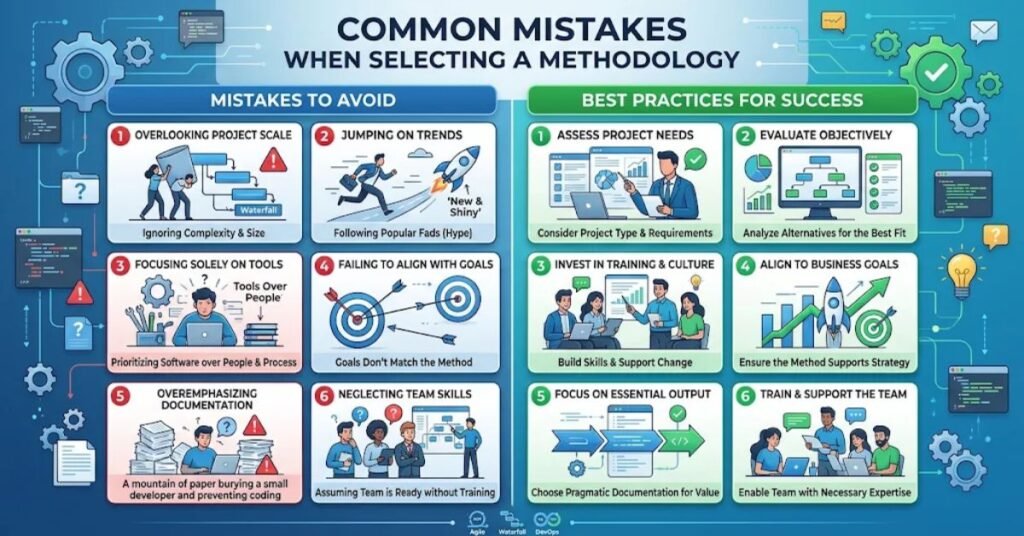
Choosing a development approach is only the first step. Teams must also avoid mistakes that can reduce its effectiveness.
Choosing a Popular Methodology Without Evaluating Project Needs: Agile may be popular, but that does not mean every project should use it. Requirements, risks, and team structure should guide the decision.
Confusing Tools With Methodologies: Project management software, code repositories, and communication platforms support development. They do not automatically establish an effective working methodology.
Ignoring Customer Feedback: Even a technically successful application can fail if it does not solve the intended problem. Teams should collect feedback from relevant stakeholders.
Skipping Testing to Save Time: Reducing testing may create more expensive problems after release. Quality checks should remain part of development.
Following Processes Too Rigidly: A methodology should support the project. Teams should understand its principles and apply appropriate practices instead of following unnecessary procedures.
Poor Communication Between Departments: Development, testing, security, and operations teams need to share important information. Communication gaps can delay releases and create defects.
Failing to Review Progress: Teams should regularly evaluate results and adjust their working methods when necessary.
Key Takeaways
- Software development methodologies organize how teams plan, build, test, and maintain applications.
- Waterfall works best for projects with clear requirements and well-defined development stages.
- Agile supports iterative development, customer collaboration, and changing requirements.
- Scrum organizes product development through fixed-length Sprints.
- Kanban allows teams to track tasks visually and manage workflows more efficiently.
- Spiral emphasizes risk assessment, while Lean focuses on reducing unnecessary activities.
- RAD enables faster prototyping, while DevOps strengthens teamwork between development and operations teams.
Conclusion
Software development methodologies help teams turn ideas into working applications through organized planning, development, testing, and delivery.
However, no single approach works best for every project. Waterfall may suit predictable projects, while Agile can help teams respond to changing requirements.
Scrum and Kanban provide different ways to organize work, Spiral supports risk management, RAD encourages rapid prototyping, and DevOps improves software delivery and operations.
Before choosing a methodology, consider the project’s size, complexity, budget, team experience, customer expectations, and maintenance requirements.
The best approach is the one that helps your team deliver reliable software, manage changes, and meet real user needs without unnecessary complexity.
FAQ
1. What are the most common software development methodologies?
Common approaches include Waterfall, Agile, Scrum, Kanban, Spiral, Lean, Rapid Application Development, and DevOps.
2. Which software development methodology is best?
There is no universal best methodology. The right choice depends on project requirements, complexity, budget, and team experience.
3. What is the difference between Agile and Waterfall?
Agile uses iterative development and supports changing requirements, while Waterfall follows a more sequential development process.
4. Is Scrum an Agile methodology?
Scrum is an Agile framework that organizes work into Sprints and supports regular inspection and adaptation.
5. What is the difference between Scrum and Kanban?
Scrum divides work into time-based Sprints, whereas Kanban uses visual task tracking to support a steady workflow.
6. When should developers use the Spiral model?
The Spiral model is useful for complex, high-risk projects that require repeated evaluation and risk analysis.
7. Is DevOps a software development methodology?
DevOps is a combination of cultural, organizational, and technical practices that connects software development with IT operations.
8. Can development teams combine different methodologies?
Yes. Teams can combine compatible practices, such as Scrum planning, Kanban workflow visualization, and DevOps automation.