


Quick Answer
Component-Based Software Engineering (CBSE) is a software development approach that builds applications using independent, reusable software components.
Each component performs a specific task and communicates with other components through defined interfaces. Developers can combine existing components instead of creating every feature from scratch.
This approach can reduce development time, improve maintainability, and make software easier to update.
Author Information
Author: Gulnaz Malik
Role: Founder, Publisher & Technology Content Specialist
Experience: 5+ Years in Technology, AI, Software & Digital Innovation.
Content Review: This article explains software engineering concepts using independent research, technical references, and established software development practices.
Introduction
Component-Based Software Engineering is an important approach to building modern software applications. Instead of developing an entire application as one large system, developers divide it into smaller, independent parts called components. Each component handles a particular function and works with other components through clearly defined interfaces.
Think about an online shopping application. It may include separate components for user accounts, product searches, shopping carts, payments, and order tracking. Each part has its own responsibility, but all components work together to provide a complete shopping experience.
This approach changes how developers plan, build, test, and maintain software. They can reuse existing components, replace individual parts, and improve specific features without rebuilding the whole application.
In this guide, you will learn how Component Based Software Engineering works, its development process, architecture, practical examples, advantages, disadvantages, and common challenges. You will also understand when this approach makes sense for a software project.
Table of Contents
- What Is Component-Based Software Engineering?
- Understanding Software Components
- How Component-Based Software Engineering Works
- Main Elements of Component-Based Architecture
- Component-Based Software Engineering Process
- Types of Software Components
- Real-World Examples of CBSE
- Benefits of Component-Based Software Engineering
- Challenges and Limitations of CBSE
- CBSE vs Traditional Software Development
- Testing and Maintaining Software Components
- Best Practices for Component-Based Development
- Future of Component-Based Software Engineering
- Key Takeaways
- Conclusion
- Frequently Asked Questions
What Is Component-Based Software Engineering?
Component-Based Software Engineering (CBSE) is a software development methodology that focuses on creating applications by combining independent and reusable software components. Each component performs a specific task and provides its functionality through a defined interface.
In traditional development, programmers often create many application features from the beginning. CBSE takes a different approach. Developers first look for existing components that can meet the project’s requirements. They reuse suitable components and develop new ones only when necessary.
For example, an application that needs user authentication does not always require developers to build an entire authentication system. They may integrate an existing authentication component that supports registration, login, password management, and access control.
A software component should have a clearly defined responsibility. It should also communicate with other components through agreed interfaces rather than depending heavily on their internal code.
This separation makes software easier to understand and manage. Developers can update one component without making unnecessary changes to other parts of the application.
CBSE is particularly useful for large applications where several features need to work together. It also supports software reuse, which can help organizations reduce repeated development work.
However, component reuse does not automatically guarantee better software. Developers must check compatibility, security, performance, and maintenance requirements before integrating any component.
Understanding Component Based Software Engineering Components

A software component is an independent and reusable unit of software that provides a particular service or function. It can be developed separately and integrated into a larger application.
Components may contain code, data, configuration files, and supporting resources. Their main purpose is to perform specific tasks while hiding unnecessary internal details from other parts of the system.
For example, a payment component may process transactions without exposing its internal payment-processing logic to the shopping cart component.
Important Characteristics of Software Components
Software components usually have several important characteristics:
- Reusability: Developers can use a component in different applications when its functionality and requirements match.
- Independence: A component should perform its assigned task without unnecessary dependence on other components.
- Encapsulation: Internal implementation details remain hidden behind a public interface.
- Interoperability: Components should communicate with other system parts through compatible interfaces and protocols.
- Replaceability: Developers should be able to replace a component without redesigning the entire application, provided the replacement meets the required interface and behavior.
- Maintainability: A well-designed component can be updated and tested separately.
These characteristics help developers build applications that are easier to expand and maintain.
Component Interfaces and Contracts
An interface defines how other components interact with a particular component. It describes the operations, inputs, outputs, and rules that the component supports.
A contract explains what a component promises to provide and what it expects from other parts of the system. Object Management Group – Unified Modeling Language (UML)
For example, a shipping component might accept an order number and delivery address. It may then return a tracking number and delivery status.
Clear interfaces reduce confusion between development teams. They also help prevent integration problems when different developers work on separate components.
How Component-Based Software Engineering Works
Component-Based Software Engineering works by dividing an application into smaller functional units. Developers identify the required features, select suitable components, and connect them to create a complete system.
Each component handles a specific responsibility. The application depends on communication between these components rather than placing every function inside one large codebase.
Consider an online banking application. It may contain an account management component, transaction component, authentication component, notification component, and reporting component.
When a customer transfers money, the authentication component verifies access. The transaction component processes the transfer, while the notification component sends a confirmation message.
These components cooperate to complete one operation.
Role of Component Communication
Components need a reliable way to exchange information. Developers usually use interfaces, APIs, events, or messaging systems for this purpose.
For example, a product component may request inventory information from a stock management component. The stock component returns the available quantity without revealing how it stores or calculates that information.
This separation allows developers to change internal implementation details while keeping the external interface stable.
Component Based Software Engineering Integration
Integration connects individual components so they can work as one application. Developers must check whether the components use compatible data formats, communication methods, and technical requirements.
Poor integration can create errors even when individual components work correctly.
Therefore, teams should test component interactions, handle communication failures, and monitor the complete system after integration.
Main Elements of Component Based Software Engineering Architecture
Component-based architecture organizes an application into independent functional units. Each unit has a defined responsibility and communicates with other parts through interfaces.
A successful architecture requires more than dividing code into separate files. Developers must establish clear boundaries, control dependencies, and define how components share information.
The following elements are important in this architecture.
1. Independent Components
Independent components handle specific responsibilities. For example, an authentication component manages user access, while a reporting component generates application reports.
Developers can improve one component without making unnecessary changes to unrelated components.
2. Component Based Software Engineering Design
Interfaces define the communication rules between components. They explain which functions are available and how other components can use them.
A stable interface makes integration easier and reduces unexpected changes.
3. Component Repository
A component repository stores reusable components and related information. Developers can search the repository to find software units that meet project requirements.
A repository may include documentation, versions, dependencies, licenses, and installation instructions.
4. Integration Mechanisms
Integration mechanisms allow components to communicate and exchange information. These may include APIs, service interfaces, event systems, or messaging technologies.
5. Configuration and Dependency Management
Components often depend on specific libraries, runtime environments, or other software units. Dependency management helps developers control these requirements and prevent compatibility problems.
Component-Based Software Engineering Process
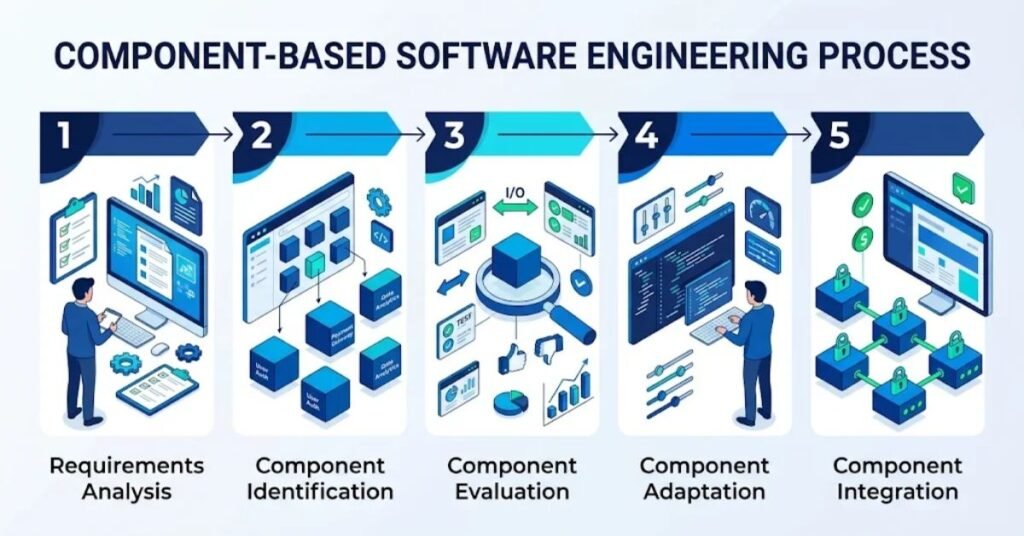
The CBSE process follows a structured approach to software development. Instead of building every feature independently, developers identify reusable components and integrate them into the required application.
The exact process may differ between organizations, but the following stages represent a common development workflow.
1. Requirements Analysis
The process starts by understanding what the application needs to accomplish.
Developers identify the required features, performance expectations, security requirements, and system limitations.
For example, an e-commerce project may require customer registration, product management, payment processing, and order tracking.
Clear requirements help developers identify which components they need.
2. Component Identification
After defining the requirements, developers search for existing components that provide the required functionality.
They may explore internal repositories, trusted third-party libraries, commercial component providers, or open-source projects.
The objective is to find components that fit the project’s technical and functional needs.
3. Component Evaluation
Not every available component is suitable for a project. Developers must evaluate each option before selecting it.
Important evaluation factors include:
- Compatibility with the existing technology stack.
- Security and vulnerability history.
- Performance and resource requirements.
- Documentation and available support.
- Licensing and usage restrictions.
- Long-term maintenance and update availability.
A component that looks useful may create problems if it is outdated, insecure, or difficult to maintain.
4. Component Adaptation
Sometimes an existing component needs configuration or an adapter before it can work with the application.
Developers may adjust settings, create wrappers, or transform data formats to support integration.
However, they should avoid unnecessary modifications to third-party component source code because those changes can make future updates difficult.
5. Component Integration
At this stage, developers connect the selected components through their interfaces.
They configure communication methods, manage dependencies, and ensure that data moves correctly between different parts of the system.
Integration testing helps identify problems that individual component tests may not detect.
6. Testing and Deployment
The complete application undergoes testing before deployment.
Developers check component functionality, communication, security, and performance. They also test common failure situations to understand how the system responds.
Once the application meets its requirements, the team prepares it for deployment and ongoing maintenance.
Types of Component Based Software Engineering Components
Software components can take different forms depending on their purpose, architecture, and deployment environment.
Understanding these types helps developers select the right approach for a particular application.
| Component type | Main purpose | Example |
| User interface component | Handles user interaction | Login form |
| Business logic component | Processes application rules | Order processing |
| Data access component | Manages data operations | Database connector |
| Service component | Provides specific services | Payment service |
| Utility component | Performs common tasks | Date and file utilities |
| Integration component | Connects different systems | API connector |
Some components operate inside the same application, while others communicate through networks.
For example, a user interface component may run in a web browser, whereas a payment service may operate on a remote server.
The important point is that each component should have a clear purpose and a well-defined way to communicate with other system parts.
Real-World Examples of Component Based Software Engineering
Component-based development is useful in many types of software applications. It allows development teams to organize complex systems into manageable parts.
Here are some practical examples.
E-Commerce Component Based Software Engineering
An online shopping platform may contain separate components for product catalogs, customer accounts, shopping carts, payments, inventory, and order management.
Each component handles its own responsibility. When a developer improves the product search feature, the payment component does not usually need to change.
Banking Component Based Software Engineering
Banking systems can use separate components for account management, authentication, transaction processing, customer notifications, and financial reporting.
This organization helps teams manage different banking functions while controlling access to sensitive information.
Enterprise Management Systems
Business applications often include components for employee records, payroll, inventory, customer relationships, and reporting.
Organizations can add or replace individual features as their business requirements change.
Web Application Component Based Software Engineering
Modern web applications frequently use reusable interface components such as navigation menus, search forms, product cards, buttons, and dashboards.
Frameworks such as React support component-based user interface development. However, UI component development is one application of component-based principles, not the entire scope of CBSE.
Benefits of Component-Based Software Engineering
Component-Based Software Engineering offers several benefits when developers choose and manage components carefully.
Its main strength is the ability to reuse existing functionality rather than repeatedly developing similar features.
Reduced Development Time
Developers can save time by using existing components instead of building every feature from the beginning.
For example, a project may use an established logging library rather than creating a completely new logging system.
This allows the team to focus on features that are unique to the application.
Improved Software Reusability
Reusable components can support multiple projects. An organization may develop a common authentication component and use it across several internal applications.
This reduces repeated work and encourages consistent software design.
Easier Component Based Software Engineering Maintenance
A component-based application separates different responsibilities. Developers can update a specific component without unnecessarily changing the entire system.
For example, a team can improve a notification component while keeping the order management component unchanged.
Better Component Based Software Engineering Scalability
Developers can add new components as application requirements grow.
A shopping platform may introduce a recommendation component without rebuilding its existing product catalog or customer account system.
However, actual scalability also depends on architecture, infrastructure, database design, and system communication.
Improved Team Collaboration
Different development teams can work on separate components when interfaces and responsibilities are clearly defined.
This makes parallel development easier and helps teams manage larger projects.
More Consistent Software Quality
Using a well-maintained component across multiple applications can encourage consistent implementation of common functions.
However, developers still need to check its security, compatibility, and performance before using it.
Challenges and Limitations of CBSE
Although CBSE provides many benefits, it also introduces challenges that developers must understand before choosing this approach.
Component reuse can save effort, but poor component selection or integration can create technical problems.
Compatibility Issues
Different components may use different programming languages, frameworks, data formats, or runtime environments.
Developers must check compatibility before combining them.
Dependency Problems
A component may rely on external libraries or other software packages. If these dependencies change or become unavailable, the application may stop working correctly.
Dependency management is therefore an important part of CBSE.
Security Risks
Third-party components can contain vulnerabilities or receive limited maintenance.
Using outdated dependencies may expose an application to security threats.
Developers should review component updates, security advisories, permissions, and vulnerability reports.
Integration Complexity
Connecting several components can become difficult when their interfaces or communication methods are poorly designed.
A component may work correctly on its own but fail when interacting with other parts of the application.
Licensing Restrictions
Some reusable components have licensing conditions that limit commercial use, modification, or redistribution.
Organizations should review licensing requirements before including third-party components in their products.
Limited Customization
An existing component may not support every feature required by a project.
Developers may need to configure it, build an adapter, extend its functionality, or create a new component.
CBSE vs Traditional Software Development
Component-Based Software Engineering and traditional software development both aim to create reliable applications, but they organize development differently.
Traditional development may involve building many application features specifically for one project. CBSE places greater emphasis on identifying, selecting, and reusing independent components.
| Comparison factor | Component Based Software Engineering | Traditional Development |
| Development approach | Combines reusable components | Often builds project-specific functionality |
| Code reuse | High focus on reuse | Depends on project practices |
| Development time | Can reduce repeated work | May require more original development |
| Maintenance | Components can be maintained separately | Depends on system structure |
| Integration | Requires component compatibility | Depends on application architecture |
| Flexibility | Supports component replacement | Changes may affect multiple areas |
| Initial planning | Requires component evaluation | Focuses on overall requirements and design |
Neither approach is automatically better for every project.
A small application with unique requirements may benefit from straightforward custom development. A large system with repeated business functions may gain more from component reuse. SEI – Software Engineering
The best choice depends on project size, available components, security requirements, development resources, and long-term maintenance needs.
Testing and Maintaining Software Components
Testing is essential in component-based applications because a problem in one component can affect other parts of the system.
Developers should test components individually and examine how they behave when connected to the complete application.
Component testing usually includes functional checks, interface validation, compatibility testing, and performance evaluation.
For example, a payment component should be tested with valid payment details, invalid information, rejected transactions, and communication failures.
Developers should also check whether a component handles unexpected inputs safely.
Software maintenance continues after deployment. Teams need to monitor dependencies, apply security updates, fix defects, and review component compatibility.
For more information about software quality, read our guide on software verification and validation.
Good testing practices help teams detect problems before they affect users. They also make future updates easier to manage.
Best Practices for Component-Based Development
Successful component-based development requires careful planning and consistent engineering practices.
Developers should focus on creating components that have clear responsibilities and predictable behavior.
The following practices can improve the quality of a CBSE project:
- Design components around specific responsibilities rather than grouping unrelated features.
- Create clear interfaces and document how components communicate.
- Avoid unnecessary dependencies between components.
- Evaluate third-party components before adding them to a project.
- Use version control and dependency management tools.
- Test components independently before integrating them.
- Perform integration and security testing regularly.
- Review licensing requirements for reusable software.
- Monitor component updates and maintenance activity.
- Replace outdated or unsupported components when necessary.
Another useful practice is to maintain documentation for every important component. Documentation should explain its purpose, supported operations, dependencies, configuration, and limitations.
These details help new developers understand the application and reduce confusion during maintenance.
Future of Component-Based Software Engineering
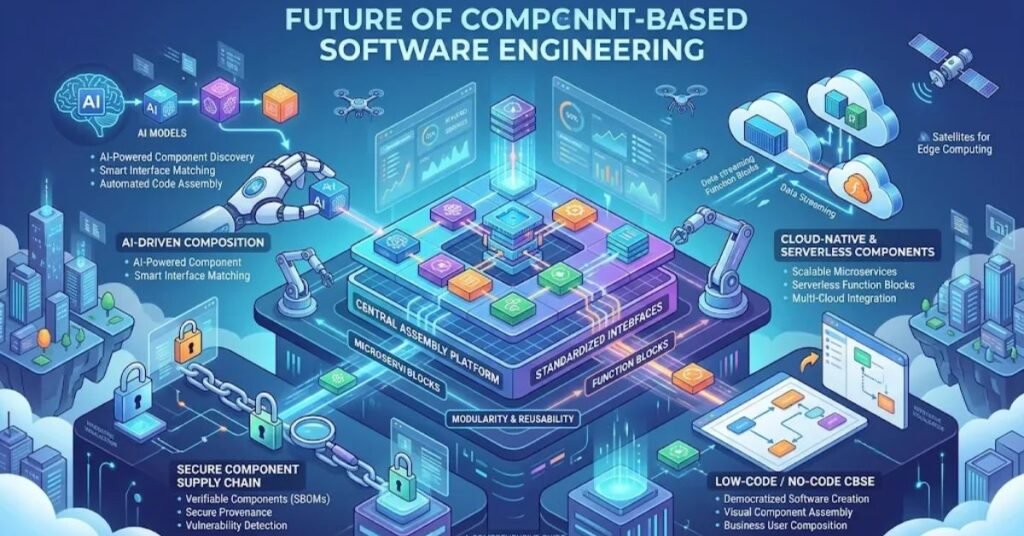
Software development continues to move toward modular architectures, reusable services, cloud platforms, and distributed systems.
These developments create more opportunities for component-based engineering.
Cloud applications often use independently managed services that communicate through APIs. This approach shares several principles with CBSE, although microservices and software components are not the same thing.
Modern development frameworks also encourage reusable components. Developers can create common functionality once and use it across different parts of an application.
Artificial intelligence may also support component discovery, code analysis, dependency management, and software testing. AI-assisted development tools can help developers identify reusable code and understand relationships between software modules.
However, AI-generated suggestions still require human review. Developers must verify functionality, security, licensing, and compatibility before integrating generated or recommended components.
Another important development is software supply chain security. Organizations increasingly need to understand where their components come from, which dependencies they contain, and whether they receive security updates.
The future of CBSE will likely depend on combining reusable software with better component governance, automated testing, and stronger security practices.
Key Takeaways
- Component-Based Software Engineering builds applications using independent and reusable software components.
- Each component performs a specific task and communicates through defined interfaces.
- Developers can reuse existing components to reduce repeated development work.
- Component-based architecture can improve maintainability, flexibility, and team collaboration.
- Compatibility, security, licensing, and dependency management require careful attention.
- Testing individual components and their interactions helps prevent integration problems.
- CBSE works best when components have clear responsibilities and well-designed interfaces.
Conclusion
Component-Based Software Engineering provides a practical way to develop and manage complex software applications. Instead of creating every feature from scratch, developers can combine reusable components to build systems that are easier to understand, update, and expand.
Its biggest advantage is software reuse. Teams can save development effort, improve consistency, and focus more on application-specific requirements.
However, successful implementation requires careful component selection, reliable interfaces, security checks, and proper testing. Reusing an unsuitable component can create more problems than it solves.
For developers and software engineering teams, understanding CBSE is valuable because modular and reusable software design remains an important part of modern application development.
Frequently Asked Questions
1. What is Component Based Software Engineering?
It is a software development approach that builds applications by combining independent and reusable software components.
2. What is the main purpose of CBSE?
Its main purpose is to improve software reuse, reduce repeated development work, and simplify application maintenance.
3. What is a software component?
A software component is an independent unit that performs a specific function and provides its services through an interface.
4. What are the main stages of CBSE?
The main stages include requirements analysis, component identification, evaluation, adaptation, integration, testing, and deployment.
5. Is CBSE suitable for large applications?
Yes. It can help organize complex applications into smaller functional units that teams can develop and maintain separately.
6. What are the disadvantages of CBSE?
Common disadvantages include compatibility problems, dependency risks, security vulnerabilities, integration complexity, and licensing restrictions.
7. How is CBSE different from object-oriented programming?
Object-oriented programming organizes software around objects and classes, while CBSE focuses on larger reusable units with defined interfaces. Both approaches can work together.
8. What is an example of component-based software?
An e-commerce application with separate payment, customer account, inventory, and order management components is a common example.