

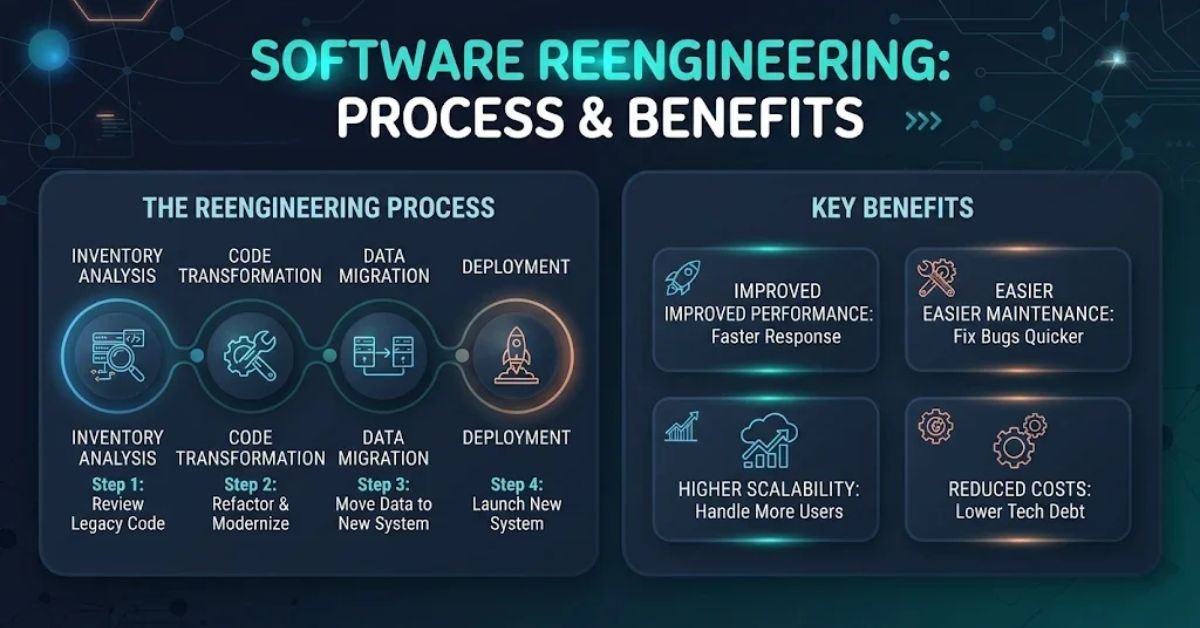
Quick Answer
Software reengineering is the process of examining, improving, restructuring, or rebuilding an existing software system to make it more useful, maintainable, and compatible with modern technology.
It involves understanding the current application, identifying weaknesses, restructuring code or data, and implementing an improved version.
Organizations use software reengineering to modernize legacy applications while preserving valuable features and business logic.
Author Information
Author: Gulnaz Malik
Role: Founder, Publisher & Technology Content Specialist
Experience: 5+ Years in Technology, AI, Software & Digital Innovation.
Content Review: Technology information is researched using official documentation, trusted sources, and technical research.
Introduction
Software systems do not always become useless when their technology gets old. Many organizations still depend on applications developed years ago. These applications may support important business operations, manage customer information, process transactions, or control internal workflows.
However, older software can become difficult to maintain. Its code may be poorly organized, documentation may be missing, and its technology may no longer support modern platforms. Replacing the entire application can also require considerable time, money, and development resources.
This is where software reengineering becomes useful. It helps organizations examine existing applications and transform them into improved systems without automatically rebuilding everything from the beginning.
The process may involve recovering the original design, restructuring source code, updating databases, improving documentation, and moving software to a modern platform.
In this guide, you will learn what software reengineering means, how its process works, which techniques developers use, and why organizations choose it. You will also explore practical examples, benefits, limitations, and best practices for modernizing legacy software.
Table of Contents
- What Is Software Reengineering?
- Why Is Software Reengineering Important?
- How Does the Software Reengineering Process Work?
- Main Techniques Used in Software Reengineering
- Real-World Examples of Software Reengineering
- Benefits of Software Reengineering
- Challenges and Limitations
- Software Reengineering vs. Software Maintenance vs. Refactoring
- Best Practices for Successful Software Reengineering
- Future of Software Reengineering
- Key Takeaways
- Conclusion
- Frequently Asked Questions
What Is Software Reengineering?
Software reengineering is an engineering approach that examines an existing software application and transforms it into a new or improved form. The process can involve analyzing the original system, recovering its design, changing its internal structure, and implementing the improved version.
The main purpose is to extend the usefulness of existing software while addressing problems that make it difficult to maintain, operate, or develop further.
For example, imagine a company that uses an old inventory management application. The application still records products and sales correctly, but it runs on outdated technology and has complicated source code.
Instead of immediately replacing the entire application, developers can study its existing functionality, identify important business rules, restructure its code, and migrate it to a more suitable platform.
Software reengineering does not always require changing what users see. Sometimes, developers improve the internal architecture while keeping the existing interface and core functionality.
The Guide to the Software Engineering Body of Knowledge (SWEBOK) describes reengineering as examining and altering software to reconstitute it in a new form, followed by implementing that form. Software Reengineering and Maintenance Techniques
This approach is especially useful for organizations that want to preserve valuable software functionality while reducing technical problems.
Why Is Software Reengineering Important?
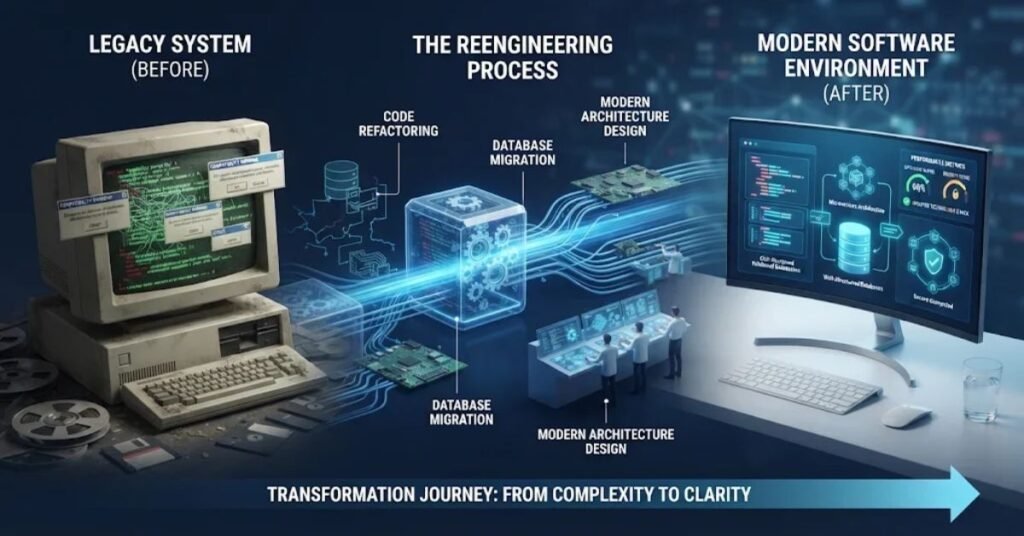
Software technology changes over time. Programming languages, operating systems, databases, security requirements, and development tools continue to evolve.
An application that worked well several years ago may struggle to meet current requirements. Its architecture may not support new integrations, and developers may find it difficult to understand or modify its source code.
Software reengineering helps organizations address these issues without assuming that every existing application needs complete replacement.
One important reason is legacy system modernization. Older applications often contain business rules and processes that organizations cannot easily reproduce. Reengineering helps recover and preserve this knowledge.
It also improves maintainability. Developers can organize complicated code, remove unnecessary duplication, update outdated components, and improve documentation. These changes make future development easier.
Security is another important consideration. Older applications may depend on unsupported libraries or outdated technologies. Reengineering can help organizations replace vulnerable components and introduce suitable security controls. However, restructuring alone does not guarantee security; the updated system still requires security reviews and testing.
Software reengineering can also support compatibility with modern infrastructure. An organization may need to move an application to a newer operating system, database, server environment, or cloud platform.
For these reasons, reengineering is a practical option when an existing application still provides business value but needs significant technical improvement.
How Does the Software Reengineering Process Work?
The software reengineering process involves several activities that help developers understand an existing application and transform it into an improved system.
A commonly taught process model includes six major activities: inventory analysis, document restructuring, reverse engineering, code restructuring, data restructuring, and forward engineering.
The order and depth of these activities depend on the condition of the original software and the organization’s goals.
1. Inventory Analysis
Inventory analysis is the first activity. Developers and project managers examine the organization’s existing software applications to identify which systems need improvement.
They evaluate applications according to their business importance, technical condition, maintenance requirements, age, and future usefulness.
For example, a company may operate several older applications. One manages employee records, another processes customer orders, and a third produces financial reports.
The team may discover that the order-processing application has become difficult to maintain, while the employee management system continues to work properly.
Inventory analysis helps prioritize the application that needs attention.
Important evaluation factors include:
- Application age and current technical condition.
- Business importance and daily usage.
- Maintenance costs and available documentation.
- Compatibility with current hardware and software.
- Security concerns and operational risks.
- Future development and integration requirements.
The outcome is a clear understanding of which applications are suitable candidates for reengineering.
2. Document Restructuring
Documentation explains how software works, how its components interact, and how developers should maintain it.
Unfortunately, many legacy applications have incomplete or outdated documentation. Original developers may have left the organization, and important technical decisions may never have been recorded.
Document restructuring addresses this problem by reviewing available documents and improving the information developers need.
The team may update system diagrams, database descriptions, installation instructions, user guides, and technical specifications.
If documentation is missing, developers can create new records using information recovered from the source code and system behavior.
The goal is not to produce unnecessary paperwork. It is to make the application easier to understand and support.
Good documentation also helps new developers learn the system and reduces confusion during future updates.
3. Reverse Engineering
Reverse engineering is the process of examining an existing software system to understand its internal structure, design, components, and relationships.
Instead of starting with requirements and writing code, developers begin with the available implementation and work backward to recover higher-level information.
For example, an older application may contain thousands of lines of source code but no useful architecture documentation.
Developers can examine its functions, database connections, data structures, and dependencies to understand how the application operates.
Reverse engineering can help recover:
- System architecture and component relationships.
- Database structures and information flows.
- Business rules and application logic.
- Program interfaces and dependencies.
- Existing design decisions.
It is important to understand that reverse engineering primarily focuses on analysis. It does not automatically improve or repair the original software.
The information recovered during this activity provides a foundation for the next stages of reengineering.
4. Code Restructuring
Code restructuring improves the organization of existing source code without necessarily changing the application’s external behavior.
Legacy software may contain duplicated functions, complicated conditions, unclear variable names, and unnecessarily connected components.
These problems make development slower and increase the risk of introducing defects.
Developers can restructure the code by simplifying complicated functions, separating responsibilities, removing duplication, and improving naming conventions.
For example, an old application may repeat the same customer validation logic in several different modules. Developers can create a shared function and use it wherever the same validation is required.
Code restructuring can also involve breaking a large module into smaller components and reducing unnecessary dependencies.
The team should run suitable regression tests to check that existing functionality continues to work after changes.
The objective is to create a cleaner and more manageable codebase without introducing unexpected changes to business operations.
5. Data Restructuring
Data restructuring focuses on improving how an application stores, organizes, and manages information.
Older applications may use outdated database designs, inconsistent data formats, duplicated records, or structures that are difficult to integrate with modern systems.
Developers examine the existing data model and identify areas that require improvement.
For example, a business application may store customer addresses in several different formats. This inconsistency can create problems when generating reports or connecting the application to another service.
Data restructuring may involve:
- Improving database tables and relationships.
- Removing unnecessary data duplication.
- Standardizing data formats.
- Correcting inconsistent records.
- Improving database organization.
- Preparing data for migration to a newer platform.
Before making changes, teams should understand how existing applications use the information.
They should also prepare backups, migration plans, validation rules, and recovery procedures. Incorrect data transformation can cause serious operational problems even when the application code works correctly.
6. Forward Engineering
Forward engineering uses the information recovered during earlier activities to develop and implement the improved software system.
Developers apply the recovered requirements, design information, and business rules to create the new implementation. Software Engineering Body of Knowledge (SWEBOK)
The work may involve updating programming languages, changing system architecture, migrating databases, replacing outdated components, and introducing modern interfaces.
For example, an organization may move a desktop-based inventory application to a web-based platform.
Developers can preserve its important inventory and reporting functions while creating a new interface and improving database integration.
Forward engineering also includes implementation, integration, testing, and deployment activities.
The team should verify that the new application performs the required tasks and that important information has transferred correctly.
After deployment, developers monitor the system and resolve any problems that appear during actual operation.
Main Techniques Used in Software Reengineering
Software reengineering uses different techniques depending on the application’s condition and modernization goals.
Reverse Engineering and Design Recovery
Reverse engineering helps developers understand an existing application by examining its code, data structures, and behavior.
Design recovery goes further by reconstructing useful architectural and design information from the available implementation.
These techniques are particularly valuable when original documentation is incomplete or unavailable.
Software Refactoring
Refactoring improves the internal organization of source code while keeping the software’s existing functionality unchanged.
Developers may simplify complex functions, improve naming, separate responsibilities, or remove duplicated code.
Refactoring is often used as part of a broader reengineering project, although the two terms do not mean the same thing.
Code Restructuring
Code restructuring reorganizes existing source code to make the program easier to understand, manage, and maintain. It can make the source code easier to read, test, understand, and maintain.
Data Restructuring
Data restructuring improves database organization, data relationships, formats, and consistency.
Architecture Restructuring
Architecture restructuring changes how major software components are organized and connected.
For example, developers may replace a tightly connected application with a modular architecture that separates different business responsibilities.
Software Migration
Software migration moves an application or its components to another environment.
This may include moving from an unsupported operating system to a newer one, transferring databases, or migrating a legacy application to cloud infrastructure.
Migration may be part of reengineering, but moving software to another platform alone does not automatically mean the entire application has been reengineered.
Real-World Examples of Software Reengineering
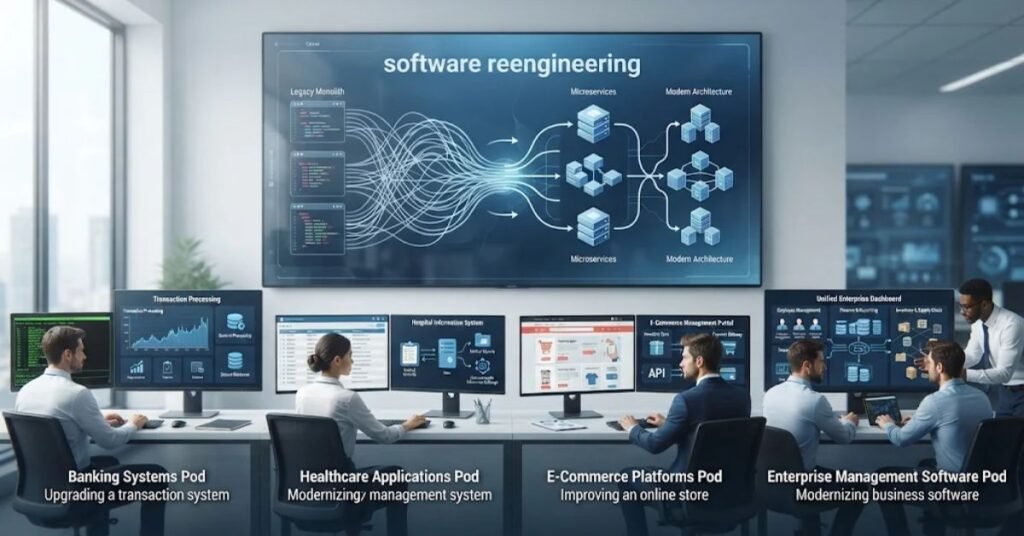
Software reengineering is useful in many industries where organizations depend on older applications.
Banking Systems: A financial organization may operate an older transaction-processing application. Developers can examine its business rules, improve the code structure, modernize database connections, and introduce updated interfaces while preserving essential transaction functionality.
Healthcare Applications: A healthcare provider may use an older patient management system. Reengineering can help improve its database structure, update unsupported components, and make information easier to exchange with other authorized systems. Privacy, access control, and data integrity must remain central requirements.
E-Commerce Platforms: An online store may use an older application that struggles with new payment services and inventory integrations. Developers can restructure its components, update APIs, and improve its ability to support modern shopping workflows.
Government Applications: Government departments sometimes depend on long-running systems that manage records, applications, or public services. Reengineering can help preserve important historical data while improving compatibility, maintainability, and operational support.
Enterprise Management Software: A company may use an older employee or resource management application. Reengineering can help organize its internal modules, update databases, and support new reporting requirements.
These examples demonstrate how organizations can improve existing systems without automatically discarding their useful functionality.
Benefits of Software Reengineering
Software reengineering offers several advantages when an organization has an existing application that still provides business value.
Improved Maintainability: Better code organization, updated documentation, and clearer component relationships make applications easier to maintain. Developers can understand the system more quickly and manage future changes with greater confidence.
Extended Software Life: Organizations can continue using valuable applications after updating their technical foundations. This can reduce the pressure to replace a system simply because its original technology has become outdated.
Better Compatibility: Reengineering can help applications work with modern operating systems, databases, development tools, and external services.
Reduced Technical Debt: Developers can address duplicated code, outdated components, complicated dependencies, and other structural problems that make future development harder.
Preservation of Business Knowledge: Existing applications may contain important business rules that have developed over many years. Reengineering helps recover and preserve this knowledge during modernization.
Improved Development Flexibility: A cleaner architecture can make it easier to introduce new features, integrate services, and support changing business requirements.
Potential Cost Savings: Reusing valuable software components and business logic may reduce the work required compared with developing a completely new application.
However, cost savings are not guaranteed. The organization must compare reengineering costs, migration risks, testing requirements, and future maintenance expenses before choosing an approach.
Challenges and Limitations
Although software reengineering provides important advantages, it also involves technical and organizational challenges.
Incomplete Documentation: Missing documents make it difficult to understand the original system. Developers may need additional time to recover its architecture and business rules.
Complex Legacy Code: Some applications contain years of modifications, duplicated logic, and dependencies that are difficult to identify. Changing one component may affect several other parts of the system.
Data Migration Risks: Moving or restructuring databases can result in missing, duplicated, or incorrectly converted records if the process is not carefully managed.
Limited Technical Skills: Older applications may use programming languages or platforms that current developers have limited experience with.
High Initial Investment: Reengineering requires analysis, development, testing, and deployment resources. Large applications may need considerable investment before improvements become visible.
Operational Disruption: Organizations must manage the transition carefully. Poorly planned deployment can interrupt important services or affect users.
Security Concerns: Modernization can introduce new vulnerabilities if teams do not review authentication, permissions, data protection, and third-party dependencies.
These limitations show why organizations should evaluate the condition of an application before starting a reengineering project.
Software Reengineering vs. Software Maintenance vs. Refactoring
Although these three software engineering activities are closely related, each serves a different purpose in improving, maintaining, and restructuring applications.
| Comparison | Software Reengineering | Software Maintenance | Software Refactoring |
| Main purpose | Transform an existing system into an improved form | Keep software useful after release | Improve internal code structure |
| Main focus | System-level examination and alteration | Fixes, adaptations, and improvements | Code organization |
| Scope | Can involve major system changes | Can involve small or large updates | Usually focused on internal structure |
| Behavior changes | May change or preserve functionality | Depends on the maintenance task | Should preserve observable behavior |
| Common example | Modernizing a legacy business application | Fixing an application error | Simplifying a complicated function |
Software maintenance is an ongoing activity that keeps an application operational and useful. Reengineering is a broader transformation that may be undertaken when the existing system needs substantial changes.
Refactoring is a technique that developers can use during reengineering or regular maintenance to improve code structure without intentionally changing external behavior.
For a deeper explanation of maintenance activities, seeSoftware Reliability Engineering and the related software engineering resources on TechCrebia.
Best Practices for Successful Software Reengineering
A successful reengineering project requires careful planning, technical analysis, and continuous evaluation.
Organizations should begin by defining the reason for modernization. They should identify the existing problems, expected improvements, available resources, and business requirements.
The following practices can help:
- Evaluate the existing application: Examine its architecture, code quality, dependencies, performance, and business importance before selecting a modernization strategy.
- Understand the original business logic: Identify the rules and processes that the organization must preserve.
- Set clear objectives: Define measurable goals for compatibility, maintainability, performance, security, and future development.
- Use version control: Track source-code changes and maintain a reliable history of development work.
- Maintain useful documentation: Record important architecture decisions, database structures, interfaces, and migration procedures.
- Protect existing data: Create verified backups and validate migrated information before production use.
- Test throughout the process: Use unit, integration, regression, performance, and security testing according to the system’s risks.
- Modernize in manageable stages: Consider incremental improvements when replacing the complete application would create unnecessary operational risk.
- Plan deployment and recovery: Prepare rollback procedures and monitor the updated application after release.
- Review the results: Compare the improved system against the original project objectives and identify remaining weaknesses.
These practices help teams control complexity and reduce the risks associated with changing important business applications.
Future of Software Reengineering
Software reengineering will remain relevant as organizations continue using applications developed with older technologies.
Modernization projects increasingly involve cloud platforms, automated development tools, artificial intelligence, and more connected software architectures.
AI-assisted tools can help developers understand unfamiliar source code, identify duplicated logic, summarize dependencies, and generate draft documentation. These capabilities may reduce some analysis work, but developers must review the results because automatically generated explanations can be incomplete or incorrect.
Cloud migration is another important area. Organizations may move older applications to cloud infrastructure to improve deployment flexibility and infrastructure management. However, a cloud migration does not automatically improve application architecture or code quality.
Automated testing can also support reengineering by checking whether existing features continue to work after changes. Regression testing is especially useful when teams modify applications with complicated dependencies.
Another important direction is incremental modernization. Instead of replacing an entire application at once, organizations may gradually replace individual components while keeping the existing system operational.
The future of software reengineering will therefore involve a combination of engineering expertise, automated analysis, careful testing, and planned modernization.
Key Takeaways
- Software reengineering transforms an existing application into a new or improved form.
- It helps organizations modernize legacy systems while preserving valuable business functionality.
- The six common process activities are inventory analysis, document restructuring, reverse engineering, code restructuring, data restructuring, and forward engineering.
- Refactoring, reverse engineering, migration, and architecture restructuring are important related techniques.
- Major benefits include better maintainability, compatibility, and reduced technical debt.
- Incomplete documentation, complicated code, migration risks, and development costs can make reengineering challenging.
- Careful planning, testing, backups, and gradual implementation help reduce modernization risks.
Conclusion
Software reengineering provides a practical way to improve existing applications that have become difficult to maintain or incompatible with modern technology.
Instead of automatically replacing an entire system, organizations can examine its existing design, recover important business logic, restructure code and data, and implement a more suitable version.
The process can improve maintainability, extend the useful life of software, support modern platforms, and make future development easier. However, it requires careful analysis, reliable testing, proper documentation, and strong data protection.
Organizations should first evaluate whether their existing application still provides business value. If it does, software reengineering may offer a sensible modernization strategy.
By following a structured process and setting clear technical goals, development teams can transform aging applications into systems that better support current and future business requirements.
Frequently Asked Questions
1. What is software reengineering?
Software reengineering is the process of examining and transforming existing software into a new or improved form.
2. What are the six phases of software reengineering?
The common activities are inventory analysis, document restructuring, reverse engineering, code restructuring, data restructuring, and forward engineering.
3. What is the main purpose of software reengineering?
Its main purpose is to modernize existing software, improve its structure, and extend its usefulness.
4. What is reverse engineering in software reengineering?
Reverse engineering examines existing code and system behavior to recover design information and understand how an application works.
5. What is forward engineering?
Forward engineering uses recovered requirements and design information to develop and implement an improved software system.
6. Is software refactoring the same as software reengineering?
No. Refactoring improves internal code structure while preserving observable behavior. Reengineering is a broader process that may include refactoring and other modernization activities.
7. What are the major benefits of software reengineering?
It can improve maintainability, compatibility, code quality, and the useful life of existing applications.
8. When should a company use software reengineering?
A company should consider it when an existing application still provides value but has become difficult to maintain, extend, or operate with modern technology.