





An AI PhD program is one of the most advanced degrees you can earn today. It trains you to think deeply, research independently, and solve real-world problems using artificial intelligence.
This degree goes far beyond learning tools and coding. You explore how machines learn, how they make decisions, and how they change our world.
Most people choose an AI PhD program because they want to lead research, not just follow it. You work directly with expert professors, publish original research, and contribute new ideas to the field of AI.
Your dissertation becomes a real contribution to science, something that advances how the world understands intelligent systems.
The demand for AI experts has never been higher. The World Economic Forum ranked AI specialists as the fastest-growing job globally through 2030. Companies, hospitals, governments, and research labs all need people who deeply understand AI.
A PhD gives you that deep understanding. It also gives you something no certification or short course can match: credibility, expertise, and the ability to lead.
An AI doctorate is a specialized doctoral degree that focuses on AI methods, theories, and applications.
Unlike computer science PhD programs that cover many topics, AI degrees focus on machine learning, natural language processing, computer vision, robotics, and knowledge representation.
If you want to shape the future of technology, not just use it, an AI PhD program is your path forward. It opens doors to top universities, major tech companies, and global research institutes. It puts you at the center of the most exciting field in modern science.
Top Universities Offering an AI PhD Program in 2026

Choosing the right university makes a huge difference in your AI PhD program experience. The best schools give you access to top faculty, cutting-edge labs, and strong industry connections. Here are the world’s leading universities for AI doctoral studies.
According to U.S. News & World Report’s 2026 Best Graduate Schools, UC Berkeley (tied #1), Carnegie Mellon (tied #1), University of Illinois Urbana-Champaign (tied #5), University of Texas-Austin (tied #9), and University of Washington (tied #9) rank among the best for Computer Science PhD programs.
Each of these schools offers something special. Stanford University, nestled in Silicon Valley, has strong ties to tech giants like Google and Facebook. Its AI program emphasizes real-world applications alongside theoretical foundations.
Carnegie Mellon University has a long-standing reputation in robotics and machine learning. UC Berkeley combines academic training with hands-on experience through the Berkeley Artificial Intelligence Research (BAIR) Lab.
Carnegie Mellon’s doctoral program in machine learning trains students through interdisciplinary coursework, hands-on applications, and cutting-edge research.
Graduates of the program are uniquely positioned to pioneer new developments in the field and lead in both industry and academia.
ETH Zurich leads AI doctoral programs in Europe. It focuses on scalable machine learning and AI safety.
Students often go on to work at DeepMind or start their own companies. ETH Zurich sits in Switzerland’s tech hub, giving access to top EU research grants.
Here is a quick comparison of top universities:
| University | Location | Key Strength | Notable Lab |
| MIT | USA | Deep learning, robotics | CSAIL |
| Stanford | USA | Real-world AI applications | HAI Lab |
| Carnegie Mellon | USA | Machine learning, robotics | ML Department |
| UC Berkeley | USA | Computer vision, NLP | BAIR Lab |
| ETH Zurich | Switzerland | AI safety, scalable ML | ETH AI Center |
| University of Washington | USA | Human-centered AI | Allen School |
| Oxford University | UK | AI ethics, NLP | Future of Humanity |
Admission Requirements for an AI PhD Program

Getting into a top AI PhD program takes careful preparation. Every university has its own rules, but most programs look for similar things. You need a strong academic background, real research experience, and clear goals.
Admission requirements typically include a bachelor’s or master’s degree in computer science, engineering, mathematics, or a related field.
Programs also look for a high GPA in technical coursework, programming proficiency in Python, R, or C++, and knowledge of linear algebra, probability, and statistics.
You also need academic transcripts, 2-3 letters of recommendation, and a statement of purpose outlining your research interests and career goals.
Around 65% of programs favor candidates who have published peer-reviewed papers. Most AI doctorate programs now treat GRE scores as optional, reflecting a move toward holistic admissions that emphasize academic and professional portfolios.
Key Documents You Need
- Transcripts from all universities you attended
- Statement of Purpose explaining your research goals
- Letters of Recommendation from professors or employers
- Research Proposal showing your area of interest
- CV or Resume highlighting your experience and publications
- English Proficiency Score (TOEFL or IELTS) for international students
Skills That Make You Stand Out
- Strong programming skills in Python and PyTorch or TensorFlow
- At least one research paper, even from a smaller conference
- Clear alignment between your goals and a professor’s current research
- Experience with real datasets or AI projects
What You Learn in an AI PhD Program

An AI PhD program gives you more than classroom knowledge. You develop the ability to think like a researcher, design experiments, and solve problems no one has solved before. The coursework covers both theory and practice.
Core areas of study include machine learning, natural language processing, and ethical AI. Programs also offer interdisciplinary electives from computer science, engineering, and other related fields.
Research areas in AI doctoral studies closely reflect industry trends. Many programs focus on deep learning architectures, large-scale data processing, and distributed computing. State-of-the-art labs equipped with GPUs or TPUs support these experiments.
Collaborations with industry give students access to large datasets and advanced tools.
Here is what a typical AI PhD program curriculum looks like:
| Year | Focus Area |
| Year 1-2 | Core coursework — ML, deep learning, statistics, algorithms |
| Year 2-3 | Lab rotations, research projects, and qualifying exams |
| Year 3-5 | Independent research, publishing papers, and dissertation work |
| Year 5-6 | Dissertation writing, defense, job search |
Core Research Areas in AI Doctoral Studies
- Machine Learning: algorithms that let computers learn from data
- Natural Language Processing (NLP): how AI understands and generates text
- Computer Vision: how AI reads and interprets images
- Robotics: designing machines that act intelligently in the real world
- AI Ethics: ensuring AI systems stay fair, safe, and accountable
- Generative AI: building systems that create content like text, images, and code
How Long Does an AI PhD Program Take?

Time is a major factor when you plan your AI PhD program journey. The duration depends on your university, your advisor, and your research progress.
A PhD in AI typically takes 4 to 6 years to complete. This includes coursework, time spent conducting independent research, and writing and defending your dissertation.
Completing a PhD in artificial intelligence in the U.S. usually takes between 5 and 7 years.
Some students finish faster if their research moves quickly. Others take longer if they switch research topics or publish multiple papers before their defense.
Typical Timeline
- Year 1–2: Complete required coursework and find your advisor
- Year 2–3: Pass qualifying exams and begin original research
- Year 3–5: Run experiments, write papers, attend conferences
- Year 5–7: Write and defend your dissertation
Funding and Scholarships for an AI PhD Program

Money is a real concern when you apply to an AI PhD program. The good news is that most top programs offer strong financial support to their students. You do not have to pay out of pocket in many cases.
Funding is highly competitive. Nearly 70% of U.S. AI PhD students receive stipends through assistantships.
Students should prepare detailed statements of purpose and research proposals to increase their chances of receiving funding.
Federal funding for AI research increased by 18% in 2024, boosting public university resources and supporting cutting-edge innovations in doctoral programs nationwide.
Types of Funding Available
- Teaching Assistantships (TA): You teach undergrad classes and receive a stipend
- Research Assistantships (RA): You work on a professor’s funded project
- Fellowships: competitive awards like the NSF Graduate Research Fellowship
- Industry Sponsorships: companies like Google, Microsoft, and OpenAI sponsor PhD students
- University Scholarships: Many universities cover full tuition plus living expenses
If you get a fully funded AI PhD program offer, you receive free tuition plus a monthly stipend. This makes the PhD a smart financial decision for many students around the world.
Career Paths After an AI PhD Program
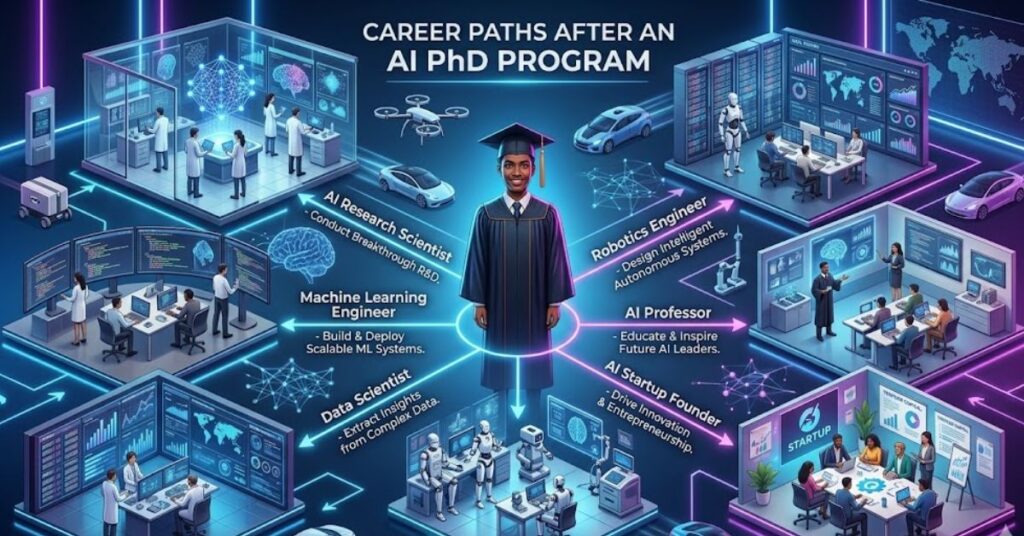
An AI PhD program opens doors to some of the most exciting and well-paying careers in technology. Graduates work at top companies, government agencies, universities, and their own startups.
Job roles for AI PhD holders include AI Researcher, AI Engineer, Data Scientist, Machine Learning Engineer, and AI Ethics Specialist.
Other career paths include AI ethics and policy advising, AI safety initiatives, AI entrepreneurship, government roles in defense and intelligence, and academic positions as professors training the next generation of AI specialists.
Salary Expectations After an AI PhD Program
AI doctorate graduates in the U.S. enjoy strong salary prospects. Typical roles, including AI research scientist, machine learning engineer, and data scientist, offer base pay generally between $120,000 and $160,000, depending on experience, location, and specialization.
Academia offers $80,000 to $120,000 for entry-level assistant professors. Private tech companies start salaries between $130,000 and $160,000, with potential for bonuses and stock options. Specialized roles in healthcare AI, autonomous vehicles, or finance command premium pay.
| Career Role | Average Annual Salary (USA) |
| AI Research Scientist | $140,000 – $230,000 |
| Machine Learning Engineer | $130,000 – $200,000 |
| Data Scientist | $115,000 – $180,000 |
| AI Ethics Specialist | $100,000 – $160,000 |
| University Professor (AI) | $90,000 – $150,000 |
| AI Startup Founder | Varies widely |
Online vs. On-Campus AI PhD Program: Which Is Better?

Many students ask whether they should choose an online or on-campus AI PhD program. Both options have advantages, but they serve different needs.
Fully online PhD programs in Artificial Intelligence remain relatively uncommon due to their research-intensive nature.
However, several universities offer comparable alternatives such as the Doctor of Artificial Intelligence (DAI), PhD in Data Science, or PhD in Information Systems. These programs uphold the same academic rigor and professional prestige.
Hybrid PhD programs exist at universities like the University of Florida and North Carolina State University.
These programs integrate virtual seminars, remote research mentorship, and short campus visits. Benefits include flexible scheduling, accessibility beyond geographic limits, and career continuity without relocation.
Comparison Table
| Feature | On-Campus | Online/Hybrid |
| Lab Access | Full access | Limited |
| Networking | Strong in-person | Mostly virtual |
| Flexibility | Low | High |
| Funding Options | More available | Fewer |
| Research Quality | High | Varies |
| Ideal For | Full-time researchers | Working professionals |
Tips to Get Into a Top AI PhD Program

Getting into a top AI PhD program requires more than high grades. You need a smart strategy and a clear research vision.
To stand out, you should know linear algebra and probability, have at least one first-author paper, even from a small AI conference, and be fluent in Python using tools like PyTorch or TensorFlow.
Reach out to 3–5 professors who do research similar to yours. In your message, name the exact paper or idea they published and how your work connects to it.
Top Strategies for Success
- Start research early: even undergraduate research experience helps
- Email professors directly: most advisors prefer personal contact before official applications
- Write a strong Statement of Purpose: focus on your research journey and future goals
- Get strong recommendation letters: choose professors who know your work well
- Apply to multiple universities: aim for a mix of reach, match, and safety schools
- Highlight real projects: GitHub repos, Kaggle competitions, and open-source contributions matter
- Attend AI conferences: NeurIPS, ICML, and CVPR help you network with future advisors
Final Thoughts
An AI PhD program is not just a degree. It is a life-changing decision. You invest years of hard work, deep thinking, and original research. But the rewards are worth every effort you put in.
The world needs smart, ethical, and skilled AI researchers more than ever. Every industry, from healthcare to finance to education, runs on intelligent systems today. And someone needs to build, improve, and guide those systems responsibly. That someone can be you.
Choosing the right AI PhD program takes time and careful planning. You need to pick the right university, find the right advisor, and align your research goals with your long-term vision. Do not rush this decision. Read about faculty research, talk to current PhD students, and visit labs if you can.
The journey will challenge you. You will face hard problems, failed experiments, and long nights of writing. But every great AI breakthrough you read about today came from someone who sat exactly where you sit now curious, determined, and ready to learn.
Start small. Build your research skills. Connect with professors. Apply with confidence. The best AI PhD program for you is the one that matches your passion, supports your growth, and pushes you to become the researcher the world needs.
The future of AI is being written right now. Make sure your name is on that page.
FAQs
1. What GPA do I need for an AI PhD program?
Most top programs expect a GPA of 3.5 or higher on a 4.0 scale. Strong technical coursework matters more than a perfect overall GPA. Programs look closely at your grades in math, algorithms, and programming courses.
2. Do I need a master’s degree before applying to an AI PhD program?
Most programs require a master’s degree in a related subject from a recognized university, with at least 55% to 60% marks. However, some U.S. universities accept students directly from a bachelor’s degree if their research experience is strong.
3. How much does an AI PhD program cost?
The NCES reports that a doctorate in math, engineering, or computer science costs an average of $25,286 per year. However, most students in fully funded programs pay nothing; the university covers tuition and provides a living stipend.
4. Is an AI PhD program worth it financially?
Yes. AI-related roles for PhD holders pay an average salary of $115,000 and up to $279,000, according to 2024 Payscale data. The career return on investment is strong, especially in private tech companies.
5. How competitive is admission to an AI PhD program?
Admission is highly competitive. Top programs like MIT, Stanford, and CMU accept fewer than 5% of applicants. You need strong research experience, excellent recommendations, and a clear research vision to stand out.
6. Can I work while doing an AI PhD program?
Most full-time programs expect you to focus on research. However, many students work as teaching or research assistants, which counts as professional experience and pays a stipend. Some hybrid or part-time programs allow more flexibility.
7. What is the job growth outlook for AI PhD graduates?
The U.S. Bureau of Labor Statistics projects 26% employment growth for Computer and Information Research Scientists from 2023 to 2033, far above the average for all occupations. This makes an AI PhD program one of the smartest long-term career investments you can make today.