





Introduction
AI Europe policies define how the European Union controls, guides, and regulates artificial intelligence systems. Europe builds these policies to protect human rights, improve safety, and support responsible innovation. The main legal framework behind these rules is the EU AI Act, which acts as the foundation of AI governance in Europe.
The European Union created AI Europe policies to make sure systems do not harm people or society. Governments across Europe believe that AI should work transparently and fairly. That is why they focus on ethics, accountability, and trust. These policies force companies to design AI systems that respect human dignity and privacy.
Europe also wants to balance innovation with safety. So AI Europe policies do not block AI development. Instead, they guide companies to build safer systems. Startups, researchers, and big tech companies all follow the same rules when they operate in Europe.
The EU introduced the AI Act in 2024, and it became the world’s first full AI law. This law uses a risk-based approach, which means the rules depend on how dangerous an AI system is. Low-risk systems face fewer rules, while high-risk systems face strict regulations.
Key Goals of AI Europe Policies
- Protect human rights and privacy
- Ensure safe AI development
- Promote ethical AI use
- Support innovation and startups
- Prevent harmful AI misuse
Europe policies now influence global AI rules. Many countries study Europe’s model to design their own laws. This makes Europe a leader in AI regulation worldwide.
AI Europe Policies Risk-Based Classification System

Europe policies use a structured risk-based system to control systems. This system divides AI into four categories based on risk level. It helps governments apply the right rules to the right technologies.
The EU AI Act classifies AI systems into:
- Unacceptable risk
- High risk
- Limited risk
- Minimal risk
This system ensures fairness. Dangerous systems get strict control, while safe systems can operate freely. The goal is to avoid over-regulation and under-regulation at the same time.
Risk Categories
- Unacceptable Risk Systems
Completely banned in Europe
Harm human rights or manipulate behavior
Example: social scoring systems
- High-Risk Systems
Used in sensitive areas like healthcare and law
Require strict testing and monitoring
Human supervision is mandatory
- Limited Risk Systems
Require transparency rules
Users must know they interact with AI
- Minimal Risk Systems
Face no strict regulations
Include chatbots and simple tools
European policies apply stricter rules when they can affect human life directly. This system protects citizens while still allowing technology growth.
Benefits of Risk-Based System
- Reduces unnecessary restrictions
- Improves AI safety
- Encourages innovation
- Builds public trust
AI Europe Policies on High-Risk AI Systems

AI Europe policies place strict rules on high-risk systems because these systems affect important life decisions. Governments consider systems high risk when they affect health, education, employment, or law enforcement.
For example, AI used in hiring decisions must follow strict rules to avoid discrimination. Similarly, AI used in hospitals must provide accurate and safe results. Europe ensures these systems do not harm individuals or create unfair outcomes.
Companies that build high-risk AI systems must follow detailed requirements. They must test their systems before release and monitor them continuously after deployment. They must also keep documentation for transparency.
Key Requirements for High-Risk AI Systems
- Perform risk assessments before use
- Maintain high-quality training data
- Ensure human oversight at all stages
- Keep technical documentation
- Monitor system performance regularly
High-Risk AI Use Cases
| Sector | Example |
| Healthcare | Disease prediction systems |
| Education | Student performance evaluation |
| Finance | Credit scoring systems |
| Law Enforcement | Fraud detection tools |
| Employment | Job applicant screening |
Europe policies ensure these systems stay safe and fair. They also reduce bias and improve decision-making quality.
AI Europe Policies and Banned AI Systems

AI Europe policies strictly ban certain systems that threaten human rights, safety, or freedom. The European Union believes that some technologies are too dangerous to use in any situation.
These banned systems focus mainly on manipulation, surveillance, and unfair control. Europe wants to prevent governments and companies from misusing AI.
Examples of Banned AI Systems
- Social scoring systems that rank citizens
- Real-time facial recognition in public places
- AI that manipulates human behavior
- Emotion detection in workplaces
- Predictive policing based on sensitive data
Why Europe Bans These Systems
- Protect human dignity
- Prevent mass surveillance
- Avoid discrimination
- Maintain freedom and privacy
AI Europe policies show a strong commitment to human rights. These bans make Europe one of the strictest AI regulators in the world.
AI Europe Policies for General Purpose AI Systems
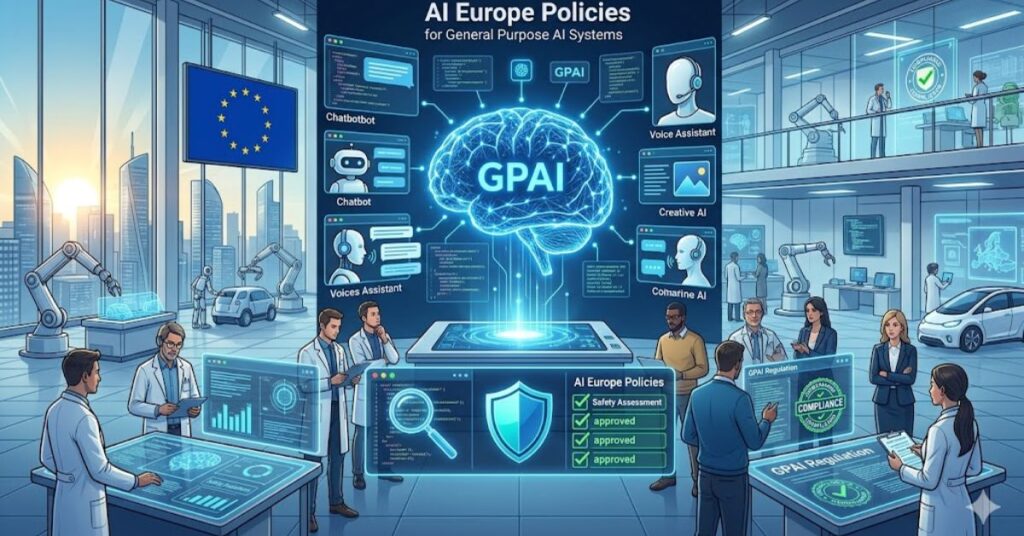
AI Europe policies also regulate general-purpose systems, also known as GPAI. These include large AI models that can perform many tasks, such as chatbots, content generators, and virtual assistants.
These systems can affect millions of users. That is why Europe applies transparency and safety rules to them. Companies must clearly explain how their models work and what data they use.
Rules for General Purpose AI Systems
- Provide training data summaries
- Follow copyright laws
- Share technical documentation
- Report system risks
- Ensure model safety testing
Extra Rules for Large Models
- Higher transparency requirements
- Stronger security checks
- Risk evaluation reports
- Ongoing performance monitoring
AI Europe policies keep these systems safe and trustworthy while also supporting innovation. They guide developers to build responsible AI that follows ethical and legal standards. These rules also help Europe balance technology growth with user protection.
AI Europe Policies Compliance and Legal Penalties

AI Europe policies include strict compliance rules. Companies must follow these rules carefully to avoid legal penalties. The European Union enforces these rules through audits and inspections.
If companies break the rules, they face heavy fines. These penalties encourage businesses to follow AI safety laws seriously.
Penalty Structure
| Violation Type | Fine |
| Minor violation | Up to €7.5 million or 1.5% revenue |
| Serious violation | Up to €35 million or 7% global revenue |
Compliance Requirements
- Document AI systems properly
- Conduct regular audits
- Ensure transparency
- Protect user data
- Maintain ethical standards
AI Europe policies create strong accountability. Companies must take responsibility for their AI systems at all times.
AI Europe Policies Impact on Businesses and Innovation

AI Europe policies significantly impact businesses, startups, and global tech companies. These rules increase responsibility but also improve trust in AI systems.
Startups face challenges due to compliance costs, but Europe supports them through innovation programs and regulatory sandboxes. These sandboxes allow companies to test AI safely before full deployment.
Large companies must invest in legal and technical teams to meet compliance standards. This improves system quality but increases development costs.
Business Advantages
- Builds customer trust
- Improves AI quality
- Encourages ethical innovation
- Provides clear legal rules
Business Challenges
- High compliance costs
- Complex regulations
- Need for expert teams
AI Europe policies keep these systems safe and trustworthy while also supporting innovation. They guide developers to build responsible AI that follows ethical and legal standards. These rules also help Europe balance technology growth with user protection.
AI Europe Policies Future Development

AI Europe policies continue to evolve as AI technology grows. The EU updates rules regularly to match new challenges in artificial intelligence.
Future policies will likely focus on generative AI, cloud systems, and advanced machine learning models. Europe also plans to improve support for startups and innovation ecosystems.
Future Trends
- Stronger AI safety regulations
- Expansion of generative AI rules
- Better startup support programs
- More global cooperation
- Improved transparency standards
AI Europe policies will continue shaping the future of global AI governance.
Final Thoughts
Europe policies create a strong and clear framework for the future of artificial intelligence. Europe designs these rules to protect people, support innovation, and ensure that companies use AI in a responsible way. The EU AI Act plays a key role in shaping how AI systems work across industries.
These policies focus on safety first. Europe does not stop AI growth, but it guides it in the right direction.
The risk-based system helps governments control harmful AI while still allowing simple and useful AI tools to grow freely. This balance makes Europe one of the most advanced regions in AI regulation.
Businesses now follow clear rules when they build AI systems. They improve transparency, reduce bias, and protect user data. At the same time, startups still get support through innovation programs and testing environments. This creates a healthy AI ecosystem where both safety and creativity grow together.
Overall, European policies build a future where work works for people, not against them.
FAQs
1. What are AI Europe’s policies?
Europe policies are EU laws that regulate artificial intelligence to ensure safety, ethics, and transparency.
2. What is the EU AI Act?
The EU AI Act is the main law that controls AI systems in Europe using a risk-based approach.
3. Which AI systems are banned in Europe?
Europe bans social scoring, mass surveillance, and behavior manipulation AI systems.
4. How does Europe classify AI risk?
Europe uses four levels: unacceptable, high, limited, and minimal risk.
5. Do AI Europe policies affect global companies?
Yes, any company operating in Europe must follow these rules, even if it is based outside the EU.
6. What happens if companies break AI rules?
Companies face fines up to €35 million or 7% of global annual revenue.