

What artificial intelligence is is a common question in today’s digital world. Artificial intelligence, also called AI, is a technology that allows machines to think and act like humans.
It helps computers learn from data, make decisions, and solve problems without human help.
In simple words, what is artificial intelligence means teaching machines how to perform tasks that normally need human intelligence.
These tasks include understanding language, recognizing images, solving problems, and making decisions.
Today, what is artificial intelligence is not just a theory. It is used in many real-life applications.
For example, when you use voice assistants, search engines, or recommendation systems, you are using AI. This shows how important artificial intelligence has become in our daily lives.
Artificial intelligence works by using data and algorithms. These algorithms help machines learn patterns and improve over time.
This process is called machine learning. The more data the system gets, the better it performs.
Another important part of what is artificial is automation. AI can perform tasks faster and more accurately than humans. This helps businesses save time and reduce errors.
AI is also changing industries like healthcare, education, finance, and transportation. Doctors use AI to detect diseases. Teachers use AI tools to improve learning. Banks use AI to detect fraud.
However, what intelligence also includes is some challenges. There are concerns about job loss, privacy, and misuse of AI. That is why experts are working to use AI responsibly.
In the future, intelligence will become even more powerful. It will continue to improve our lives and change the way we work and live.
History of What is Artificial Intelligence

The history of what is artificial intelligence shows how this technology has grown over time. AI did not start suddenly. It developed step by step over many years.
In the early days, scientists wanted to create machines that could think like humans. In 1956, the term artificial intelligence was officially introduced. This was an important moment in the history of AI.
During the 1960s and 1970s, researchers created simple programs that could solve basic problems. These systems were limited, but they showed that machines could perform intelligent tasks.
In the 1980s, expert systems became popular. These systems used rules to make decisions. They were used in medicine and business. However, they were expensive and difficult to maintain.
In the 1990s and 2000s, AI improved with better computers and more data. Machine learning became more powerful. Computers could now learn from large amounts of data.
Today, what is includes advanced technologies like deep learning and neural networks. These systems can recognize images, understand speech, and even drive cars.
The history of intelligence shows continuous growth. Each stage helped improve the next generation of AI systems.
Key Milestones in AI History
- Early idea of thinking machines
- Introduction of the AI term in 1956
- Development of expert systems
- Rise of machine learning
- Growth of deep learning
- Modern AI applications in daily life
Types of What is Artificial Intelligence
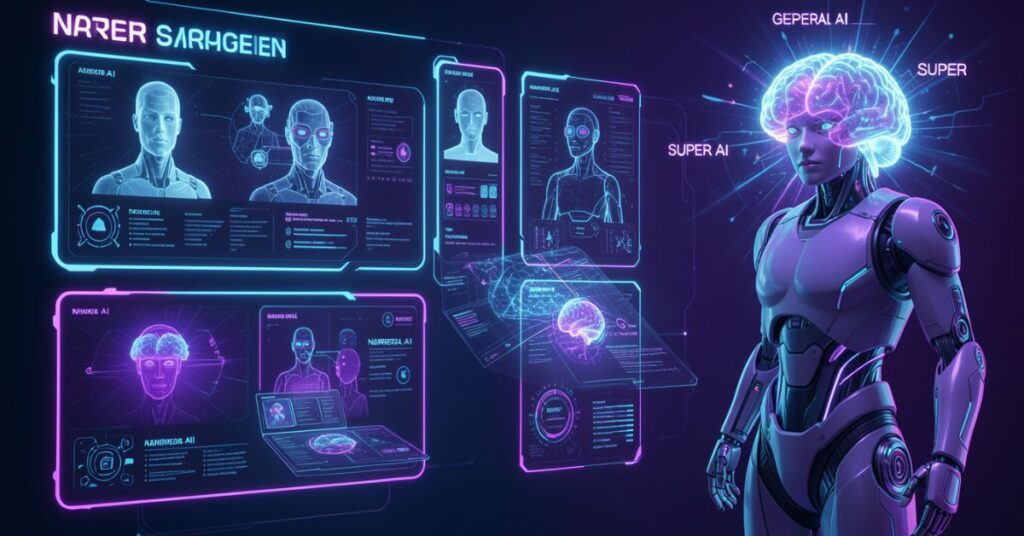
Understanding the types of what is artificial intelligence helps us know how AI works in different situations. AI is divided into different types based on its capabilities.
The first type is narrow AI. This type focuses on one specific task. For example, voice assistants and recommendation systems use narrow AI. They perform one task very well, but cannot do other tasks.
The second type is general AI. This type can perform any intellectual task like a human. However, this type of AI is still in development and not fully created yet.
The third type is super AI. This type is more advanced than human intelligence. It can think, learn, and make decisions better than humans. This type is still theoretical.
Another way to classify what is intelligence is based on functionality. Reactive machines only respond to current inputs.
Limited memory AI can learn from past data. Theory of mind AI understands emotions. Self-aware AI is the most advanced type.
These types help us understand how AI systems are designed and used in different fields.
Main Types of Artificial Intelligence
- Narrow AI (specific tasks)
- General AI (human-like intelligence)
- Super AI (beyond human intelligence)
- Reactive machines
- Limited memory systems
- Self-aware AI (future concept)
How What is Artificial Intelligence Works

To understand what artificial intelligence is, we need to know how it works. AI works using data, algorithms, and computing power.
First, AI systems collect data. This data can be text, images, videos, or numbers. The quality of data is very important for AI performance.
Next, algorithms process the data. These algorithms find patterns and relationships. This helps the system learn from data.
Machine learning is a key part of what artificial is. It allows systems to improve automatically without being programmed again.
Deep learning is a more advanced form of machine learning. It uses neural networks that work like the human brain. These networks help AI understand complex data.
AI also uses natural language processing. This helps machines understand human language. It is used in chatbots and voice assistants.
Another important part is decision-making. AI systems analyze data and make decisions based on patterns. This makes them useful in many industries.
Key Components of AI
- Data collection and processing
- Algorithms and models
- Machine learning techniques
- Deep learning systems
- Natural language processing
- Decision-making systems
Applications of What is Artificial Intelligence

The applications of what is intelligence are growing quickly. AI is used in many industries and daily activities.
In healthcare, AI helps doctors diagnose diseases. It can analyze medical images and detect problems early. This improves patient care.
In education, AI provides personalized learning. Students get content based on their needs. This helps them learn better.
AI helps the finance sector by detecting fraud and reducing risks. Banks use AI systems to study transactions and stop suspicious activities quickly.
In transportation, AI powers self-driving cars. These cars use sensors and algorithms to navigate safely.
In business, AI improves customer service. Chatbots answer questions and solve problems quickly.
In entertainment, AI recommends movies and music. It studies user preferences and suggests content.
Common Uses of AI
- Healthcare diagnosis and treatment
- Online learning systems
- Fraud detection in banking
- Self-driving vehicles
- Customer service chatbots
- Content recommendations
Benefits of What is Artificial Intelligence

Understanding the benefits of artificial helps us see its importance. AI offers many advantages in different fields.
One major benefit is efficiency. AI performs tasks quickly and accurately. This saves time and reduces human effort.
Another benefit is automation. AI can handle repetitive tasks. This allows humans to focus on more important work.
AI also improves decision-making. It analyzes large amounts of data and provides accurate results.
Cost reduction is another advantage. Businesses save money by using AI systems.
AI also improves customer experience. It provides fast and personalized services.
Main Benefits of AI
- Faster task completion
- Reduced human errors
- Improved decision-making
- Cost savings for businesses
- Better customer experience
- Increased productivity
Challenges of What is Artificial Intelligence
While what is artificial intelligence offers many benefits, it also has challenges. These challenges must be managed carefully.
One major challenge is job loss. Automation can replace some human jobs. This creates concern for workers.
Another issue is privacy. AI systems gather and process a large amount of data from different sources. This can risk personal information.
Security is also a concern. AI systems can be misused for harmful purposes.
Bias in AI is another problem. If data is biased, AI decisions may also be unfair.
High cost is also a challenge. Developing AI systems requires money and resources.
Common Challenges of AI
- Job displacement
- Data privacy risks
- Security threats
- Bias in algorithms
- High development costs
Future of What is Artificial Intelligence

The future of what is artificial intelligence looks very promising. AI will continue to grow and improve in many ways.
In the future, AI will become more intelligent. It will handle complex tasks easily. It will also improve human life.
AI will play a big role in smart cities. It will manage traffic, energy, and security systems.
AI will support healthcare by detecting diseases at an early stage. It will help doctors identify health problems quickly and provide better treatment.
In education, AI will make learning more interactive. Students will get better support.
AI will also create new job opportunities. While some jobs may disappear, new ones will emerge.
Future Trends of AI
- Smarter AI systems
- Growth in automation
- AI in smart cities
- Advanced healthcare solutions
- New job opportunities
Key Information About What Artificial Intelligence Is
| Aspect | Details |
| Definition | Machines that think and learn like humans |
| Main Technology | Machine learning, deep learning |
| Uses | Healthcare, education, finance |
| Benefits | Efficiency, accuracy, automation |
| Challenges | Privacy, job loss, bias |
| Future | Advanced and more intelligent systems |
Final Thoughts
What is artificial intelligence is no longer just a technical topic. It has become an important part of our daily life.
From mobile apps to smart devices, AI is everywhere. It helps people work faster, make better decisions, and solve problems easily. This shows that intelligence is shaping the modern world.
At the same time, what is also brings some challenges. Issues like job changes, data privacy, and security need proper attention.
People and organizations must use AI in a responsible way. This will help reduce risks and increase trust in this technology.
In the future, what is artificial intelligence will continue to grow and improve. It will create new opportunities and make life more comfortable. If we use it wisely, artificial intelligence can bring positive change for everyone.
FAQs
1. What is artificial intelligence in simple words?
Artificial intelligence is a type of technology that enables machines to think, learn, and make decisions similar to humans.
2. Where is artificial intelligence used?
AI is used in healthcare, education, banking, transportation, and many other industries.
3. Is artificial intelligence safe?
AI is safe when used properly, but it needs rules to prevent misuse and protect data.
4. What are the types of artificial intelligence?
The primary types of artificial intelligence include narrow AI, general AI, and super AI.
5. How does artificial intelligence work?
AI works by using data and algorithms to learn patterns and make decisions.
6. What does the future of artificial intelligence look like?
The future of AI is bright. It will improve technology and create new opportunities.